Google Releases Gemini 4 Carbon: Frontier Model Built for Long-Horizon Agentic Workflows
Google DeepMind has introduced Gemini 4 Carbon, its top-tier frontier model optimized for multi-step debugging, scientific discovery, and cybersecurity, accessi
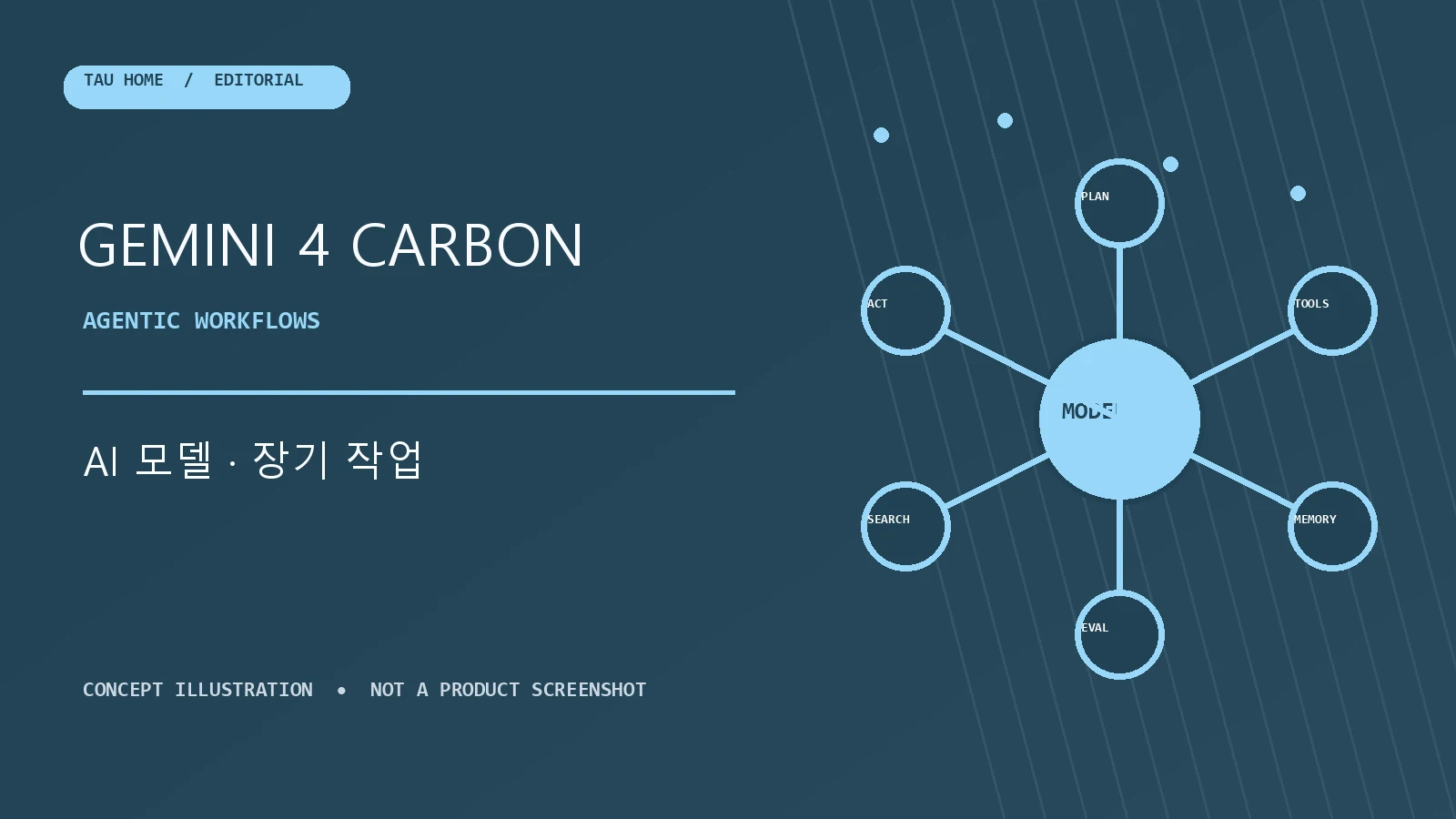
On November 10, 2026, Google officially launched Gemini 4 Carbon, its highest-tier frontier model designed specifically for long-horizon agentic workflows and deep reasoning. Following the earlier introduction of Gemini 4 Argon, Carbon establishes an advanced performance tier aimed at operations with high structural complexity.
Hero image: Original TAU HOME editorial concept illustration, not a product screenshot. Moving beyond single-turn prompt responses and linear generation, Carbon is engineered to sustain multi-step software engineering cycles, vulnerability remediation in cybersecurity, and open-ended scientific research through prolonged exploration and autonomous verification loops.
Model Architecture Centered on Deep Exploration and Verification Loops
Gemini 4 Carbon distinguishes itself by spending significantly more compute tokens on hypothesis generation, testing, and self-correction during task execution.
Google DeepMind emphasized that Gemini 4 Argon remains the optimal, cost-efficient choice for routine software engineering and general knowledge work. Carbon is reserved for challenging scenarios that stretch model capabilities, such as cross-subsystem root-cause investigations, complex multi-package migrations, and fundamental architectural redesigns.
- Workflow Benchmarks: Carbon secured the #1 rank on CursorBench 4.0, Perplexity's WANDR, and Zapier's AutomationBench.
- Multimodal Evaluation: On the Multimodal Knowledge Agent (MKA) benchmark co-developed with Artificial Analysis, Carbon ranked #2.
Carbon also integrates into Google Antigravity's new preview feature, /swarm, turning a single natural language prompt into a coordinated team of autonomous agents. Developers can assign Carbon to roles requiring deep contextual judgment—such as architectural design, cross-agent coordination, and code auditing—while offloading parallel subtasks to lighter, faster models within isolated workspaces.
Real-World Applications in Cybersecurity and Scientific Discovery
Two weeks prior to public availability, Google distributed Carbon to select security specialists through its Fairwind Program.
The model posted top scores on vulnerability discovery (SEC-bench Pro), exploitation verification (ExploitGym), and patch generation (CWE-bench v1). In Project Fortify, Google's autonomous scanning and remediation system, Carbon achieved a 100% recall rate on scanning alongside 95% precision on triage in internal benchmarks, marking an over 25% relative improvement in recall on open-source repositories compared to Argon. Through Wiz's Scan for Good initiative, Carbon identified zero-day vulnerabilities across two enterprise SaaS providers within two hours, accelerating security triage.
In scientific research, Carbon paired with AlphaProof Code—a formal verification framework writing in Lean—to produce formal mathematical proofs for cryptographic code in Signal within weeks. For structural biology, multi-agent Carbon setups identified 40 times more remote homologs across unannotated petabase-scale sequence databases for low-homolog protein families in CASP17, supplying critical input data for AlphaFold 3 without requiring structural model retraining.
Availability Tiers, Pricing, and Deployment Considerations
Developers and enterprises can access Gemini 4 Carbon via the Google AI Studio API and Gemini for business. Introductory pricing is set at $2 per million input tokens and $10 per million output tokens, matching the base rate of Gemini 4 Argon.
Consumer web access is restricted to Google AI Ultra subscribers across the Gemini app, Google Antigravity, and AI Mode in Search. Pro plan subscribers do not receive immediate interface access.
From an architectural standpoint, matching the nominal token rate ($2/$10) of Argon does not translate into equal operational costs per request. Because Carbon relies on sustained exploratory reasoning and multi-step verification routines, aggregate output token counts rise considerably per completed job. Managing operational expenditures will depend more on task-level token budgets and guardrails than on raw per-token list prices.
Sources
- Google Official Blog: Gemini 4 Carbon is now available
- Google AI Official X (@GoogleAI): Gemini 4 Carbon Release Announcement