Google Cloud Publishes Practical Guide for Open Model Knowledge Distillation and Fine-Tuning on Gemini Platform
Google Cloud has officially published practical documentation for supervised fine-tuning and knowledge distillation on open models within the Gemini Enterprise
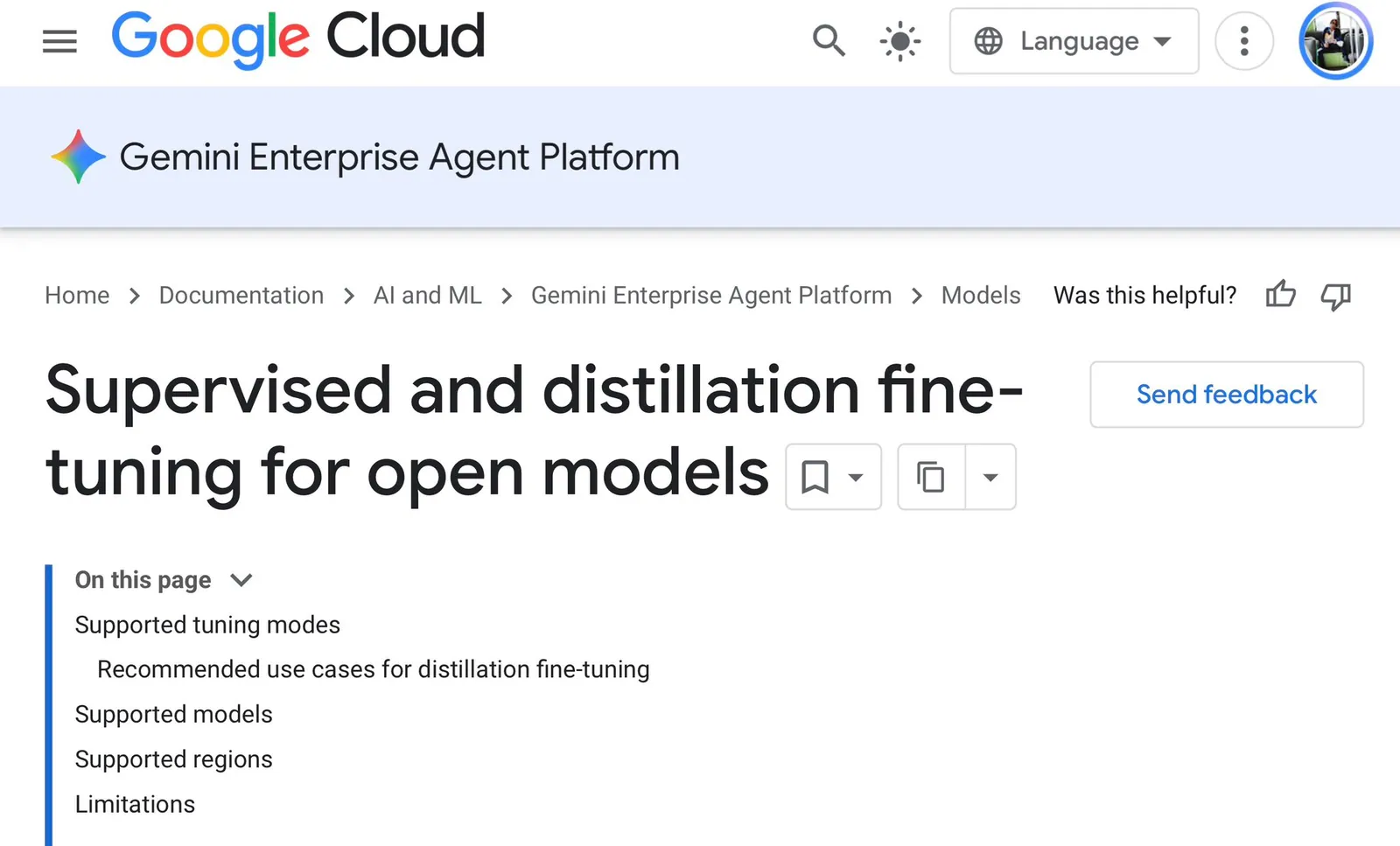
Google Cloud has officially published practical documentation for supervised fine-tuning and knowledge distillation on open models within the Gemini Enterprise Agent Platform. This release provides developers with a clear engineering pathway to transfer capabilities from larger models into lighter, more efficient compact models, reducing costs and streamlining production deployment.
Image source: https://x.com/BrianRoemmele/status/2126532905048695250
The newly released documentation covers major open models widely used across the industry, including Meta's Llama 3.1, the Gemma series from Google, and Qwen variants from Alibaba. Notably, it details both full fine-tuning and parameter-efficient LoRA (Low-Rank Adaptation) options, lowering the technical barrier for practical developers looking to optimize their workflows.
Mechanics of Knowledge Distillation and Teacher-Student Models
Knowledge distillation, a central pillar of the documentation, involves directing a larger, more powerful teacher model to generate responses and reasoning traces that serve as training labels for a smaller student model. This method enables compact models to achieve performance levels well beyond their unaided capabilities.
According to the documentation, supported teachers currently include GLM 5.2 from Z AI, while supported students encompass Qwen 3 sizes ranging from 4B to 32B and Gemma 3 sizes from 1B to 27B IT. The transfer is especially useful for multi-step reasoning tasks such as math, science, and medical question answering, where the teacher's chain-of-thought outputs lift the student above its baseline performance. The workflow runs through the GenAI SDK, producing a labeled dataset as an intermediate artifact before yielding deployable checkpoints.
Supervised Fine-Tuning and Production Infrastructure Integration
Alongside distillation, the platform provides supervised fine-tuning paths for Llama 3.1 8B and larger Gemma and Qwen checkpoints. Both full fine-tuning and adapter modes are available depending on architectural needs, with notebooks and console paths directly linked from the documentation page.
This release continues the lineage of foundational work formalized years ago by Google Brain in the paper “Distilling the Knowledge in a Neural Network,” turning those principles into managed tooling on open models. Developers can now transfer capabilities from stronger open-weight teachers into compact students that run at lower operating costs, then deploy the resulting models on Google infrastructure or export the model weights.
Contrasting Open Innovation with Closed Security Stances
Google Cloud's documentation release highlights a sharp contrast in contemporary AI philosophy regarding openness and regulation. Leadership at companies like Anthropic has publicly called for crackdowns on industrial-scale distillation, treating powerful open-weight models as high-risk objects that require tighter controls on chips, testing, and knowledge transfer. Anthropic has enforced account bans and restricted reasoning traces when users attempt capability extraction, keeping their strongest models within a strictly closed commercial perimeter.
In contrast, Google's documentation hands the methodology directly to any developer capable of provisioning a project and preparing a JSONL dataset. By publishing explicit model identifiers and tying workflows to existing deployment options, Google enables smaller, specialized open models to absorb advanced reasoning without forcing every lab to train a frontier system from scratch.
Sources
- Brian Roemmele X Official Account: Google Cloud Published Practical Documentation for Fine-Tuning and Distillation