Mia AI Lab Releases GLM-5.3-Flash 4-Bit EXL3 Quantization with New Calibration and TensorFold
Mia AI Lab has released GLM-5.3-Flash-EXL3-4bpw-TensorFold, a drop-in 4-bit quantization upgrade that reduces MoE layer quantization error by up to 46% and enha
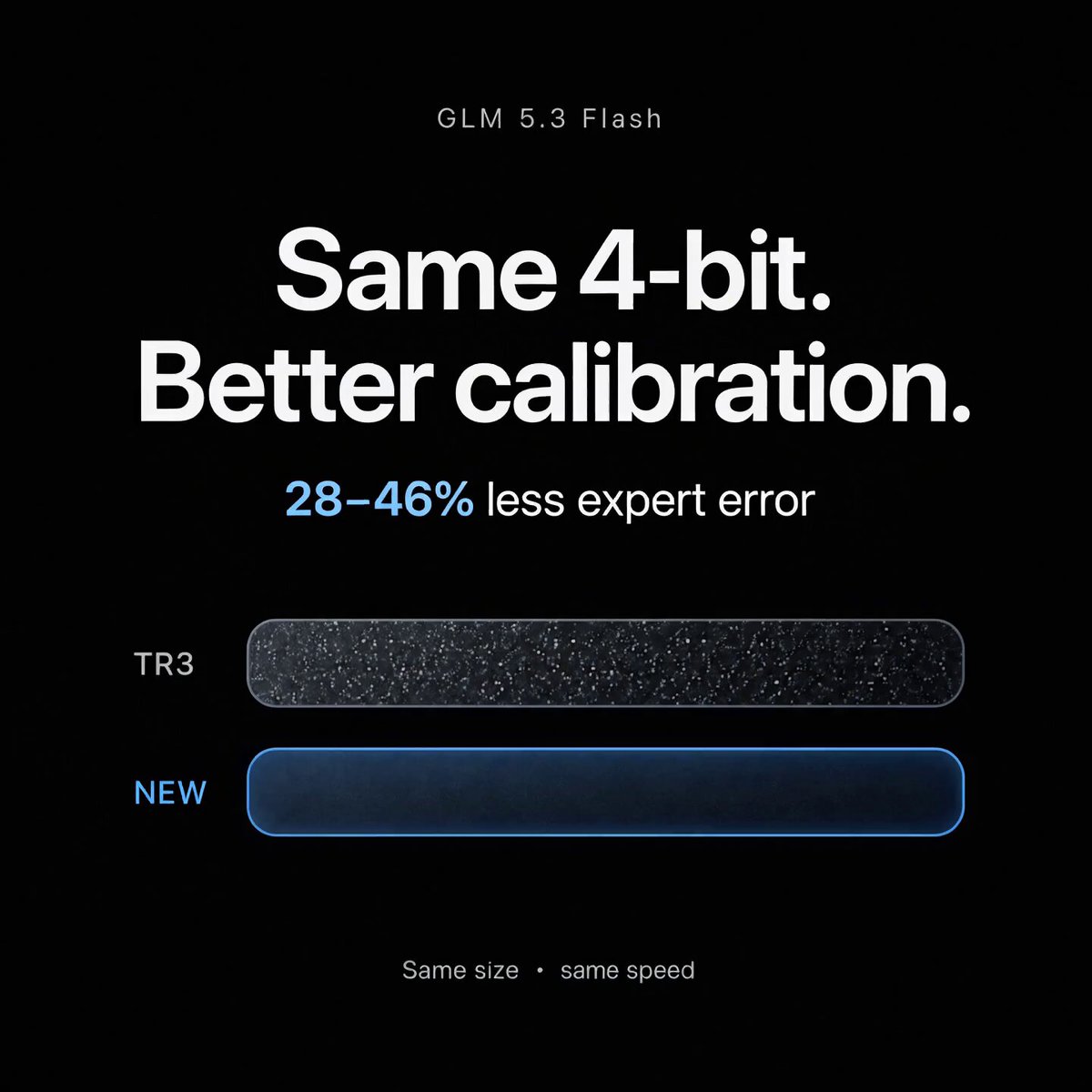
On October 4, 2026, open-source AI research group Mia AI Lab (@MiaAI_lab) officially released 'GLM-5.3-Flash-EXL3-4bpw-TensorFold' on Hugging Face, introducing an advanced calibration technique to 4-bit quantization. Maintaining the established TR3 4bpw format, the new release delivers a substantial reduction in quantization error without changing memory footprint or execution speed.
Image source: @plotarmordev / Mia AI Lab
As a massive Mixture-of-Experts (MoE) foundation model from Z.ai, GLM-5.3-Flash has seen widespread local deployment where minimizing expert layer quantization noise remains critical. This new calibration brings 4-bit serving closer to uncompressed baseline fidelity while addressing common local inference artifacts.
Advanced Calibration Cuts MoE Quantization Error by 28–46%
The primary technical advance in this release lies in mitigating numerical drift across quantized expert layers.
- Eliminates 28–46% of MoE Quantization Error: Compared to the standard TR3 4bpw quantization, this release removes 28% to 46% of the error introduced by the 4-bit routed expert layers.
- Closer to Full-Precision Baselines: Across 7 of 8 evaluated benchmark test sets, output distributions aligned 2% to 18% closer to the unquantized full-precision model.
- 37% Fewer Confident Wrong Picks: The model significantly curtails hallucinated certainty, reducing instances where the quantized network strongly commits to incorrect token selections by up to 37%.
Cleaner Coding Output with Drop-in Compatibility
Practical coding workflows and operational ergonomics both see tangible improvements.
- Concise Outputs and Reduced Truncations: Code generation yields approximately 10% shorter, more focused responses while noticeably reducing mid-generation token truncations.
- True Drop-In Replacement: Retaining identical parameter sizes, VRAM memory footprints, and decoding speeds compared to the original TR3 4bpw weights, deployments can be updated by swapping checkpoints without infrastructure reconfiguration.
- Consistent Benchmark Scores: While overall macro benchmark scores remain comparable to previous 4bpw builds, inference reliability during complex reasoning paths is markedly higher.
Serving Infrastructure and Trade-offs
The model is tailored for high-performance local inference and on-premise infrastructure.
- Serving Stack Compatibility: Optimized for runtimes supporting the EXL3 and TensorFold formats, including custom vLLM builds, DGX Spark, and SM120 architectures.
- Precision-Focused Design: Prioritizes logical correctness and error suppression over time-to-first-token (TTFT) acceleration, making it a recommended free upgrade for developers running local coding assistants.
Sources
- Hugging Face: Mia-AiLab/GLM-5.3-Flash-EXL3-4bpw-TensorFold Model Repository
- X (@plotarmordev): GLM-5.3-Flash EXL3 4bpw TensorFold Release Announcement