Google Announces Frontier Model Gemini 4 Argon: 1 Million Output Tokens and Deep Reasoning for Long-Horizon Workflows
Google has officially unveiled its next-generation frontier model, Gemini 4 Argon, featuring deep reasoning across complex long-horizon workflows, an industry-l
On September 30, 2026, Google AI and Google DeepMind officially introduced Gemini 4 Argon, the company's next-generation frontier model engineered to sustain deep reasoning across complex, long-horizon workflows.
Image source: Google
Announced by Koray Kavukcuoglu, SVP at Google DeepMind and Chief AI Architect at Google, Gemini 4 Argon marks the first release in the Gemini 4 family. The model focuses on real-world software engineering, enterprise knowledge work across legal and financial domains, and defensive cybersecurity, highlighted by an expansion of its output token ceiling to 1 million tokens.
1 Million Output Tokens and Deep Reasoning Across Long-Horizon Workflows
The headline architectural advancement in Gemini 4 Argon is the dramatic expansion of its output token limit.
While existing frontier models typically cap single generations around 64,000 (64K) tokens, Argon raises this ceiling to an industry-leading 1 million (1M) tokens. This expanded output window enables the model to execute end-to-end code refactoring across massive codebases, author comprehensive regulatory or financial audits, and generate multi-layered system specifications without requiring manual prompt chunking or losing intermediate context.
Google emphasized that Argon is optimized to sustain structured reasoning over extended multi-step tasks, self-correct errors during execution, and maintain logical coherence across multimodal inputs throughout long-running operational workflows.
Autonomous Vulnerability Patching and Defensive Cybersecurity
In enterprise and infrastructure domains, Argon places dedicated emphasis on defensive cybersecurity capabilities.
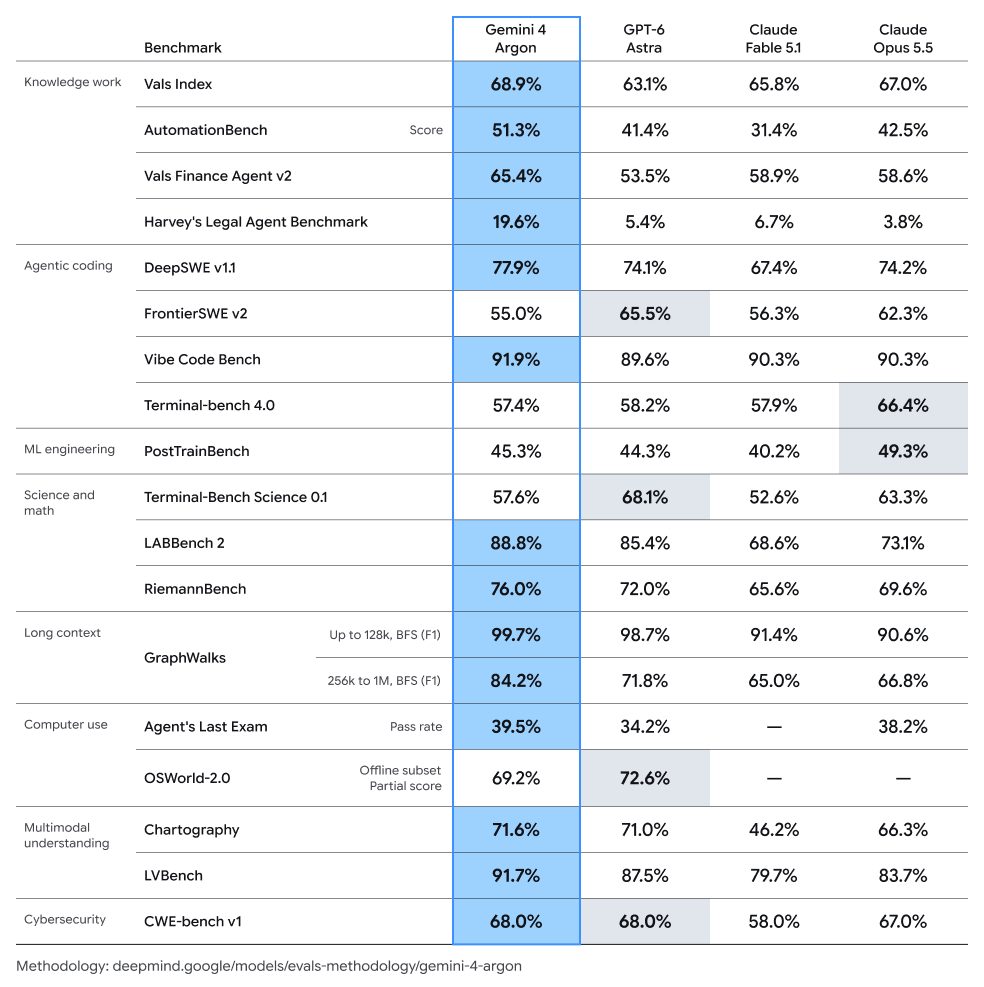
According to Google DeepMind, Argon is equipped to autonomously discover critical software vulnerabilities, validate their exploitability, and engineer functional remediation patches. On the CWE-bench v1 Cybersecurity benchmark, the model achieved a 68.0% resolution score.
Beyond cybersecurity, Google noted that Argon delivers upgraded proficiency in high-stakes knowledge work, including complex contract review and financial quantitative analysis, where adherence to domain-specific constraints and rigorous factual grounding are essential.
Safeguards, U.S. Pre-Release Review, and Phased Fairwind Rollout
To manage potential misuse vectors associated with high-capability frontier systems, Google is deploying Argon through a phased rollout strategy rather than an immediate general public release.
- Fairwind Program Access: Early access is restricted to vetted cybersecurity defenders and trusted enterprise partners participating in Google's Fairwind Program.
- Pre-Release Model Assessment: Google is participating in the U.S. government's voluntary pre-release model assessment framework to evaluate frontier safeguards prior to broad availability.
- Broader Availability Timeline: Following evaluation and feedback from Fairwind participants, Google plans to expand access to paid API customers and Google AI Ultra subscribers.
Sources
- Google Official Blog: Gemini 4 Argon: our next era of frontier intelligence
- Google AI Official X (@GoogleAI): Gemini 4 Argon Announcement Post
- Google DeepMind: Gemini Model Overview