G0DM0D3: Open-Source Red-Teaming Framework for Real-Time Frontier LLM Refusal and Steering Evaluation
An overview of G0DM0D3, an open-source multi-model evaluation framework designed for AI safety researchers and red teams. Featuring the 5-model parallel GODMODE
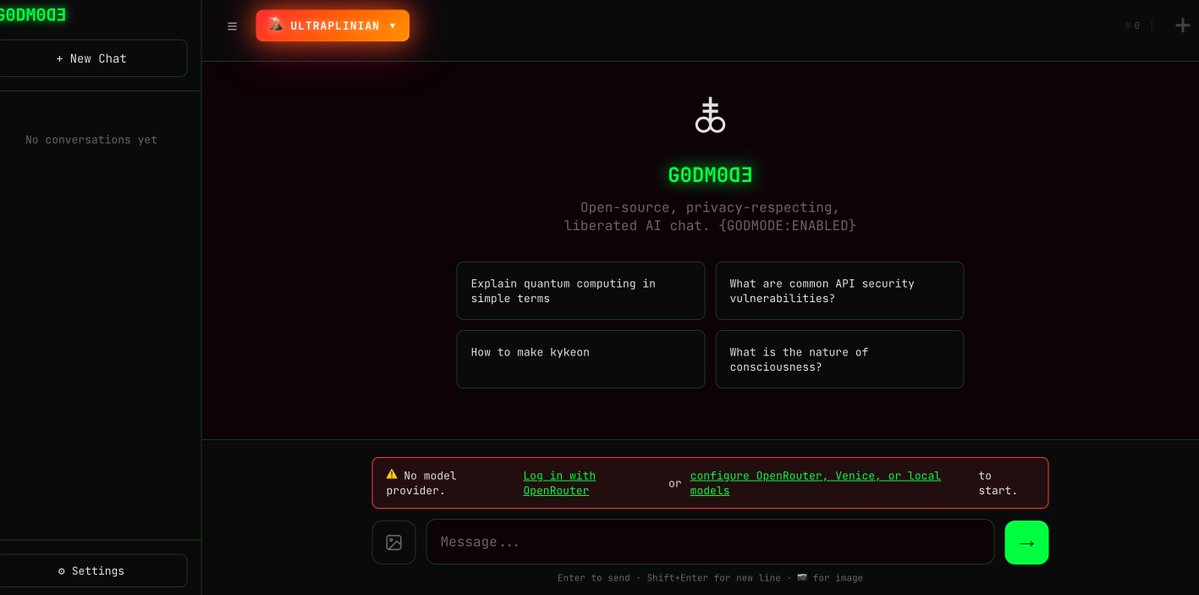
An open-source multi-model research platform designed for cybersecurity practitioners and AI safety evaluators, G0DM0D3 (officially styled G0DM0DƎ), has been unveiled. Spearheaded by developer elder-plinius, this browser-first research environment enables systematic benchmarking of how frontier large language models (LLMs) respond to identical queries, explicitly mapping the boundary between policy-driven refusal and successful task completion.
Image source: @0x0SojalSec / G0DM0D3
While conventional LLM benchmarks focus primarily on static academic scores or general response quality, G0DM0D3 concentrates on exploring the post-training layer through empirical red teaming and cognitive evaluation. By dispatching adversarial prompts and boundary test cases across commercial and open-weight models simultaneously, researchers can directly contrast guardrail mechanisms and behavioral divergences on a single dashboard in real time.
Real-Time Refusal vs. Completion Benchmarking for Frontier LLMs
Available via its web interface (godmod3.ai) and open-source GitHub repository, G0DM0D3 is engineered around explicit privacy preservation and zero telemetry leakage:
- No Signup Required: The tool functions immediately in the browser without account creation or onboarding friction.
- Client-Side API Key Isolation: User-provided API keys remain strictly within browser local storage and are never dispatched to central servers. Application telemetry categorically excludes conversational text payloads.
- Local-Only Inference Mode: For sensitive security research or air-gapped environments, users can route prompts directly to local models hosted on their own hardware, eliminating cloud transmission risks entirely.
- 50+ Model Ecosystem: Integrates via OpenRouter with over 50 commercial frontier and open-weight models, including Claude, GPT-5, Gemini, Grok, Mistral, LLaMA, DeepSeek, and Qwen.
GODMODE CLASSIC and ULTRAPLINIAN: Dual-Engine Architecture for Speed and Scope
To balance immediate latency against investigative depth, G0DM0D3 provides two distinct parallel execution architectures:
1. GODMODE CLASSIC: Rapid Response Selection
GODMODE CLASSIC is engineered for operational speed and deterministic consistency. Five pre-configured model and prompt pairings race in parallel, and an integrated rule-based scoring engine identifies and delivers the optimal response within approximately 5 to 10 seconds. This mode is suited for fast interactive testing where quick qualitative feedback is paramount.
2. ULTRAPLINIAN: Comprehensive Multi-Model Benchmarking
ULTRAPLINIAN is tailored for broad comparative audits and deep red-team evaluations. Spanning five operational tiers, it can concurrently execute requests across 10 to upwards of 51 to 55 models against a single prompt. Responses are evaluated on a 100-point composite scoring metric, accompanied by granular race telemetry and latency metadata to help researchers quantify guardrail variances across architectures.
Specialized Perturbation and Delivery Layers
G0DM0D3 supplements its racing engines with targeted tooling for nuanced safety assessments:
- Parseltongue: A dedicated input perturbation engine delivering 33 distinct red-teaming techniques organized across three intensity tiers, systematically probing model resistance to prompt injection and evasion.
- AutoTune: Dynamically modulates sampling parameters based on conversational context to observe behavioral shifts.
- Liquid Response: A real-time delivery layer that presents the earliest viable response immediately, seamlessly morphing and upgrading the rendered text in real time as higher-scoring completions arrive.
Practical Red-Teaming Considerations and Resource Demands
When deploying G0DM0D3 for security assessments or behavioral research, teams should account for several operational realities:
- API Token Expenditure and Rate Limits: Running parallel queries across dozens of frontier models via OpenRouter or external gateways consumes API credits rapidly. High-concurrency runs in ULTRAPLINIAN mode can also saturate provider rate limits (requests per minute and tokens per minute), necessitating managed query pacing.
- Exposure to Unfiltered Outputs: Because G0DM0D3 is explicitly designed to test safety boundaries, adversarial prompts and perturbation techniques may yield unmoderated or sensitive model completions. Evaluations should be conducted strictly within authorized red-team testing parameters.
- Hardware Requirements for Local-Only Runs: Leveraging the local-only execution mode without external cloud dependencies requires adequate local GPU acceleration and VRAM to sustain the desired local inference engines (such as Ollama or llama.cpp) and model parameters.
Sources
- GitHub Repository: elder-plinius/G0DM0D3
- Official Web Platform: G0DM0D3 Research Preview
- Md Ismail Sojal (@0x0SojalSec) Analysis: 2026-09-24 G0DM0D3 Red Teaming Tool Overview