5-Step Framework to Find Validated App Ideas: $50k/mo Revenue and Recent Launch Filters
Discover a 5-step research framework to identify validated app ideas by filtering for apps making over $50k/mo launched under a year ago, ensuring demand before
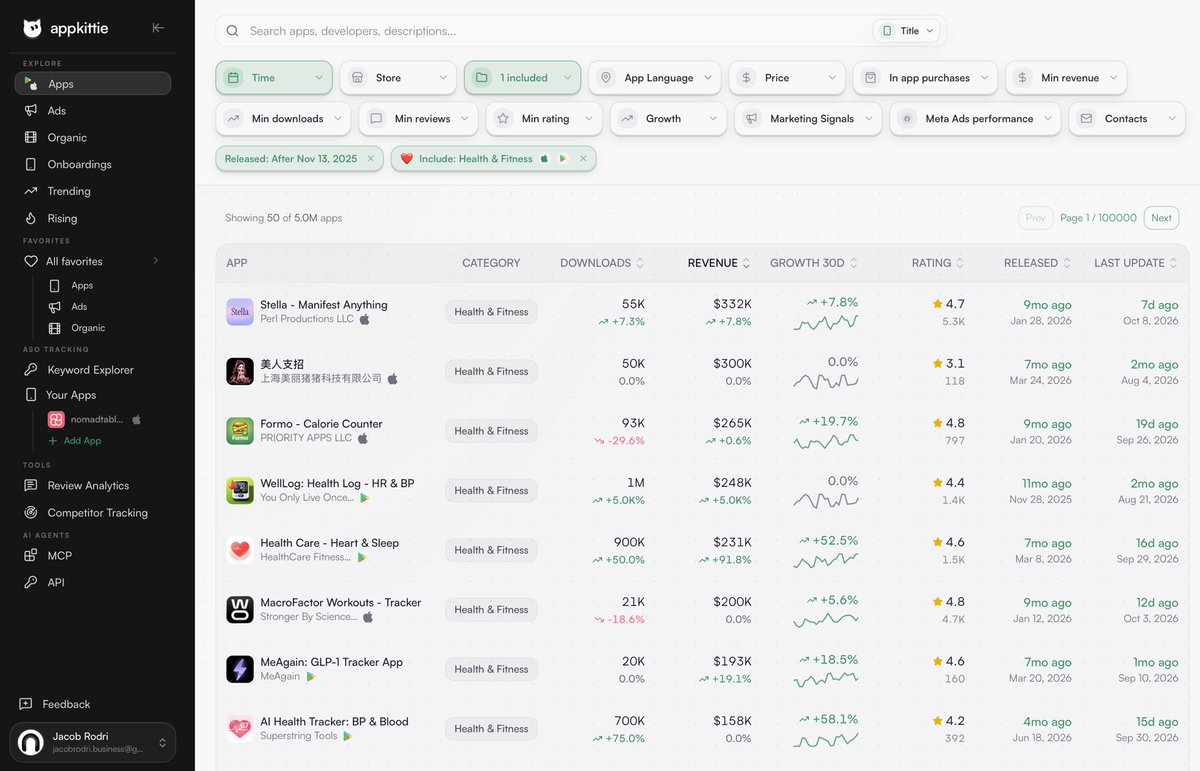
For indie developers and startup founders, the greatest risk is rarely technical feasibility, but spending months building a product that no one wants or is willing to pay for. To eliminate unvalidated guesswork before writing code, Appkittie (@Appkittie) shared an actionable 5-step research workflow on X (formerly Twitter) designed to uncover proven app concepts by tracking products that already demonstrate verified market demand.
Image source: Appkittie (@Appkittie via X)
A 5-Step Research Workflow to Uncover Proven Commercial Demand
Rather than attempting to invent an untested category from scratch, this workflow begins by reverse-engineering existing market successes where real customers are actively paying for solutions. Appkittie (@Appkittie) outlined the following five steps:
- Access the Intelligence Platform: Navigate to the app market intelligence website AppKittie at https://appkittie.com.
- Filter by Proven High Revenue: Apply a filter for mobile apps generating over $50,000 per month in estimated revenue.
- Filter by Launch Recency: Narrow the scope exclusively to apps that launched less than one year ago.
- Extract Inspiration and Product Insights: Examine the resulting catalog to analyze customer pain points, feature architectures, and market positioning.
- Build a Differentiated, Superior Version: Leverage confirmed commercial demand to engineer a better product that resolves existing shortcomings.
The underlying philosophy is captured in a concise directive: "Find demand, then build."
The Strategic Rationale: Why $50k/Month and Sub-1-Year Age Matter
The combination of a $50,000 monthly revenue threshold and a launch date within the past 12 months provides specific strategic advantages for early-stage product planning:
- Proof of Sustained Willingness to Pay: Monthly revenue exceeding $50k/mo indicates that an app has progressed beyond novelty downloads and achieved legitimate commercial traction with subscriptions or in-app purchases.
- Evidence of Accessible Market Openings: Filtering out legacy incumbents that established their dominance years ago highlights fast-rising newcomers. This demonstrates that user demand in the niche is currently expanding and remains accessible to nimble teams or solo creators.
- Actionable Windows of Product Improvement: Rapidly scaling newcomers often struggle with feature completeness, user onboarding, localized support, or aggressive pricing structures. Studying real user feedback on these apps exposes clear opportunities for differentiation.
Execution Realities: Analytics Estimation Limits and the Anti-Clone Rule
While identifying validated demand provides a substantial head start, successfully executing on these insights requires understanding the inherent limits of third-party data and avoiding shallow imitation:
- Third-Party Revenue Estimations Are Approximations: Revenue numbers on third-party intelligence platforms like AppKittie are derived from public store rankings, download velocity models, and in-app purchase price points. They represent modeled estimates rather than audited financial ledgers and should be treated as directional benchmarks rather than exact accounting figures.
- The Pitfall of Mere Duplication: Niches supporting apps making $50k/mo are inherently competitive. Simply copying the visual design or replicating feature sets line-by-line is ineffective against incumbent momentum, app store algorithmic rankings, and established user reviews.
- The Obligation to Deliver a Truly Better Version: Building a superior product requires developing a distinct Unique Selling Proposition (USP). Builders must identify specific user complaints, eliminate clunky workflows, provide superior performance, or tailor the solution to an underserved sub-segment.
Original source
- Appkittie (@Appkittie) Official X Post: 2026-10-16 5-Step App Idea Discovery Workflow