CrowdStrike Reveals AI Hack on South Korean Banks via ARTEX and Multi-LLM Stack
CrowdStrike reported a cyberattack on South Korean banks using open-source AI tool ARTEX alongside DeepSeek v4.1-Flash, GLM-5.3, Grok 4.6, and Claude Code.
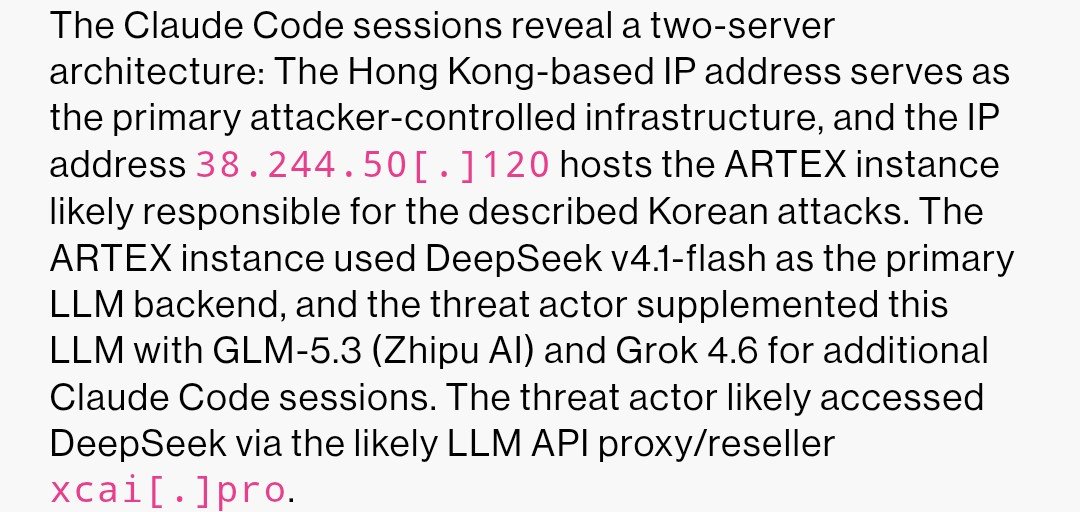
Global cybersecurity firm CrowdStrike released a threat intelligence analysis report on October 8, 2026, investigating a recent cyberattack that hit several of South Korea's major commercial banks. According to the findings, the entire intrusion may have been carried out by a single individual threat actor leveraging an offensive stack that combined an open-source AI penetration testing tool with multiple large language models.
Image source: Andrew Curran (@AndrewCurran_) / CrowdStrike
The disclosed campaign represents a notable development in the threat landscape, illustrating how attacks against major financial infrastructure—historically mounted by coordinated teams—can now be orchestrated by a lone individual using combined AI tooling and multi-model workflows.
1. ARTEX and the Multi-LLM Offensive Stack
CrowdStrike's threat intelligence breakdown details that rather than relying on a single foundation model, the threat actor constructed an offensive stack combining specialized tools and diverse foundation models:
- ARTEX Open-Source Penetration Tool: An open-source AI penetration testing framework utilized as the core offensive tooling in the attack pipeline.
- Multi-Model Foundation Layer (DeepSeek v4.1-Flash, GLM-5.3, Grok 4.6): The set of large language models combined in the attack. The threat actor did not restrict operations to a single provider, drawing across DeepSeek v4.1-Flash, GLM-5.3, and Grok 4.6.
- Claude Code Orchestration: Anthropic's Claude Code was incorporated as an execution and orchestration interface, with session artifacts reflecting the attacker's operational workflows.
By coupling an open-source penetration tool with multiple model APIs and coding agent capabilities, the lone operator was able to coordinate complex intrusion tasks across the targeted infrastructure.
2. The Solo Threat Actor Assessment and Implications
A central finding highlighted in CrowdStrike's analysis is that the entire attack against major banking targets may have been conducted by a single person.
In conventional cybersecurity environments, mounting intrusions against major commercial banks typically requires a team of security specialists dividing operational roles. This case demonstrates how agentic AI stacks significantly lower organizational barriers for offensive operations:
- Amplified Individual Capability: By orchestrating multiple LLMs alongside purpose-built penetration tools, a single individual can mount complex operational workflows without requiring an entire team.
- Multi-Model Ecosystem Utilization: The operator avoided reliance on any single AI platform, combining open-source software with disparate foundation models (DeepSeek, GLM, Grok, and Claude Code).
- Execution Efficiency: Coupling penetration tools with agentic coding interfaces allowed rapid iteration and execution across targets.
3. Verified Limitations and Defense Priorities
While the CrowdStrike report provides concrete evidence of generative AI and open-source penetration tools being combined in active intrusions, several key factual limitations must be noted:
First, CrowdStrike has not publicly confirmed the specific identity, organizational affiliation, or origin of the attacker; the conclusion that a single individual conducted the attack remains an assessment derived from observed intrusion artifacts and session telemetry. Second, the extent of data exfiltration or operational damage across the impacted South Korean institutions has not been detailed and will require verified confirmation from financial regulators and follow-up reports.
For financial institutions and cybersecurity defenders, the incident emphasizes the growing necessity to detect behavioral anomalies and automated multi-model traffic patterns rather than relying solely on traditional static signature defenses.
Sources
- CrowdStrike: Unknown Threat Actor Uses ARTEX to Target South Korean Finance
- Andrew Curran (@AndrewCurran_): Threat Intelligence Report Briefing on X