VCNet: Brain-Inspired Vision Network Combines Predictive Coding and Dual-Stream Processing
A research paper introduces VCNet, combining primate visual cortex ventral/dorsal streams and predictive coding to overcome occlusion and bottom-up model fragil
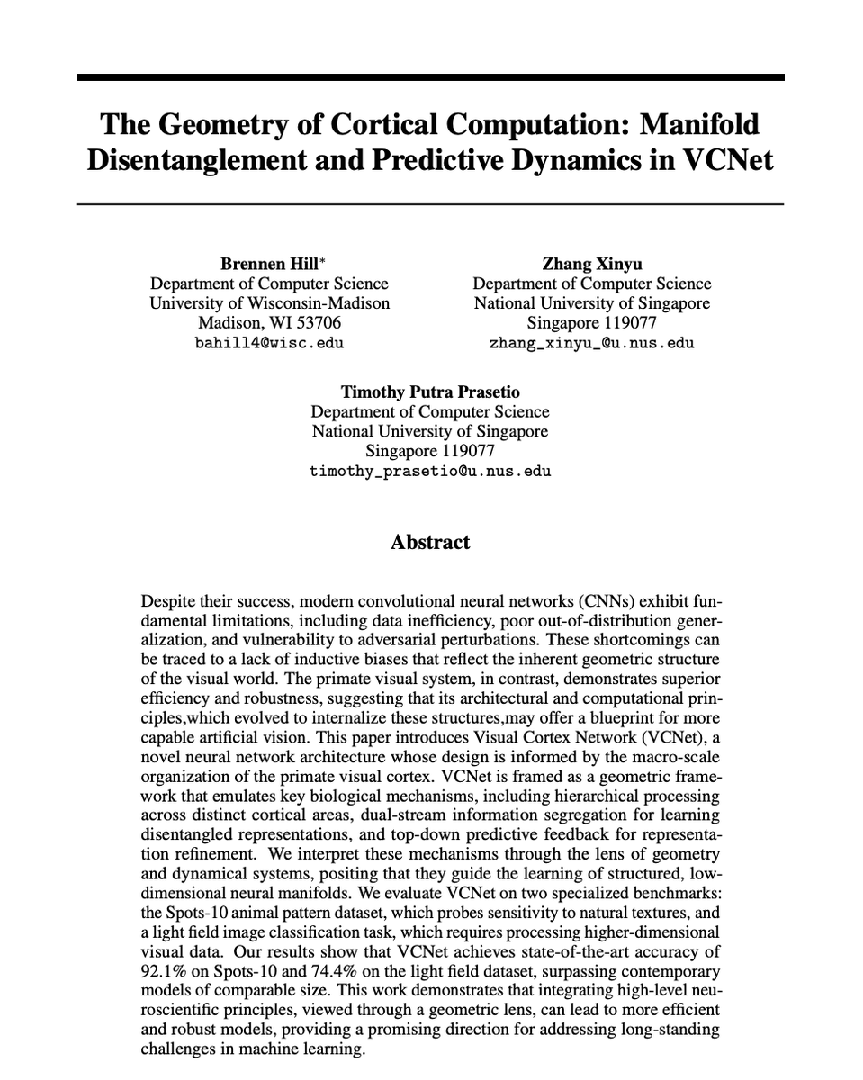
A research paper introducing 'VCNet', a novel vision neural network architecture that incorporates dual-stream visual processing and top-down predictive coding inspired by the primate visual cortex, was published in October 2026.
Image source: @HowToPrompt__ (X / arXiv:2508.02995)
Most mainstream computer vision models today—including standard CNNs and Vision Transformers—rely on a strictly unidirectional, bottom-up feedforward pipeline. They begin by processing raw pixels, extracting edges, constructing intermediate shapes, and finally classifying objects. While effective in controlled environments, this structure remains vulnerable to minor adversarial perturbations, partial occlusions, and dim lighting conditions.
Dual-Stream Processing: Separating 'What' and 'Where'
To replicate how biological systems recognize objects from minimal visual cues even under heavy occlusion, VCNet splits visual information processing into two specialized pathways.
Instead of relying on a single blind feedforward loop, processing is bifurcated:
- Ventral Stream ('What'): Dedicated to learning object identity and intrinsic geometry, maintaining robustness against variations in lighting conditions and viewing angles.
- Dorsal Stream ('Where'): Dedicated to tracking spatial coordinates, position, and motion dynamics across the visual field.
By decoupling identity recognition from spatial tracking, the architecture preserves classification capability even when portions of an object are obstructed or transformed.
Top-Down Hypothesis Generation and Real-Time Error Signals
The defining technical characteristic of VCNet is its integration of predictive coding principles for bidirectional inference.
Rather than waiting for lower layers to push processed features upward, the highest levels of the network generate a top-down hypothesis about the scene before full processing completes.
- Hypothesis Dispatch: Higher layers establish an initial prediction and project it downward to lower layers.
- Pixel Comparison & Error Signal: Lower layers compare the top-down prediction against incoming raw pixel data, generating an explicit error signal where discrepancies occur.
- Real-Time Adjustment & Learning: The network utilizes these localized error signals to refine representations and update weights dynamically.
According to reported benchmark results on complex patterns, VCNet achieved superior generalization and robust occlusion handling compared to benchmarked baseline models while utilizing significantly fewer parameters.
Current Availability and Practical Deployment Outlook
The current release represents an academic architecture and benchmark validation study (arXiv:2508.02995).
- Open-Source Code Repository: An official code release was not included in the initial preprint announcement and remains pending future release.
- Production Integration: Displacing established commercial pipelines (such as YOLO or production ViT variants) will require broader large-scale dataset evaluations, hardware-level runtime optimizations, and production tooling support.
Sources
- arXiv Research Paper: arXiv:2508.02995
- Technical Overview Thread: X post by @HowToPrompt__ (2108098129585389852)