cli-printing-press: Automated CLI, Claude Code Skill, and MCP Server Generator for APIs
An overview of cli-printing-press, an open-source tool that analyzes API docs and private endpoints to automatically generate dedicated CLIs, Claude Code skills
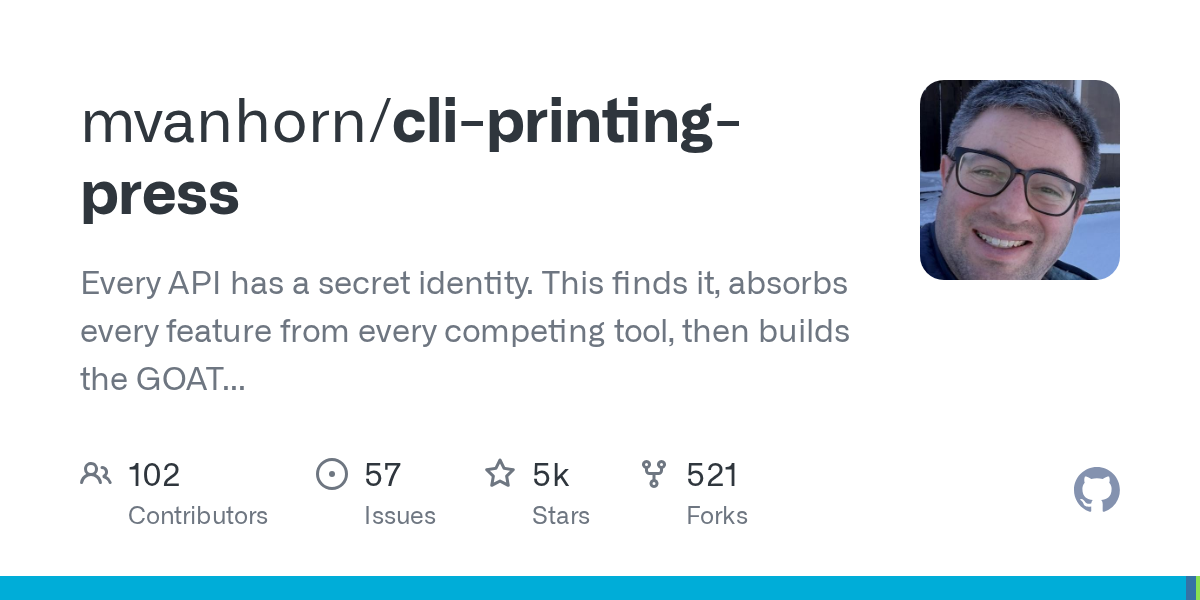
As AI coding assistants and autonomous agents become integral to modern software development workflows, fetching external service data and interfacing with third-party APIs have become routine tasks. However, relying on agents to browse full web pages or guess undocumented API structures across multiple back-and-forth prompt cycles introduces severe latency and runaway token consumption. To address this structural inefficiency, an open-source utility named 'cli-printing-press' has been released, capable of analyzing official documentation and private endpoints to generate dedicated CLIs, Claude Code skills, and MCP servers in an all-in-one automated pipeline.
Image source: https://github.com/mvanhorn/cli-printing-press
Developer curator Slopman (@UniverseB1020) highlighted the architecture and practical value of mvanhorn/cli-printing-press on October 13, 2026. While traditional agent workflows that lean on runtime web scraping consume excessive context windows on every interaction, pre-building lightweight, purpose-built CLIs delivers clean, structured data directly to the agent—drastically improving long-term token economics.
1. The 'Printing Press' Metaphor: Automated Generation of CLIs, Skills, and MCP Servers
The core concept behind cli-printing-press reflects its name: treating service integration like moveable type, mass-producing standardized tooling packages for any target service. When provided with an API's official documentation, an existing open-source CLI, or a Model Context Protocol (MCP) server specification, the tool parses the endpoint schema and automatically outputs three distinct integration artifacts:
- Dedicated Lightweight CLI: A standalone terminal tool that queries the service endpoint through concise, single-line commands.
- Claude Code Skill: A structured skill definition tailored for coding agent harnesses like Claude Code, allowing the model to understand tool intent and arguments without ambiguous prompting.
- MCP Server: A standardized MCP server implementation ready to plug directly into any MCP-compatible AI client without custom bridge code.
With this three-tier suite in place, an AI agent no longer needs to inspect complex HTML DOM trees or ingest dozens of pages of API documentation. Instead, it simply executes a predefined, compact command and receives structured output at a fraction of the token cost. Although the upfront generation step requires modest analysis overhead and token expenditure, every subsequent invocation runs deterministically at minimal cost—a transition described in community discussions as akin to moving from "hand-washing dishes to running a dishwasher."
2. Probing Private APIs and Undocumented Services: Real-World Catalog Examples
Beyond services that offer well-documented public developer APIs, cli-printing-press supports reverse-engineering and probing services that lack official developer programs or rely on private web endpoints. For platforms such as Google Flights, Domino's Pizza, and ESPN, the tool can discover internal network endpoints and assemble single-command CLI utilities to extract data effortlessly.
The pre-built catalog examples included in the repository showcase its practical scope:
- ESPN CLI: Retrieves live game scores, top scorers, and injury rosters in a single CLI invocation, avoiding the need to scrape dynamic sports broadcast portals.
- flight-goat: Simultaneously queries private endpoints across Kayak and Google Flights, enabling unified flight price and schedule comparison directly from the terminal.
- linear-pp-cli: Mirrors Linear issues and project data into a local SQLite database, serving complex queries with ultra-fast 50ms local response times without incurring network latency.
3. Practical Caveats: Endpoint Volatility and Cache Consistency
While cli-printing-press significantly curbs agent execution costs, integrating it into production workflows requires factoring in several real-world maintenance and operational considerations:
- Sensitivity to Private API Changes: Unlike public APIs protected by backward-compatibility guarantees, tools built on private endpoints or web scraping targets remain vulnerable to upstream schema changes or layout updates. When internal endpoints shift, the corresponding CLI package must be regenerated or updated.
- Optimization for Recurring Workflows: Because initial schema discovery and code generation consume model calls and compute resources, the return on investment is highest for high-frequency, recurring queries rather than one-off lookups.
- Local Storage and Cache Invalidation: Utilities employing local SQLite caching (such as linear-pp-cli) require deliberate lifecycle management, including cache expiration rules, synchronization schedules, and data consistency safeguards between local mirrors and remote platforms.
Sources
- GitHub Repository: mvanhorn/cli-printing-press
- X @UniverseB1020: Slopman's Analysis and Practical Evaluation of cli-printing-press