AI/ML API One-Shot 3D Scene Benchmark: Claude Opus 5.5 vs GPT-6 Sol Compared
AI/ML API tested Claude Opus 5.5 and GPT-6 Sol on one-shot 3D scene generation. Opus 5.5 delivered finer detail at $4.37 across four scenes, while GPT-6 Sol cos
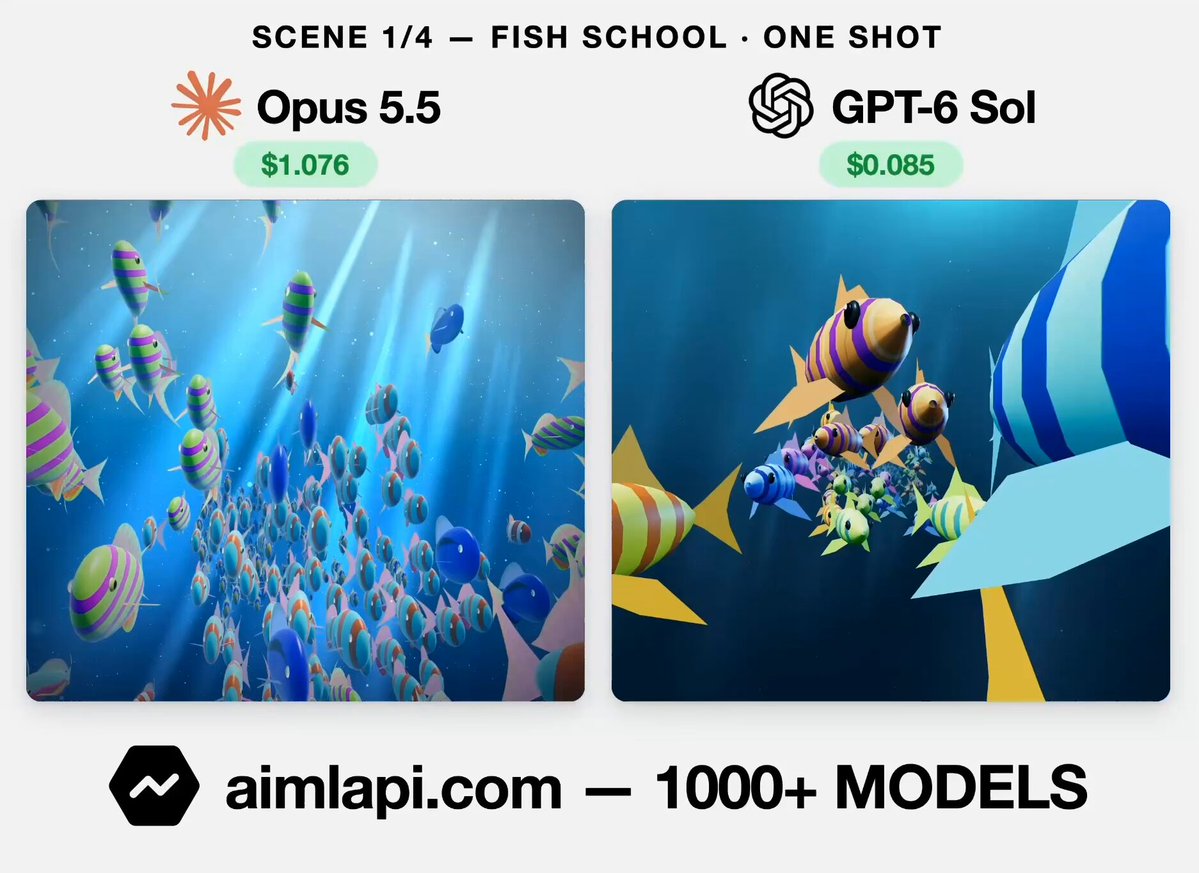
On September 23, 2026, API aggregator platform AI/ML API (AIML API) published comparative benchmark results evaluating Anthropic's Claude Opus 5.5 and OpenAI's GPT-6 Sol on one-shot 3D scene generation. The benchmark highlights a stark real-world divergence between rendering fidelity and inference economics when using frontier LLMs for procedural 3D graphics creation.
Image source: X @testingcatalog / AI/ML API
The test suite challenged both models with four distinct 3D scene prompts without multi-turn correction, beginning with an 'animated fish school' simulation. Across the four generated scenes, AI/ML API reported that Claude Opus 5.5 produced noticeably more detailed visual renders at a cumulative API cost of $4.37, whereas GPT-6 Sol completed the identical workload for $0.34—a 12.85-fold reduction in API expense.
Four One-Shot Scenes Tested: $4.37 for Precision vs $0.34 for Economy
The empirical data released by AI/ML API delineates a clear functional divide between a high-end reasoning flagship and an economy-focused frontier model in 3D code generation tasks.
- Claude Opus 5.5 Metrics: Processing the four scene prompts accrued $4.37 in total API charges, with the initial animated fish school scene billing at $1.076. In return, AI/ML API's evaluation noted that the model delivered superior visual polish and rendering detail.
- GPT-6 Sol Metrics: The identical four scene prompts generated just $0.34 in cumulative API charges, with the first scene costing $0.085. Compared to Opus 5.5, GPT-6 Sol completed all four scenes at roughly 1/13 the expense.
- Input and Output Cost Dynamics: The baseline per-token pricing difference between the two architectures compounded significantly during long-form code generation, widening the nominal dollar spread.
While Claude Opus 5.5 demonstrated more detailed visual results according to the benchmark evaluation, spending over $4 across just four single-shot scene generations raises substantial budget concerns for high-volume asset production pipelines.
One-Shot Prompting vs Agentic Feedback: The True Production Cost
Developer communities evaluating the benchmark noted that evaluating single one-shot generations captures only the starting point of production asset creation.
In professional 3D and procedural graphics workflows, initial code generation outputs frequently encounter syntax warnings, coordinate misalignments, or visual bugs. As a result, practical agentic systems rely on automated feedback loops where the model re-inspects errors, edits scripts, and refines parameters across multiple turns.
In an Opus 5.5 environment where four raw generations cost $4.37, running automated repair loops across dozens or hundreds of variations could easily push asset costs into double-digit dollar figures per object. Conversely, GPT-6 Sol's $0.34 baseline offers substantial headroom for iterative execution, making it far more economical for experimental or trial-and-error loops.
Production Fidelity vs Scalable Real-Time Generation: Selection Criteria
The benchmark underscores the growing importance of workload-specific model routing as developer-oriented LLMs take on advanced 3D graphical tasks.
- Hero Assets and Production Visuals: When creating primary scenes or marketing-grade 3D assets where visual nuance and rendering quality are paramount, Claude Opus 5.5 justifies its higher cost structure.
- Mass Scene Scaffolding and Rapid Prototyping: For procedurally generating background environments, testing scene layouts, or powering real-time generation features, GPT-6 Sol's $0.34 price point provides overwhelming cost advantages.
- Tiered Hybrid Architecture: A practical implementation involves using economical models like GPT-6 Sol for initial scaffolding and syntax verification, routing only the final aesthetic refinement and high-fidelity rendering passes to Claude Opus 5.5.
Sources
- TestingCatalog X post (@testingcatalog): AIML API Claude Opus 5.5 vs GPT-6 Sol 3D Scene Benchmark