claude-mem for Claude Code: Author Reports ~87% Token Savings on 50 Stored Records
A DEV_TOOL rundown of the claude-mem session-memory plugin for Claude Code as introduced by X user @lucian__03 on October 11, 2026: how it auto-records and rest
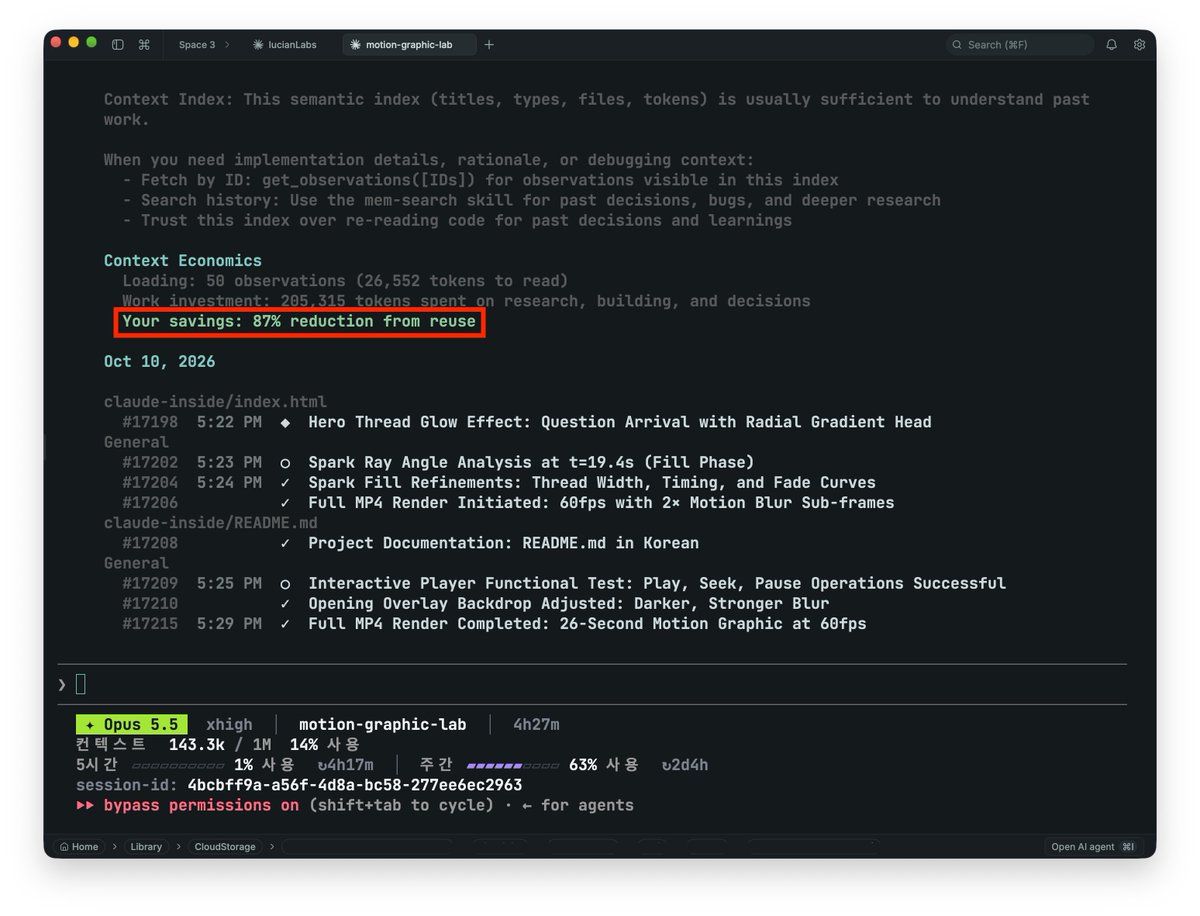
X user Lucian (@lucian__03) published a post on October 11, 2026 introducing claude-mem, a session-memory plugin for Claude Code. According to the author, it automatically records fixed bugs, edited files, facts discovered during work, and past decisions, then restores that memory automatically when needed after /clear or in a new session.
This article stays strictly inside that post and the verified desk memo: the author's own measurements, the author's summary of an external comparison test, and the parts that could not be verified. The original post contains no install command or official repository link, so none appears here.
What claude-mem does and who it suits
Per the author's description, claude-mem accumulates working context from Claude Code sessions and surfaces prior memory automatically in a new session, only when appropriate and needed. The author likens this to a human memory mechanism.
The author's claim is that this fits projects that run for days or weeks rather than finishing in a day, where every new session otherwise pays the cost of re-learning what was done, why it was implemented that way, and which problems were solved. The author says it is the only Claude Code plugin they have kept using for about a year — a personal endorsement, not an independent finding.
Author's own numbers: ~87% on a record-reuse basis
The author presents three figures from a project they were actually working on. The savings rate is the author's own calculation against the cost of re-reading stored records, not against total token usage.
- Past work records: 50
- Tokens spent on that work: 205,315
- Expected tokens to re-read the stored records: 26,552
- Record-reuse savings rate: about 87% (a difference of over 178,000 tokens, per the author)
These figures come from one project and are not a general savings guarantee. The author frames them explicitly as a record-reuse comparison.
The WPP Research on/off comparison, as summarized by the author
The author says WPP Research ran a direct comparison on October 1, with claude-mem enabled in one session and disabled in another, assigned several tasks, then opened a fresh session to test recall. No link to the original report appears in the post, so the following stays within the author's summary.
- Test A (recalling yesterday's work): Without claude-mem, the session checked Git history and guessed at past work; with it, the session loaded a stored work summary and described what had actually been done, according to the author.
- Test B (why a feature was removed): Without claude-mem, the session guessed from current code alone; with it, the session remembered the reason decided at the time. Per the author, the project removed a batch status-check feature because it does not batch multiple prediction requests.
- Test C (asking about a nonexistent feature): Asked how a previously implemented API rate-limiting feature was built — a feature that did not exist — the session without claude-mem allegedly misdescribed an API retry feature as the rate limiter, while the session with claude-mem searched its records and answered that no such feature had been implemented. The author presents this as reducing confabulated explanations of nonexistent features.
Verification limits: star count, install path, external test source
Check these gaps before adopting the tool.
- GitHub stars: The author claims 99.1k in this post. There is no repository URL or GitHub measurement in the post, so it is not independently verified.
- Install and usage path: The post gives no install command or official repository link. Confirm the official repository directly before installing.
- WPP Research source: With no link to the original report, the comparison above should be read only as the author's secondhand summary.
- Attached image: The post carries one attached image (a pbs.twimg.com URL), but there is no evidence of its contents, so it is not used as a source here.