Opus 5.5, Sonnet 5.5, and Fable 5.1 Division of Labor: Cutting Claude Code Token Costs with Multi-Model Advisor Setup
A practical guide to structuring Claude Code with Opus 5.5 for planning, Sonnet 5.5 for subagent execution, and Fable 5.1 as a passive advisor, featuring an aut
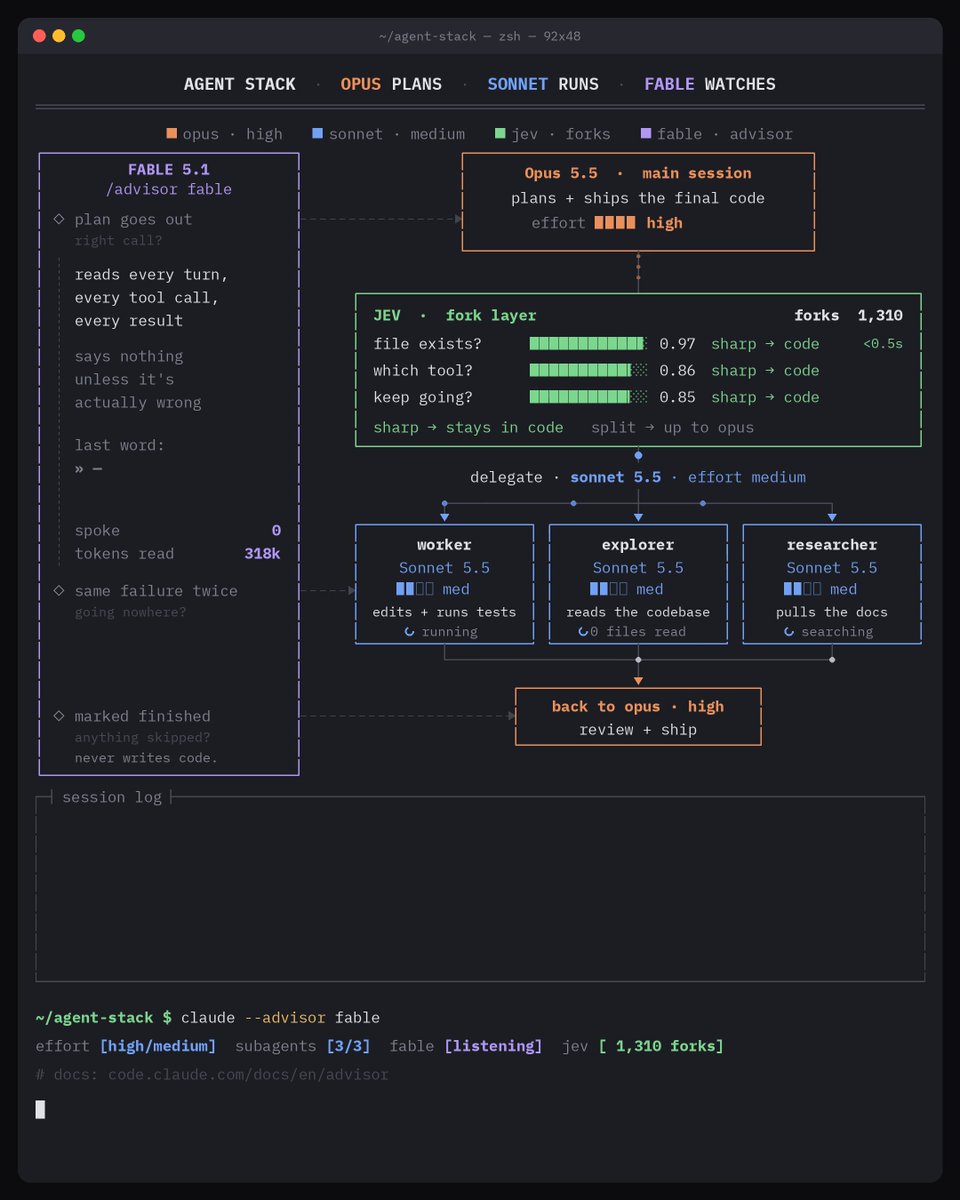
AI developer @rvaniaaaa shared a high-efficiency multi-model workflow for Claude Code that combines Claude Opus 5.5, Sonnet 5.5, and Fable 5.1 to eliminate unnecessary token burn and save thousands of dollars. Instead of running a single flagship model for every minor task, this approach clearly delineates the roles of planning, execution, and passive oversight.
Image source: @rvaniaaaa via X
Architecture: Three-Tier Multi-Model Division of Labor
The governing philosophy is simple: "The strong model plans, the mid-tier model executes, and Fable stays quiet until it's actually needed."
The exact division of responsibilities is structured as follows:
- Claude Opus 5.5 (High Effort): Acts as the primary orchestrator, responsible for high-level architectural planning and shipping the final verified code.
- Claude Sonnet 5.5 (Medium Effort): Handles the high-volume operational workload across dedicated subagents:
- Explorer: Reads the codebase and maps file dependencies.
- Worker: Edits source files and runs test suites.
- Researcher: Queries documentation and external API specifications.
- Claude Fable 5.1 (
/advisor fable): Ingests session context in the background but remains silent unless a critical defect or decision point arises.
Taking this optimization further with lightweight decision engines like Jev allows deterministic micro-decisions—such as checking whether a file exists, picking a tool, or deciding whether to loop—to resolve in under half a second. High-capacity models are reserved exclusively for choices requiring nuanced judgment, preventing scenarios where users pay Opus-tier rates just to confirm file existence.
The Three Critical Triggers for Fable 5.1 Advisor Intervention
Rather than consuming tokens on every conversational turn, Fable 5.1 intervenes only at three pivotal moments:
- When a plan is issued: Verifying whether the proposed architecture and approach are optimal before execution begins.
- When the same error repeats: Intervening when repeated failures indicate the worker is trapped in an unproductive search loop.
- When a task is marked complete: Performing a final audit to ensure no edge cases, requirements, or verification steps were skipped.
One-Click Claude Code Setup Automation Prompt
To apply this multi-model architecture to an existing Claude Code installation, submit the following structured prompt directly into your Claude Code session:
Rebuild my Claude Code setup around this structure:

Look through ~/.claude/agents and .claude/agents for subagents already covering explorer, worker, and researcher. Only create new ones for roles that are missing. Set model: sonnet, effort: medium on each. If an existing subagent is locked to a different model, leave it as is and just list it.

In ~/.claude/settings.json, set effortLevel to high and advisorModel to fable.

Check for anything disabling the advisor, CLAUDE_CODE_DISABLE_ADVISOR_TOOL, DISABLE_TELEMETRY, or anything blocking feature-flag fetches, plus CLAUDE_CODE_EFFORT_LEVEL, which can override subagent effort settings. Report what you find. Don't change any of it yet.

Add one line to ~/.claude/CLAUDE.md: check in with the advisor before a big plan, when the same error shows up twice, and before marking a long task done.

Show every change as a diff first. Wait for my go-ahead before touching anything.
Automation Execution Steps
- Subagent Directory Audit: Scans
~/.claude/agentsand.claude/agentsfor existingexplorer,worker, andresearcherconfigurations, creating only missing roles configured withmodel: sonnetandeffort: medium. Locked subagents are reported without modification. - Configuration Update: Updates
~/.claude/settings.jsonto seteffortLeveltohighandadvisorModeltofable. - Environment Audit: Checks for flags that might suppress the advisor (
CLAUDE_CODE_DISABLE_ADVISOR_TOOL), block telemetry feature flags (DISABLE_TELEMETRY), or override subagent effort levels (CLAUDE_CODE_EFFORT_LEVEL). - Project Instructions: Appends an advisory checkpoint rule to
~/.claude/CLAUDE.mdtriggering reviews before major plans, upon duplicate errors, and prior to completing long-running tasks. - Diff Confirmation: Presents all proposed configuration changes as unified diffs and waits for explicit user confirmation before applying modifications.
Original source
- @rvaniaaaa via X: Opus 5.5, Sonnet 5.5, and Fable 5.1 Multi-Model Division of Labor Tip