Slash Costs by 3.4x in Claude Code: Multi-Model Orchestration with the /advisor Command
A complete configuration guide to setting up Claude Code v2.1.321+ with Fable 5.2 for reasoning, Sonnet 5.5 for implementation, Opus 5.5 for code reviews, and H
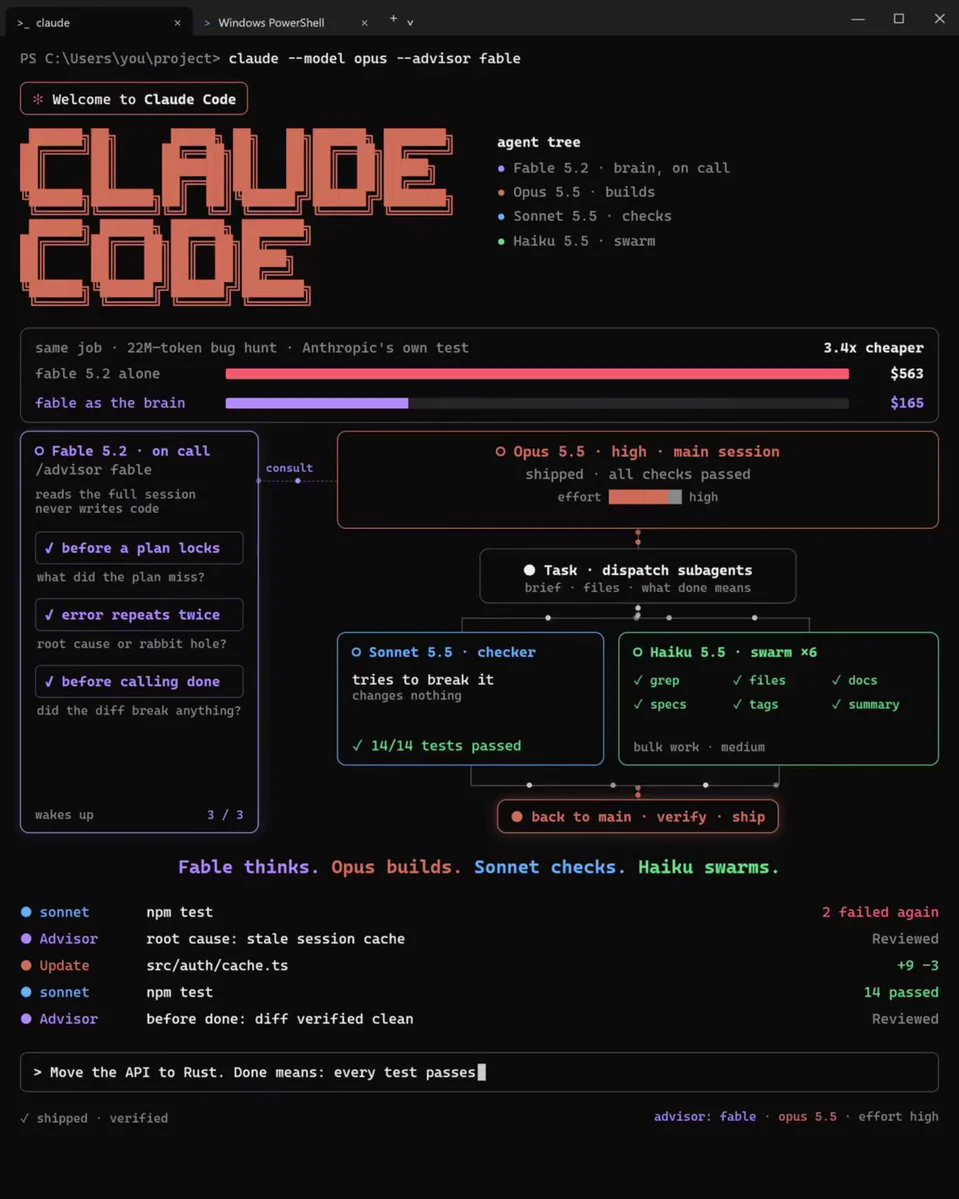
A high-efficiency multi-model orchestration workflow for Claude Code that reduces overall token expenses by 3.4 times has been shared by AI developer @thedelost. Built on Anthropic's official /advisor command, this configuration splits reasoning, code generation, peer review, and information retrieval across distinct, specialized models.
Image source: https://x.com/thedelost/status/2121720755192799480
Relying on a single flagship model for every phase of software development introduces severe cost inefficiencies, as high token rates apply equally to routine file searches, scaffolding, and refactoring loops. This setup requires only a one-minute initial configuration to restrict premium model calls strictly to critical decision bottlenecks, delegating heavy scanning and routine coding to significantly more economical models.
The Four-Model Division of Labor and Cost Optimization
The core mechanism rests on aligning four Claude models with tasks that match their strengths and price tiers, rather than depending on a single generalist model.
- Fable 5.2 (High-Level Advisor): Fable 5.2 never writes implementation code. Instead, its role is confined strictly to high-level strategic decisions. It activates exclusively at three critical milestones: right before finalizing an execution plan, when an error recurs repeatedly without resolution, and immediately before declaring a task complete. Premium tokens are consumed only when making crucial architectural decisions.
- Sonnet 5.5 (Main Builder): Serves as the primary worker responsible for analyzing the repository, authoring logic, writing unit tests, and implementing core application features.
- Opus 5.5 (On-the-Spot Reviewer): Inspects newly generated code on the spot, catching logical edge cases, security regressions, and architectural inconsistencies before changes are finalized.
- Haiku 5.5 (Swarm Retrieval and Research): Orchestrates a swarm of lightweight subagents to search documentation, scan repositories, and retrieve background context. Because Haiku's token cost is 80 times lower than Fable's, it absorbs the bulk of context-heavy token consumption at minimal cost.
By channeling broad retrieval through Haiku at an 80-fold price discount, assigning hands-on implementation to Sonnet, and gating Fable's reasoning to high-stakes junctures, the pipeline achieves an overall 3.4x cost reduction without degrading output quality.
Step-by-Step Configuration Guide
Deploying this workflow across your machine requires updating Claude Code to the latest release and establishing a user-level configuration that spans all local projects.
Step 1: Update Claude Code
Support for Fable 5.2 and the refined advisor mechanics requires Claude Code v2.1.321 or later. Upgrade your installation by running the following command in your terminal:
claude update
Verify your active version after completion to ensure the build meets the minimum version requirement.
Step 2: Ingest Official Advisor Documentation
Launch Claude Code and paste the setup prompt into the prompt interface. This instructs Claude Code to read Anthropic's official documentation on advisor mode directly, ensuring the system parses proper parameter structures and team orchestration rules.
Step 3: Configure the Team at the User Level
To ensure the multi-model architecture applies globally across all development repositories rather than a single workspace, register the team configuration at the user level:
- Main Model: Sonnet 5.5
- Advisor: Fable 5.2
- Subagent Swarm: Haiku 5.5
- Reviewer: Opus 5.5
Step 4: Review Automated Backups and Diff Comparisons
Claude Code automatically creates a backup of your existing user configuration files and displays a side-by-side comparison (diff) highlighting proposed changes. The modifications take effect only after you review and approve the diff, safeguarding against configuration regressions.
Critical Requirement: Specifying Explicit Trigger Conditions
The single most critical factor in this workflow is defining explicit trigger conditions that dictate exactly when Sonnet 5.5 must consult Fable 5.2.
According to Anthropic's internal benchmark across 198 test cases, omitting explicit activation rules caused the advisor mode to trigger zero times. In other words, models will not spontaneously ask for advice unless instructed precisely when to do so.
To ensure proper engagement, configuration prompts must hardcode the three specific invocation triggers:
- Before finalizing a plan: Sonnet must request Fable's review on architectural soundness before locking down its implementation strategy.
- When an error keeps recurring: If a compilation or test failure persists across multiple consecutive attempts, Fable must be summoned to provide a fresh debugging perspective.
- Before declaring the work done: Prior to concluding any session or marking a feature complete, Fable must conduct a final verification pass to ensure all requirements are satisfied.
Specifying these three conditions guarantees that Fable activates when truly needed, preventing model idling while eliminating unnecessary token expenditure.
Original source
- @thedelost on X: Claude Code /advisor workflow