60 Essential AI and Claude Prompt Engineering Practical Guidelines
A comprehensive practical guide of 60 essential prompt engineering techniques covering role prompting, output formatting, content creation, research analysis, a
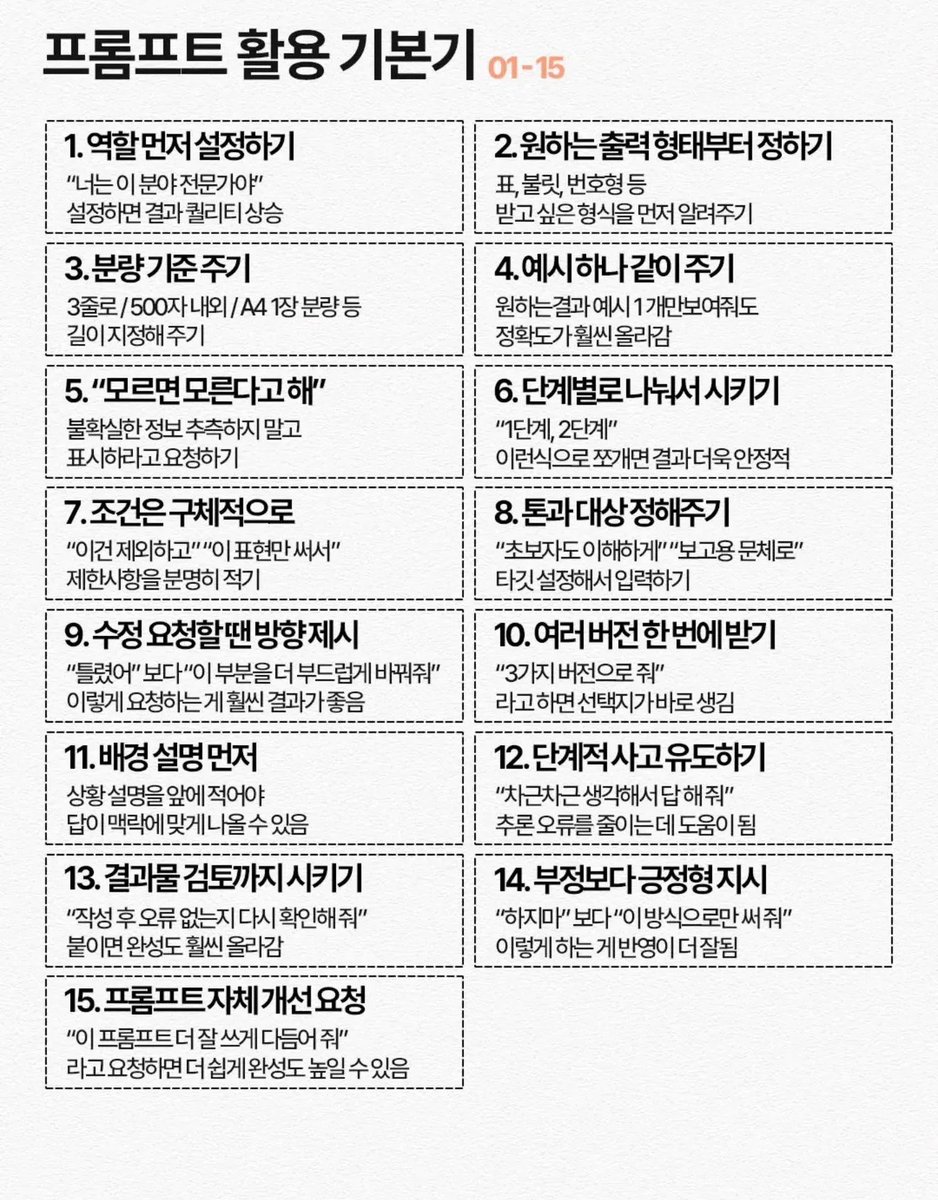
A practical field reference compiling '60 Essential Prompt Engineering Guidelines' to maximize output accuracy and operational efficiency across Claude and modern Large Language Models (LLMs) was shared by creator Kamin (@HUUK72670323).
Image source: @HUUK72670323 via X
The performance and reliability of generative AI systems vary dramatically based on how prompts are structured. Rather than relying on open-ended or vague queries, applying structured constraints—such as explicit role assignments, predefined output schemas, step-by-step reasoning prompts, and precise negative boundaries—substantially reduces hallucinations and yields production-ready deliverables.
The guide organizes 60 actionable techniques across four primary operational domains: fundamental prompting principles, writing and content creation, research and analytical workflows, and business productivity.
Core Prompting Fundamentals (01–15)
Fifteen foundational directives designed to establish clear task boundaries and improve reasoning depth.
- 1. Set the role first: Instructing the model with
'You are an expert in this field'immediately frames the domain context, terminology level, and analytical rigor of the output. - 2. Specify the output format upfront: Explicitly define the target presentation format—such as tables, bullet lists, numbered rankings, or raw JSON—at the beginning of the prompt.
- 3. Define explicit length constraints: Set clear boundaries such as
'summarize in 3 lines','within 500 words', or'1 page of A4'to eliminate unnecessary fluff. - 4. Provide a single few-shot example: Including just one representative input/output pair dramatically clarifies formatting expectations and structural nuances.
- 5. Explicitly allow 'Say you don't know': Instruct the model not to guess or fabricate details when information is uncertain, requiring it to state unknowns explicitly to curb hallucinations.
- 6. Decompose tasks into sequential steps: Break complex workflows into phased instructions (e.g.,
'Step 1: Outline structure → Step 2: Draft sections') to ensure consistent output quality. - 7. Specify granular constraints: Clearly articulate hard boundaries, such as
'exclude specific keywords'or'use industry-standard nomenclature exclusively'. - 8. Define tone and target audience: Direct the model's communication style by specifying
'accessible to beginners'or'formal executive briefing tone'. - 9. Provide directional guidance during revisions: Instead of simply saying
'this is wrong', give actionable direction like'rewrite this paragraph to sound more concise and professional'. - 10. Request multiple versions concurrently: Ask for
'3 distinct variations from different perspectives'to review diverse creative angles in a single turn. - 11. Frontload background context: Provide the operational circumstances and context before asking the primary question to ensure contextual alignment.
- 12. Encourage step-by-step thinking: Use Chain-of-Thought prompting (e.g.,
'think through this step by step before answering') to eliminate logical reasoning flaws. - 13. Instruct the AI to self-review: Require the model to execute a post-draft validation pass with
'review your draft for omissions or logical inconsistencies before finalizing'. - 14. Favor positive instructions over negative bans: Directives framed positively (e.g.,
'write exclusively using this format') exhibit higher adherence than negative bans ('do not do X'). - 15. Prompt the AI to refine your prompt: Ask
'how can I improve this prompt to achieve a more rigorous result?'to iteratively optimize prompt phrasing.
Writing and Content Creation Workflows (16–30)
Practical patterns for elevating marketing copy, articles, scripts, and multi-channel content assets.
- 16. Clarify content purpose upfront: Define the exact end-use case, such as an internal whitepaper, YouTube script, or technical documentation.
- 17. Pinpoint the reader persona: State the exact target demographic, such as
'entry-level job applicants'or'tech-savvy professionals in their 20s and 30s'. - 18. Review outlines before full drafts: Require an outline approval stage before generating complete long-form articles.
- 19. Request diverse hook variations: Generate three distinct introductory styles—such as question-driven, empathy-focused, and statistic-led hooks—to test reader engagement.
- 20. Brainstorm multiple headline options: Produce 10 high-click-through headline candidates after drafting the body text.
- 21. Repurpose long-form text into short-form assets: Condense full articles or reports into
'60-second video script'formats. - 22. Generate platform-specific hashtag sets: Extract tailored hashtag clusters optimized for Instagram, TikTok, and YouTube algorithms.
- 23. Apply established copywriting formulas: Mandate proven marketing frameworks like AIDA (Attention-Interest-Desire-Action), PAS (Problem-Agitate-Solution), or 4U.
- 24. Maintain consistent brand voice: Pre-inject brand tone-and-manner guidelines to safeguard stylistic consistency across campaigns.
- 25. Condense articles into carousel slide copy: Structure long-form content into a logical flow: Executive Summary → Key Takeaway → Slide-by-Slide Copy.
- 26. Mine customer feedback for content topics: Input user comment logs and product reviews to identify recurring pain points and latent content demand.
- 27. Conduct competitor content gap analysis: Provide competitor URLs or excerpts to extract unique angles and brand differentiators.
- 28. Structure keyword hierarchies for SEO: Organize terms into primary, secondary, and long-tail keyword clusters with strategic placement plans.
- 29. Build structured interview question sets: Generate comprehensive interview questions mapped against interviewee background, interview goals, and available duration.
- 30. Solicit critique from an editor's perspective: Direct the model with
'act as a strict managing editor and pinpoint only logical leaps and redundancies'.
Research and Data Analysis Workflows (31–45)
Analytical frameworks for deconstructing complex topics, distilling reports, and evaluating business hypotheses.
- 31. Deconstruct topics into issue trees: Break broad research topics into branched, granular sub-questions for systematic investigation.
- 32. Extract core summaries from whitepapers: Condense dense research documents focusing strictly on core claims, empirical evidence, limitations, and practical implications.
- 33. Demand balanced multi-perspective arguments: Require an equal balance of 5 supporting arguments and 5 opposing arguments with matching analytical depth.
- 34. Spot strategic opportunities in industry trends: Analyze macro market shifts to extract actionable business opportunities for your organization.
- 35. Compile executive profiles: Synthesize biographical background, competitive strengths, vulnerabilities, and recent milestones into a 1-page profile.
- 36. Delegate quantitative data interpretation: Input raw numerical tables to identify distributions, anomalies, outliers, and meaningful directional trends.
- 37. Construct hypothesis testing frameworks: Define prerequisite conditions, verification criteria, and required metrics to validate business hypotheses.
- 38. Generate structured SWOT matrices: Automatically derive Strengths, Weaknesses, Opportunities, and Threats from product and market descriptions.
- 39. Establish objective benchmarking criteria: Standardize evaluation dimensions and baseline criteria before executing competitive analyses.
- 40. Estimate tiered market sizing: Model market scope methodically across TAM (Total Addressable Market), SAM (Serviceable Addressable Market), and SOM (Serviceable Obtainable Market) tiers.
- 41. Distill insights from user interviews: Analyze raw interview transcripts to uncover recurring linguistic expressions and unmet customer needs.
- 42. Build competitive positioning matrices: Summarize key competitors' core offerings, pricing structures, and positioning into a unified 1-page comparison table.
- 43. Extract operational legal and regulatory summaries: Distill complex statutory guidelines down to the mandatory operational clauses required for compliance.
- 44. Map risks alongside mitigation protocols: Tabulate anticipated project risks paired directly with concrete contingency and mitigation scenarios.
- 45. Formulate optimized search queries: Build advanced Boolean search strings, operators, and keyword combinations for specialized web research.
Business Operations and Productivity (46–60)
Daily operational templates for automating meeting prep, executive communications, project scoping, and internal documentation.
- 46. Structure time-blocked meeting agendas: Input meeting objectives, participant lists, and time constraints to generate time-allocated agendas.
- 47. Convert meeting transcripts into action items: Extract clear action items with explicit role ownership (R&R) and firm delivery deadlines from raw meeting notes.
- 48. Generate three parallel email tones: Draft side-by-side versions of an email in polite, firm, and casual registers to match interpersonal dynamics.
- 49. Design persuasive proposal structures: Architect proposal tables of contents tailored directly to the evaluation priorities of key decision-makers.
- 50. Draft structured OKR frameworks: Fast-track goal setting with 1 clear Objective supported by 3 measurable Key Results.
- 51. Document Standard Operating Procedures (SOPs): Draft standard operating procedure manuals including step-by-step checklists and exception-handling workflows.
- 52. Translate performance data into executive commentary: Convert raw metrics and charts into concise, one-line qualitative summaries ready for leadership reviews.
- 53. Polish recruitment job postings: Refine job descriptions from the applicant's vantage point to clarify responsibilities and enhance candidate appeal.
- 54. Prepare structured negotiation scenarios: Map out potential counterarguments and prepare defensive talking points prior to client negotiations.
- 55. Plan KPI monitoring dashboards: Propose high-impact performance indicators, calculation formulas, and recommended data visualization formats.
- 56. Conduct pre-kickoff project risk audits: Methodically evaluate the top 5 preventative risk factors before deploying capital or engineering resources.
- 57. Draft contextual customer communications: Generate situational customer service and client notification emails tailored to specific support scenarios.
- 58. Streamline company-wide announcements: Polish internal announcements to ensure clear, high-readability phrasing that minimizes organizational ambiguity.
- 59. Compress approval memos: Summarize complex business cases so executives can comprehend core trade-offs and render decisions within 1 minute.
- 60. Structure handover documentation: Build structured onboarding and task handover indices that enable successors to assume workflows immediately.
Practical Implementation and Prompt Stacking
The unifying factor across all 60 techniques is shifting the perception of AI from an 'omniscient magic box' to a deterministic reasoning partner requiring precise context, scoped boundaries, and strict output formatting.
For recurring workflows, practitioners are encouraged to store and combine modular prompt components. Chaining core formatting rules (Rule 02), step-by-step reasoning (Rule 12), and explicit action item extraction (Rule 47) provides a robust foundation for automating complex, multi-stage knowledge work with consistent reliability.
Original source
- Kamin on X (@HUUK72670323): 60 Essential Claude Prompt Engineering Guidelines