Alibaba Qwen Unveils 'Qwen Intelligence' and Three Specialized Mobile AI Agents
Alibaba Qwen has unveiled Qwen Intelligence for smartphones, featuring Mobile Planner, Mobile-Use, and Mobile Creative agents alongside four open-source benchma
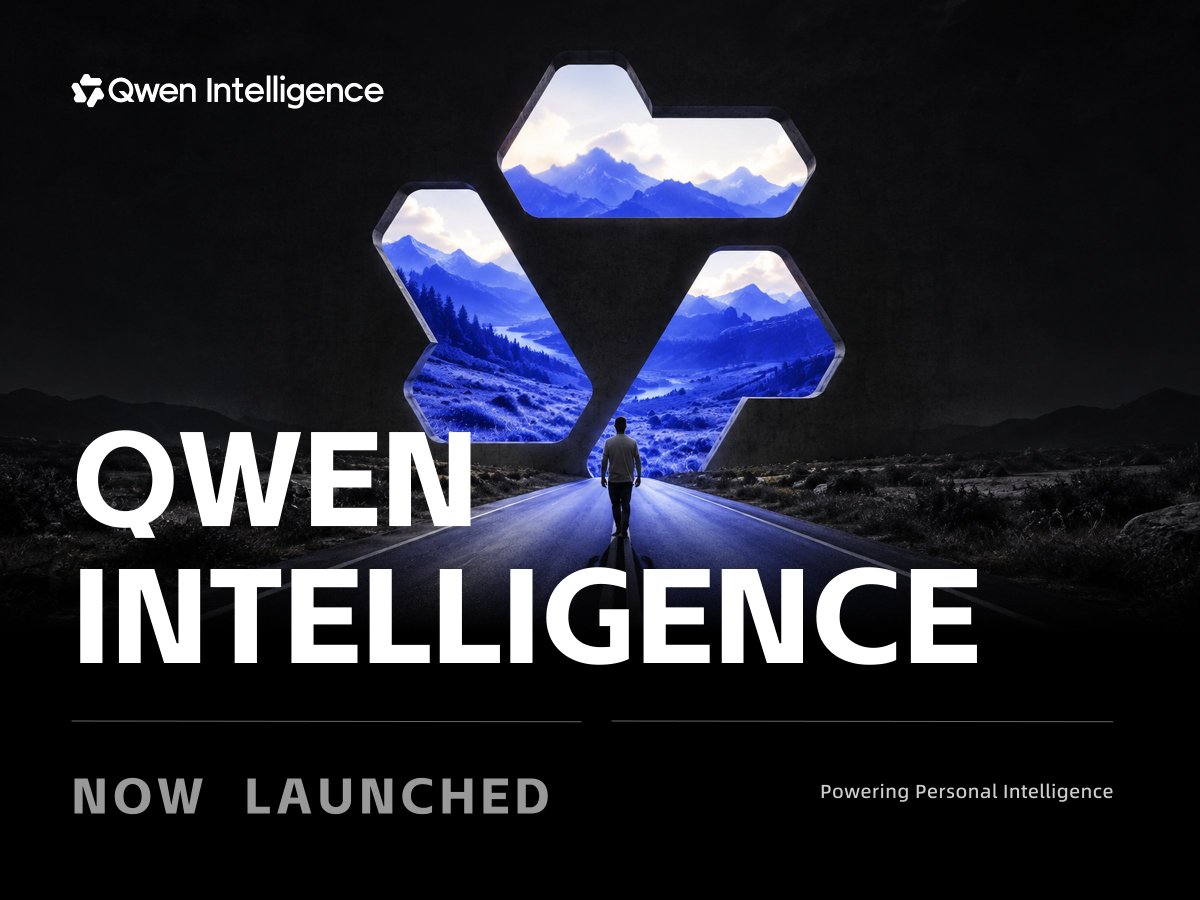
On September 23, 2026, at 20:50 KST, the Alibaba Qwen team announced Qwen Intelligence, an on-device personal intelligence system tailored specifically for smartphone operating systems. The release pairs three purpose-built mobile agents—Mobile Planner, Mobile-Use, and Mobile Creative—with a suite of four open-source benchmarks designed to standardize evaluation across planning, action execution, physical device latency, and runtime safety.
Image source: @Alibaba_Qwen on X
Mobile user interfaces present unique challenges for autonomous agents: compact viewports, touch-driven interaction models, frequent app context switches, and stringent power and thermal constraints. Deploying conventional large language models directly into mobile environments frequently results in unacceptable response latency and rapid battery drain. Qwen Intelligence addresses these trade-offs by pairing compact, specialized on-device models with a structured agent runtime harness to handle everyday mobile tasks.
Specialized Three-Agent Architecture: Planner, Mobile-Use, and Creative
Rather than relying on an unwieldy single foundation model to handle all device interactions, Qwen Intelligence divides mobile responsibilities across three dedicated agents optimized for constrained computing resources and dynamic user environments:
- Mobile Planner Agent: Decomposes multi-step user prompts and orchestrates execution across applications. It implements a 'Model x Harness co-evolution' design where the core language model focuses on high-level reasoning and semantic intent, while the runtime harness manages device state, tool coordination, and iterative feedback loops. The agent incorporates dynamic working memory, structured long-term memory for personalization, and subagent dispatch to solve complex multi-turn workflows. In evaluations, it ranked #1 overall on MobilePA-Bench as well as in the specialized business and memory categories.
- Mobile-Use Agent: Directly interacts with device tools and application interfaces using a hybrid 'API-first with GUI fallback' model. Where system or application APIs (such as MCP, DeepLink, or CLI) are available, the agent calls programmatic endpoints directly to minimize latency and token expenditure. When executing tasks inside apps lacking accessible APIs, the agent automatically falls back to visual UI navigation. It incorporates a three-tier safety control system to block risky requests and require user confirmation for sensitive operations like financial actions or data deletion, and achieved scores of 82.1 on MobileWorld, 92.2 on MobileWorld-Real, and 97.2 on AndroidDaily, reaching a reported 90% end-to-end task completion rate.
- Mobile Creative Agent: Transforms single-sentence natural language prompts into ready-to-use visual assets on device. According to Alibaba's internal testing claims, the engine generates images in approximately 3 seconds on-device, representing a reported 2x speedup compared to leading peer models, with support for creative editing and style transfer.
Four Open-Source Benchmark Suites for Mobile Evaluation
Evaluating mobile agents requires methodologies that capture UI latency, touch precision, API failures, and real-world execution constraints. Alongside the agent framework, Alibaba open-sourced four benchmark suites:
- MobilePA-Bench: Covers 1,705 evaluation tasks spanning 212 real-world tools across 13 functional domains, focusing on persistent working memory, subagent delegation, and complex task decomposition. The Qwen team's Mobile Planner Agent achieved the #1 ranking on the overall benchmark as well as the specialized business and memory categories.
- MobileWorld: Measures API and GUI execution across 100+ application environments and 2,000+ benchmark tasks across both simulated and real applications.
- MobileWorld-Real: Evaluates end-to-end task execution directly on physical devices across 104 production mobile applications, validating agent robustness under real hardware conditions.
- MobileWorld-Safety: Co-developed with Fudan University's BaiZe security research team, this suite evaluates agent defensive guardrails and safe actions under risk scenarios.
Hardware Deployment and Practical Considerations
Alibaba is bringing Qwen Intelligence to consumer devices through original equipment manufacturer (OEM) partnerships.
Smartphone manufacturer HONOR has been confirmed as the first launch partner. Qwen Intelligence is slated to debut commercially on HONOR's upcoming flagship Magic9 smartphone series and Robot Phone, scheduled for launch on September 28, 2026.
While the release marks a notable shift toward edge-native agentic AI, several practical boundaries warrant attention. Although the benchmark code, evaluation environments, and the Qwen-UI-Agent technical report (arXiv:2607.28227) are publicly accessible, the underlying model weights and commercial on-device runtime binaries have not been released for general developer download. Furthermore, benchmark scores on MobilePA-Bench and MobileWorld as well as performance claims—such as the 3-second generation latency and 2x acceleration—reflect vendor-reported figures that remain to be verified independently across diverse third-party chipsets and real-world usage scenarios.
Key Takeaways and Resources
- Framework: Qwen Intelligence (Mobile Planner, Mobile-Use, and Mobile Creative agents)
- Benchmarks: MobilePA-Bench (planning/memory), MobileWorld (execution), MobileWorld-Real (physical hardware), and MobileWorld-Safety (security)
- First Hardware Integration: HONOR Magic9 series and Robot Phone (scheduled for September 28, 2026)
- GitHub Repository: Tongyi-MAI/MobileWorld
- Leaderboard: MobileWorld Leaderboard
- Technical Paper (Qwen-UI-Agent / Mobile-Use): arXiv:2607.28227