Alibaba Cloud Apsara 2026: CBN Unveils Qwen-Powered 'Digital Worker' Platform
At Apsara Conference 2026, Indonesian digital infrastructure provider CBN unveiled its Qwen-powered 'Digital Worker' platform, automating enterprise workflows v
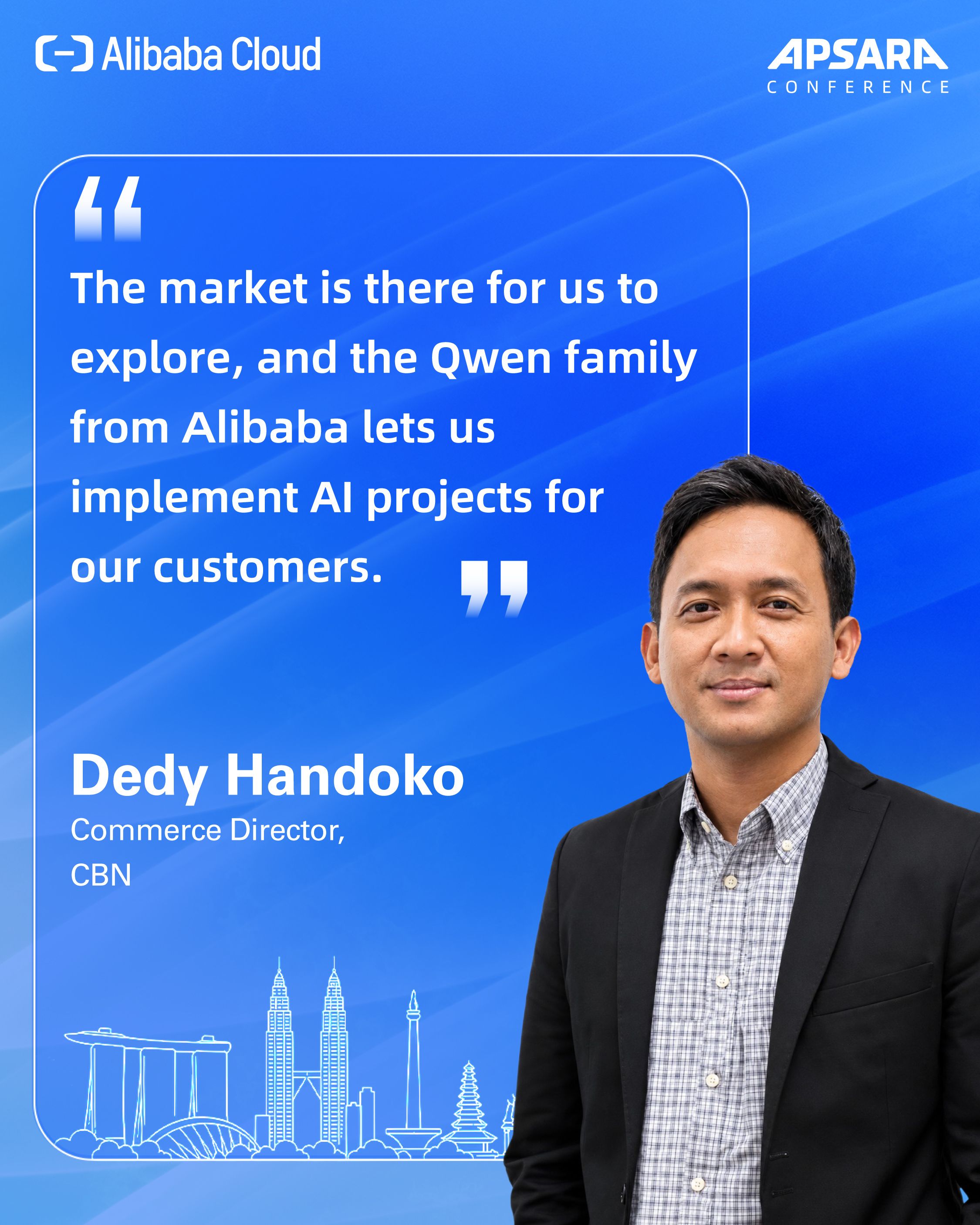
On September 23, 2026, at Alibaba Cloud's annual flagship technology conference Apsara Conference 2026, leading Indonesian digital infrastructure provider CBN (PT Cyberindo Aditama) officially announced its enterprise 'Digital Worker' vision powered by the Qwen foundation model family. Designed to move past conversational chatbots toward executing multi-step enterprise business processes, the initiative highlights Alibaba Cloud's expanding full-stack AI ecosystem across Southeast Asia.
Image source: Alibaba Cloud (@alibaba_cloud)
Held from September 22 to 23 in Hangzhou, China, Apsara Conference 2026 served as the staging ground for Alibaba Cloud's full-stack AI roadmap—ranging from custom-designed AI accelerator chips to agentic cloud infrastructure and multimodal Qwen models. During the conference, Dedy Handoko, Commerce Director at CBN, presented the architectural vision of the CBN Digital Worker and detailed how the Qwen family supports business workflow automation for the company's enterprise customer base.
Moving Beyond Conversational Chatbots: Architecture of the CBN Digital Worker
Founded in 1996, PT Cyberindo Aditama (CBN) serves over 8,000 corporate clients and 700,000 consumer subscribers across Indonesia, providing fiber connectivity, dedicated leased lines, data centers, and managed cloud infrastructure. The newly unveiled 'CBN Digital Worker' shifts enterprise AI usage away from single-turn chat interfaces toward autonomous platforms capable of executing multi-step operational workflows.
Co-developed through technical collaboration with Alibaba Cloud, the platform combines Qwen's document comprehension, natural language processing, and tool-calling capabilities with CBN's enterprise connectivity and cloud management services. Instead of building custom internal machine learning pipelines, corporate clients can deploy digital workers integrated with secure cloud infrastructure to automate data-heavy back-office workflows—such as financial invoice extraction, internal voucher verification, customer ticket routing, and structured reporting.
Alibaba Cloud's Full-Stack AI Strategy and Southeast Asian Localization
At Apsara Conference 2026, Alibaba Cloud presented its full-stack AI roadmap spanning dedicated AI chips, cloud infrastructure, foundational models, and agent architectures to accelerate enterprise adoption of the Qwen family. The announced strategy focuses on moving AI from isolated experiments into production business workflows across global markets.
Within this strategic roadmap, Southeast Asia serves as an active expansion market for enterprise Qwen deployments. Rather than relying solely on standalone API access, Alibaba Cloud is pairing its cloud and model ecosystem directly with regional infrastructure and software partners:
- Enterprise AI Solution Portfolio: Progressively building out tailored enterprise AI capabilities, including internal knowledge processing, business application development, and workflow automation.
- End-to-End AI and Cloud Infrastructure Modernization: Going beyond basic model API endpoints by combining Alibaba Cloud's computing infrastructure, AI platforms, and Qwen model inference engines into a secure, scalable deployment foundation.
- Connectivity-Bundled Delivery (CBN): CBN bundles Qwen AI capabilities directly with enterprise connectivity, managed hosting, and local system integration services, lowering the technical friction of enterprise AI adoption.
Operational Hurdles and Enterprise Governance Considerations
The CBN Digital Worker is not a self-hosted standalone tool for individual developers; it is delivered as an enterprise-grade B2B solution tied directly to Alibaba Cloud infrastructure and CBN service agreements.
Deploying autonomous agents into production environments requires addressing organizational challenges before cutover. Enterprises must establish secure API permission boundaries with legacy ERP and CRM systems, isolate departmental access to corporate knowledge bases, and comply with Indonesian data sovereignty and privacy mandates. Organizations must also define clear Service Level Agreements (SLAs) that distinguish between underlying cloud infrastructure uptime and model execution anomalies. Because commercial pricing tiers and deployment metrics were not disclosed during the Apsara 2026 session, enterprise teams should evaluate real-world pilot milestones as production rollouts progress.
Sources
- Alibaba Cloud Press Room: Alibaba Unveils Roadmap on Full-Stack AI Strategy from Chips, Cloud Infrastructure, Models to Agents
- Alibaba Cloud Official X (@alibaba_cloud): Apsara Conference 2026 CBN Digital Worker Announcement
- Kompas Business: AI Mulai Masuk Struktur Kerja Perusahaan, CBN Siapkan Digital Worker