Comparing AI Video Generation with the Same Prompt: Cost and Speed Analysis Between GPT-6 Astra and Gemini 4 Hydrogen
A benchmark analyzing video generation costs and rendering times across Fable 5.2, Opus 5.5, Gemini 4 Hydrogen, and GPT-6 Astra using the 'Rio Above the Clouds'
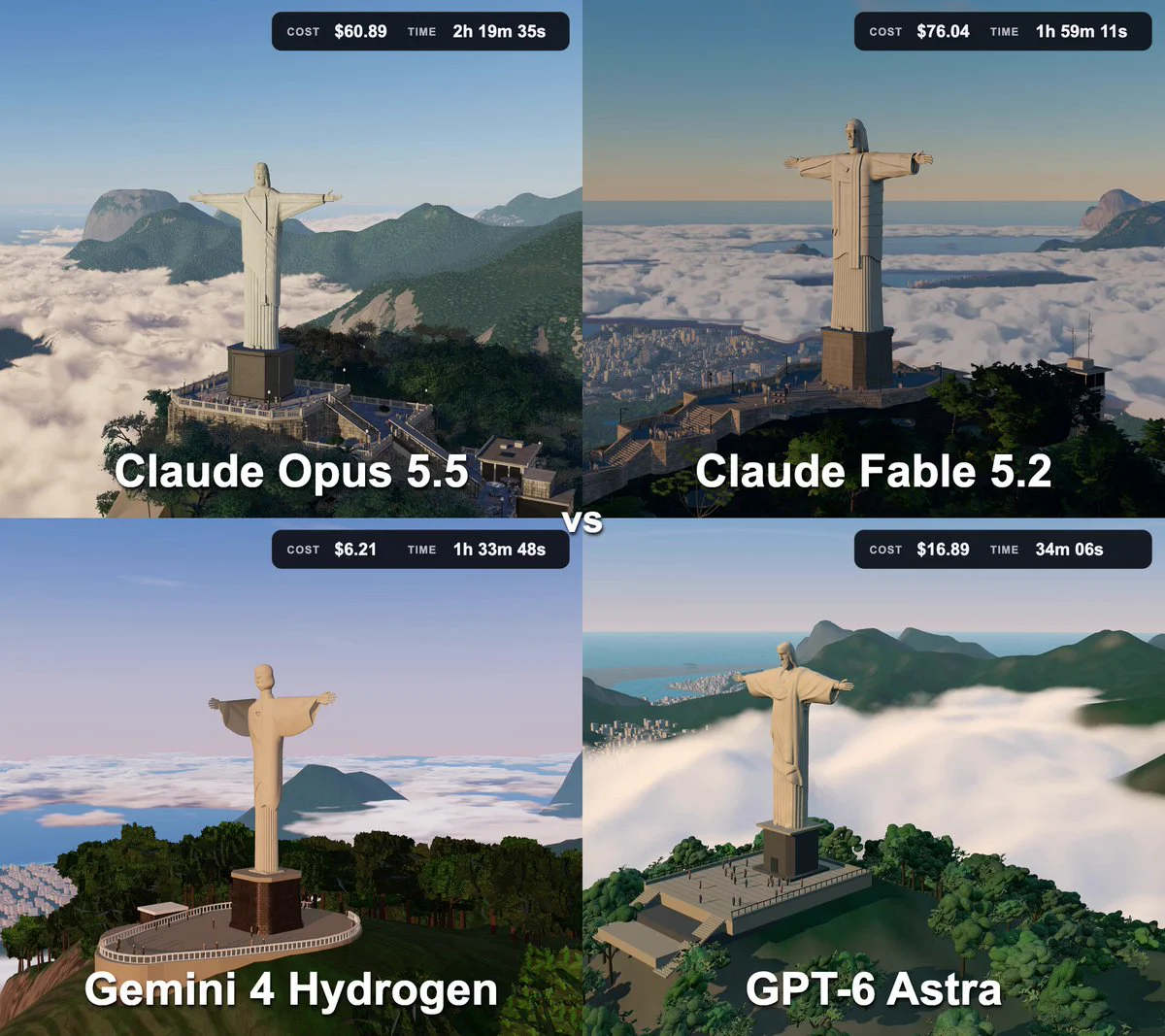
AI developer Tony (@EnvolDev) has shared benchmark results measuring video production costs and rendering turnaround times across four leading generative AI models using identical prompts and visual quality settings. By holding the prompt and processing parameters constant, the test provides a practical reference for video creators evaluating generation cost against pipeline latency.
Image source: https://x.com/EnvolDev/status/2121701704139956250
The benchmark used the prompt 'Rio Above the Clouds' and configured all models to the 'Extra High' rendering preset. While previous test runs were restricted to 'High' due to platform limitations, this comparison executed all four runs under the same Extra High configuration.
Benchmark Summary Across Four Models
The test evaluated two frontier-tier foundation models (Fable 5.2 and Opus 5.5) alongside two lightweight or speed-optimized models (Gemini 4 Hydrogen and GPT-6 Astra). The total API generation expenditure and elapsed wall-clock time—encompassing prompt execution and final video rendering—were recorded as follows:
- Opus 5.5: $60.89 · 2h 19m 35s
- Fable 5.2: $76.04 · 1h 59m 11s
- Gemini 4 Hydrogen: $6.21 · 1h 33m 48s
- GPT-6 Astra: $16.89 · 34m 06s
The cost gap between the most affordable and most expensive runs spanned more than a 12-fold difference ($6.21 versus $76.04), while execution times ranged from roughly 34 minutes to nearly two hours and twenty minutes.
GPT-6 Astra Leads in Speed and Overall Balance
GPT-6 Astra emerged as the strongest performer in terms of throughput and balanced output quality. Completing both execution and rendering in 34 minutes and 6 seconds, Astra finished nearly an hour ahead of the next-fastest model, Gemini 4 Hydrogen (1 hour 33 minutes 48 seconds).
From an operational cost perspective, Astra demonstrated a compelling middle ground. It cost $10.68 more than Gemini 4 Hydrogen ($16.89 compared to $6.21), but remained substantially below the $60 to $76 price range commanded by the frontier models.
Visual output also revealed noticeable fidelity differences. Tony noted that while Gemini 4 Hydrogen successfully generated the entire film for just over $6, its overall visual fidelity was the weakest among the four candidates. In contrast, GPT-6 Astra delivered a more coherent and detailed rendition of the central landmark—the Christ the Redeemer statue—making it Tony's preferred choice when factoring in visual fidelity alongside turnaround time.
Frontier Model Visual Fidelity and Turnaround Latency
The two frontier models, Fable 5.2 ($76.04) and Opus 5.5 ($60.89), required substantial compute windows, taking approximately two hours each to complete.
Responding to user feedback favoring Fable 5.2's visual aesthetics, Tony acknowledged that "Fable did a great job on the city behind the statue," crediting the model's rendering of distant urban landscapes and complex background textures. However, incurring over $70 per take alongside a two-hour turnaround poses serious friction for production environments that demand rapid iteration or high shot counts.
Addressing community questions regarding why Gemini Carbon was excluded from this run, Tony clarified that he had previously tested Carbon in an ice scene benchmark. This test was explicitly structured to evaluate how Hydrogen, a budget-tier lightweight model, holds up directly against larger, more demanding models under high-load rendering presets.
The Retry Calculus in Production AI Video
Evaluating generative video workflows requires looking beyond single-pass generation fees to consider the cost of retries.
As participants in the discussion highlighted, an inexpensive $6 run that delivers 80% visual quality quickly loses its economic advantage if prompt drift, structural artifacts, or camera instability force three or four regeneration cycles. When each generation takes upwards of 90 minutes, the cumulative latency overhead compounds the financial cost.
Tony agreed with this operational dynamic, concluding that paying an estimated $17 for GPT-6 Astra—securing a cleaner subject representation while completing the render in 34 minutes—yields greater end-to-end efficiency. While community members proposed giving cheaper models multiple iterations within the same overall budget to refine scene details, single-pass pipeline reliability paired with rapid rendering currently gives balanced mid-tier models an edge in production pipelines.
Original source
- Tony (@EnvolDev) X Post: Fable 5.2 vs Gemini 4 Hydrogen vs Opus 5.5 vs GPT-6 Astra Benchmark