Practical Composition Prompting for AI Video: Replacing Vague 'Cinematic' Adjectives with Physical Frame Directing
A comprehensive guide to framing and composition prompting in AI video and image generation, replacing vague buzzwords with precise spatial cues, depth layering
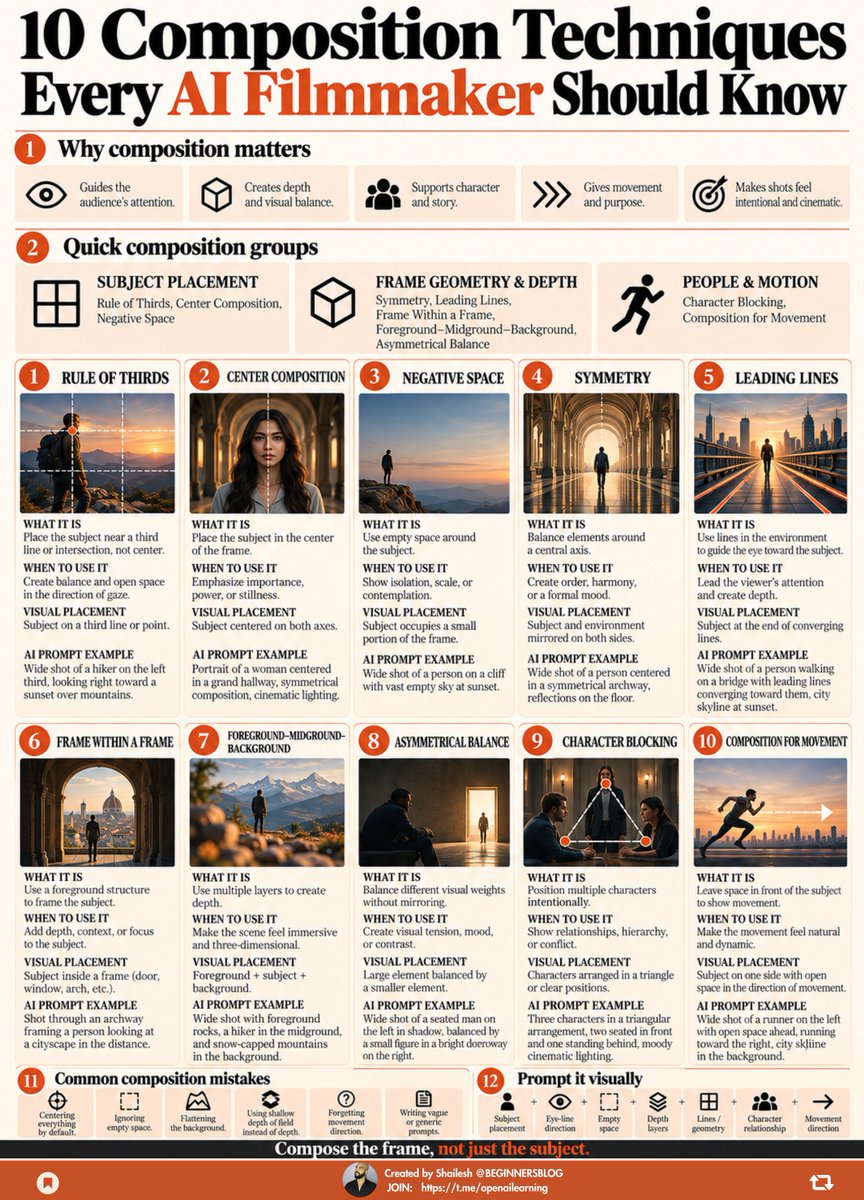
AI creator Beginnersblog (@beginnersblog1) pointed to composition as the fundamental reason why even technically high-fidelity AI-generated shots often look amateurish, sharing a practical composition prompting framework that replaces vague adjectives with concrete physical frame direction.
Image source: Beginnersblog / X
While creators routinely spend hours fine-tuning prompts, switching generative models, and chasing pixel-level texture details, shots that lack deliberate visual guidance and spatial layout frequently fail to engage the viewer. Rather than vaguely requesting a "beautiful frame," intentional directing relies on deliberately orchestrating viewer attention, narrative focus, and spatial depth.
1. Composition Is Intentional Visual Control, Not Decoration
Effective composition is not a superficial stylistic embellishment. It acts as an active spatial grammar that controls key visual parameters within the frame:
- Primary focal anchor: Determines where the viewer's eye lands first upon viewing the shot.
- Subject hierarchy: Establishes how significant, dominant, or vulnerable a subject feels.
- Spatial volume and margins: Regulates the balance of negative space surrounding key elements.
- Perceived depth: Controls whether the scene appears flat or possesses convincing dimensional layers.
- Character dynamics: Defines interpersonal relationships, psychological tension, and power balance.
- Action boundaries: Designates the designated screen area where movement, action, and camera motion can unfold.
The primary objective of cinematography in AI generation is not merely making every frame look pretty, but ensuring every visual element inside the frame is intentional.
2. Eight Core Composition Techniques for AI Creators
These eight foundational framing techniques provide actionable spatial anchors for image and video generation prompts:
-
Rule of Thirds
- Positions the key subject along one of the vertical or horizontal third lines rather than dead center.
- Ideal when contextualizing characters within their environment or providing ample look room and lead room for movement.
-
Center Composition
- Aligns the subject directly on the vertical center axis of the frame.
- Provides strong visual impact for pivotal character introductions, direct confrontations, formal hierarchy, or striking graphic simplicity.
-
Negative Space
- Leaves a significant portion of the frame deliberately unoccupied.
- Powerful for evoking isolation, immense architectural scale, emotional vulnerability, anticipation, or hinting at off-screen presence.
-
Leading Lines
- Employs roads, walls, railings, light beams, shadows, or architectural contours to guide the viewer's gaze toward the primary subject.
- Minimizes visual distraction while accentuating perspective depth.
-
Symmetry
- Balances visual elements evenly across a central axis.
- Enhances scenes requiring rigid order, clinical precision, strictly controlled architectural spaces, or intentional surrealism.
-
Frame Within a Frame
- Encloses the subject using foreground elements like doorways, windows, archways, mirrors, or structural silhouettes.
- Effective for establishing depth layers, voyeuristic observation, secrecy, or physical entrapment.
-
Foreground–Midground–Background
- Builds distinct, readable spatial planes rather than placing subjects against a flat backdrop.
- One of the most effective and reliable ways to give AI-generated scenes rich cinematic dimensionality.
-
Visual Balance
- Distributes visual weight across the frame without requiring strict geometric symmetry.
- For example, a large dark silhouette on one side of the frame can be visually counterbalanced by a small, bright window on the opposite side.
3. Why Prompting the Word "Composition" Fails
A common mistake among AI filmmakers is including generic, subjective descriptors in their prompts:
- Weak Prompt:
“Cinematic shot, beautiful composition.”
This generic phrasing gives diffusion and video models virtually no usable instruction regarding spatial layout or geometry. To achieve consistent results, prompts must describe the scene's physical layout:
- Improved Physical Prompt:
“Medium-wide shot of a lone man positioned on the left third of the frame, eyes near the upper-third line, large negative space extending in the direction of his gaze, blurred foreground architecture creating depth, distant city softly separated in the background.”
This structured prompt gives the model five distinct physical coordinates:
- Subject placement: Anchored specifically on the left third of the frame
- Eye-line positioning: Eyes resting near the upper third grid line
- Negative space volume: Open space extending toward the direction the character is facing
- Subject orientation: The clear directional heading of the subject's gaze
- Depth layering: Optical separation between the shallow blurred foreground and the atmospheric distant background
4. The 6-Step Physical Framing Blueprint
When constructing prompts for AI video and image models, describing spatial elements in the following sequence produces the most reliable cinematic results:
SUBJECT POSITION → EYE LINE → EMPTY SPACE → DEPTH LAYERS → LINES / GEOMETRY → GAZE OR MOVEMENT DIRECTION
- Subject Position: Precise framing coordinate (center, left/right third, wide/tight)
- Eye Line: Vertical baseline for the subject's gaze (upper third line, centered)
- Empty Space: Direction and proportion of deliberate negative space
- Depth Layers: Relative treatment and optical separation between foreground, midground, and background
- Lines / Geometry: Guiding architectural vectors, framing silhouettes, or symmetrical axes
- Gaze or Movement Direction: The vector of character attention and trajectory for subsequent motion
Moving away from subjective aesthetic demands ("make it cinematic") toward explicit spatial geometry is the defining shift for achieving professional-grade AI cinematography.
Original source
- Beginnersblog (@beginnersblog1) on X: https://x.com/beginnersblog1/status/2106299293443457135