10 GitHub Repositories to Maximize Claude Code and Codex Agent Productivity
A curated collection of 10 GitHub repositories to supercharge Claude Code and Codex workflows, covering spec-driven development, cross-model reviews, and MCP se
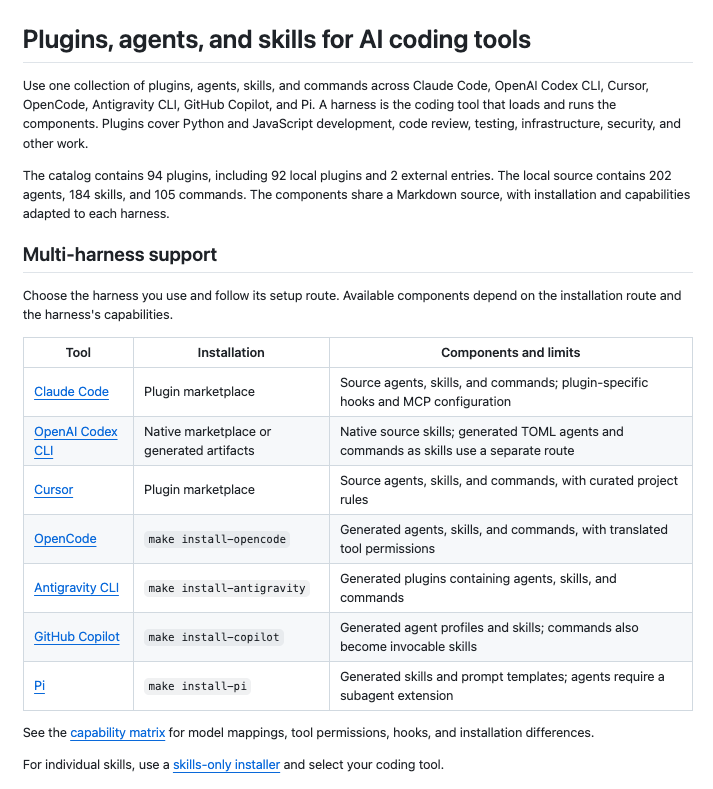
On October 5, 2026, AI automation creator Brendan Jowett (@jowettbrendan) shared a curated collection of 10 essential open-source GitHub repositories designed to maximize developer productivity with terminal-based AI coding agents such as Claude Code and OpenAI Codex. The collection targets developers transitioning from manual browser copy-pasting to structured, autonomous agent workflows directly in their local terminal environment.
Image source: @jowettbrendan on X
In contemporary software development, terminal-native AI agents like Claude Code and Codex have rapidly evolved beyond simple chat interfaces into full-fledged development copilots. However, providing agents with unstructured prompts often leads to drifting requirements, broken abstractions, and ungrounded code generation. To address these failure modes, Jowett highlighted 10 open-source repositories spanning Spec-Driven Development (SDD), multi-model cross-auditing, Model Context Protocol (MCP) tooling, and subagent orchestration.
Spec-Driven Engineering and Specialist Subagents (Repos 1–4)
Establishing strict architectural guardrails before code generation and distributing tasks across specialized agents are foundational steps for maintaining deterministic outputs.
-
GitHub Spec Kit (github/spec-kit)
- Core Function: GitHub's official toolkit for Spec-Driven Development (SDD), backed by over 130,000 GitHub stars (cited as 140K+ in Jowett's post).
- Practical Impact: Eliminates agent hallucination and guesswork by requiring developers to write an explicit, structured specification upfront. The agent analyzes the spec, generates an executable plan, breaks work down into discrete tasks, and systematically implements each stage. This process ensures the agent delivers precisely what was requested rather than wandering off-scope.
-
112 Specialist Agents and 146 Skills Marketplace (Open Link)
- Core Function: A unified open-source marketplace that installs 112 domain-specific subagents and 146 modular skills in a single setup pass.
- Practical Impact: Moves teams away from relying on a single generalist model for all engineering tasks. Dedicated agents take ownership of targeted domains—such as debugging, security, code review, and documentation—operating as an integrated virtual software department.
-
OpenAI Official Codex Plugin for Claude Code (Open Link)
- Core Function: An official plugin from OpenAI enabling developers to invoke Codex directly from within a Claude Code terminal session.
- Practical Impact: By entering
/codex:review, developers can trigger a second frontier coding model to audit the code produced by the primary model. Having two top-tier coding models evaluate and verify each other within a single command-line interface provides automated peer review at zero extra tool switching cost.
-
Canonical Catalog of 500+ MCP Servers (Open Link)
- Core Function: The definitive directory of verified Model Context Protocol (MCP) servers and tool integrations.
- Practical Impact: Indexes over 500 integrations spanning databases, web browsers, GitHub repositories, Slack channels, and filesystems. It transforms passive conversational models into active system operators capable of interacting directly with production infrastructure.
Automation Pipelines and End-to-End Guardrails (Repos 5–8)
Scaling development requires robust background task automation, natural language pipeline orchestration, and continuous state monitoring during extended refactoring sessions.
-
Self-Hosted Agent Automation Engine (Open Link)
- Core Function: An open-source, self-hosted workflow automation platform supporting native MCP and more than 400 integrations.
- Practical Impact: Allows developers to connect internal and external services into reactive workflows that Claude Code or Codex can trigger on demand. It provides a self-hosted, cost-effective alternative to commercial per-task subscription services like Zapier while giving autonomous agents direct control over pipeline execution.
-
Claude Code n8n Automation Builder (Open Link)
- Core Function: A specialized agent tool enabling Claude Code to programmatically design, configure, and deploy n8n automation pipelines.
- Practical Impact: Developers describe complex automation logic in plain English—such as "watch this inbox, summarize new emails, post them to Slack"—and the agent configures the necessary nodes and data mapping without requiring manual UI configuration.
-
Production-Ready Subagent Library (Open Link)
- Core Function: A repository of over 100 drop-in subagent configurations tailored specifically for Claude Code.
- Practical Impact: Covers specialized engineering domains including backend, frontend, DevOps, security, and more. Teams can copy and paste verified subagent definitions into their project configs to onboard expert virtual teammates instantly.
-
Automated Spec Lifecycle and Dashboard (Open Link)
- Core Function: An end-to-end framework that guides tasks through four deterministic phases: Requirements, Design, Tasks, and Implementation.
- Practical Impact: Includes an observability dashboard to track development progress in real time. It introduces strict guardrails that prevent agents from quietly drifting away from core architectural requirements during long-running implementation tasks.
Official Skill References and the Ecosystem Toolbox (Repos 9–10)
Foundational reference patterns developed by model creators alongside expansive directories that map the complete tooling ecosystem.
-
Anthropic Official Claude Code Skills Library (Open Link)
- Core Function: The canonical skills repository maintained directly by Anthropic's engineering team.
- Practical Impact: Serves as the benchmark implementation for document handling, web application testing, and core patterns. It provides the reference standard against which all third-party community skills are evaluated.
-
The Claude Code All-in-One Toolbox (Open Link)
- Core Function: A massive ecosystem directory bundling 135 agents, 42 commands, 176+ plugins, 20 lifecycle hooks, and 14 pre-configured MCP setups.
- Practical Impact: Acts as a comprehensive map of the Claude Code landscape. Developers exploring terminal automation can inspect verified implementations across plugins and hook triggers to discover what the agent runtime is capable of handling.
By integrating Spec-Driven Development, multi-model verification, and modular MCP plugins, developers can elevate their terminal-based coding agents into reliable, production-ready engineering partners.
Original source
- Brendan Jowett on X: https://x.com/jowettbrendan/status/2107027031561224263
- GitHub Spec Kit Repository: https://github.com/github/spec-kit
- Brendan Jowett Free AI Community: https://www.skool.com/brendan
- Brendan Automation on YouTube: https://www.youtube.com/@brendanautomation