Xyntetik-Kvist-14B: a 14B tool-calling model distilled to half of its Muse-Glimmer-30B parent
Xyntetik-Kvist-14B, a 14B-class text-generation model for agentic workflows and tool calling, is now public. This article covers its width-pruned 14.4B dense st
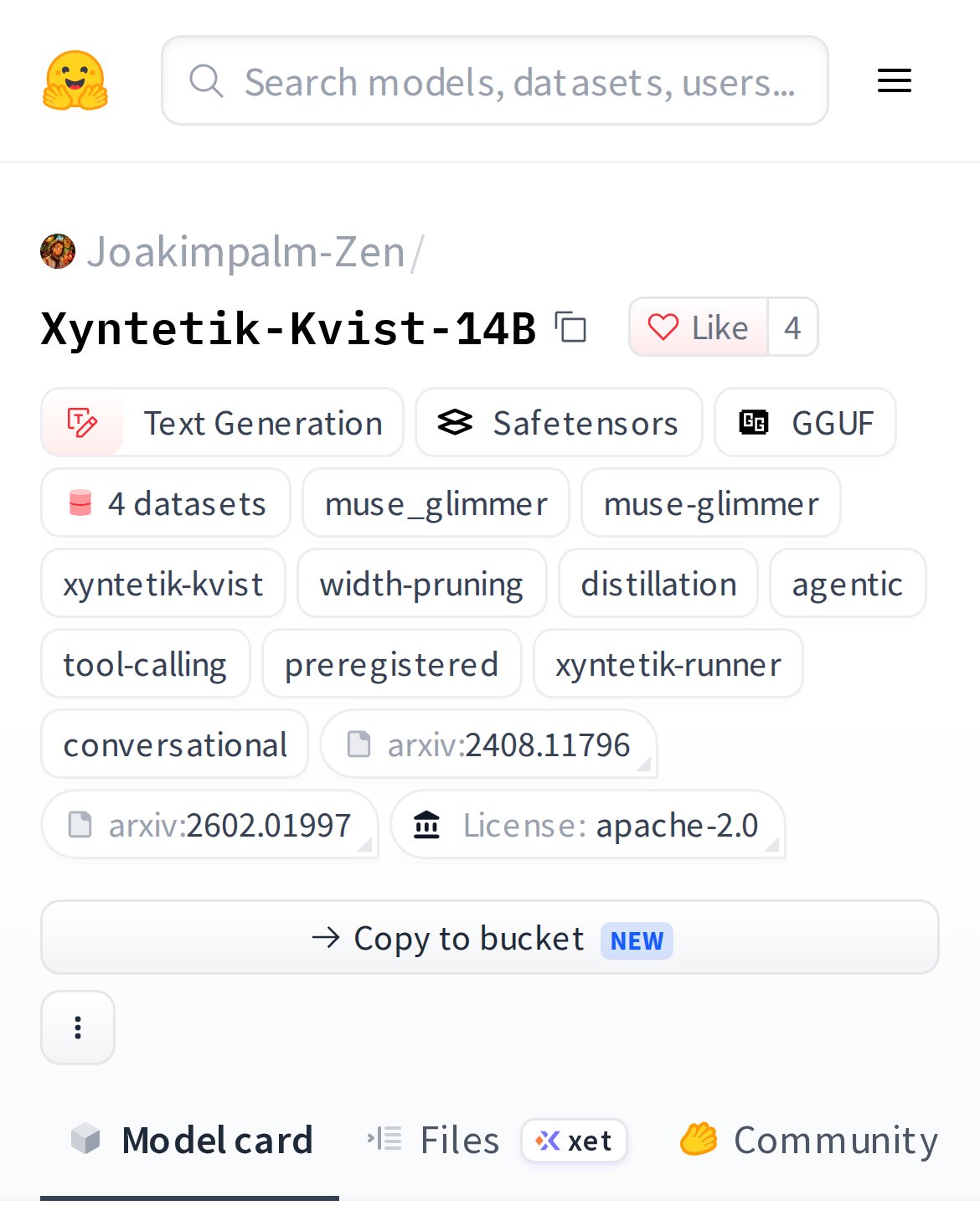
On October 7, 2026, Xyntetik-Kvist-14B, a 14B-class text-generation model for agentic workflows and tool calling, was introduced through an X thread from the Hugging Models account. The weights are published on Hugging Face.
Image source: @HuggingModels X 게시물 첨부 이미지
The notable part of this release is not only the size but the documented construction method. The thread describes a combination of width pruning and distillation aimed at keeping the model lean while handling real tasks. The builds ship as safetensors and GGUF, and the thread confirms both local and cloud execution.
14.4B dense student design and training budget
The training record and release notes agree on the lineage: a 30B-class parent model was width-pruned down to a dense 14.4B student that keeps all 52 layers, then distilled back from its frozen parent.
- Scale: the training-record dataset and release notes consistently describe an approximately 14.4B dense student.
- Budget: 6,000 distillation steps (98.3M tokens, 162 hours) plus 1,440 steps on agentic trajectories.
- Method: multiple sources agree that distillation only was used, with no RL anywhere.
- Policy teacher: Ornith-1.0-9B is named as the tool-policy teacher.
One qualifier matters: the Muse-Glimmer-30B parentage appears in the X thread only as an inference from the muse_glimmer tag. Until the model card itself is confirmed, treat the parent identity as tag-suggested, not settled.
Study-limited 57-of-60 result and what it means
The key practical figure, repeated across xyntetik.com, Hugging Peers, and MindPattern summaries, is study-limited: the student solved 57 of the 60 held-out closed-loop tool tasks that its parent solves.
What the number covers and where it stops:
- Task set: 57 of 60 held-out closed-loop tool tasks covering contacts, weather, flights, currency, dates, units, and stocks.
- Environment-limited: the result holds for the study's environment and Runner's
musewire format only; it should not be read as general-purpose performance. - Not a general replacement: the Hugging Peers summary explicitly says this is not a drop-in replacement for the parent or other general models, citing KLD 0.762 against its own parent on held-out text.
- Practical setup: summaries describe it as a research student for tool-calling agent loops, fitting a 24 GB card at Q8_0 (about 15.4 GB). Reasoning loops were reported in 7 of 160 runs, so pairing it with helper tools such as a calculator is recommended.
The 1,036-download figure cited in the X thread is a snapshot from the October 7, 2026 posting time and will change over time. Readers evaluating the model should read the training-record dataset and evidence pages alongside the weights.
Sources
- Hugging Face model page: Joakimpalm-Zen/Xyntetik-Kvist-14B
- Hugging Models X thread (2026-10-07): Introducing Xyntetik-Kvist-14B
- Training record dataset: Xyntetik-Kvist-14B-training-record
- Xyntetik official page: Xyntetik Runner
- Hugging Peers model summary: Xyntetik-Kvist-14B-GGUF