VoiceStudio: Open-Source Local Voice AI Studio and ElevenLabs Alternative (646 Languages, 16 TTS Engines)
An overview of VoiceStudio, an open-source desktop voice AI suite that bundles 16 TTS engines and 646 languages for local voice cloning, video dubbing, and dict
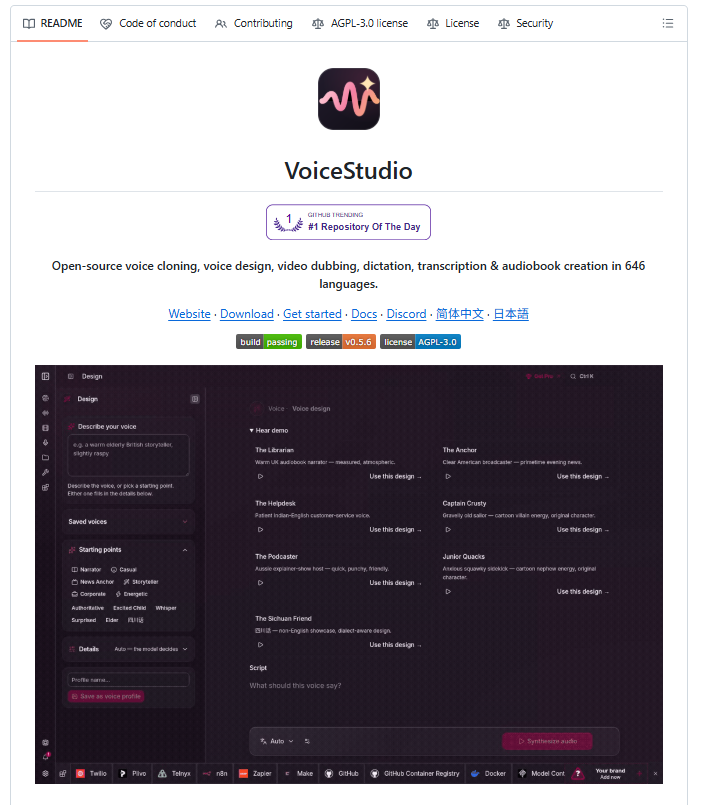
VoiceStudio (formerly OmniVoice-Studio), an open-source desktop voice AI workstation designed to run speech synthesis and recognition workflows entirely on local hardware, is gaining rapid traction across developer and creator communities. Released by developer debpalash under the AGPL-3.0 license, VoiceStudio serves as a privacy-centric, local-first alternative to commercial cloud speech platforms like ElevenLabs. By unifying a catalogue of 646 languages, 16 text-to-speech (TTS) engines, and 11 automatic speech recognition (ASR) engines behind a single desktop application, it delivers zero-shot voice cloning, automated video dubbing, and real-time dictation without external cloud calls or per-character billing meters.
Image source: @josesilesdata / GitHub debpalash/VoiceStudio
While proprietary commercial platforms typically restrict their voice catalogues to several dozen languages and enforce monthly recurring subscriptions with metered character caps, VoiceStudio guarantees that no audio data ever leaves the user's personal workstation. From zero-shot voice cloning to long-form audiobook rendering and time-synchronized multilingual video dubbing, the tool provides an end-to-end studio environment accessible across macOS, Windows, and Linux.
Unified Local Voice Workbench: 16 TTS Engines, 11 ASR Engines, and 646 Languages
The technical core of VoiceStudio lies in its integration of disparate open-source speech models and runtimes into a unified, user-friendly desktop interface.
- 16 TTS and 11 ASR Engines: Instead of locking creators into a single synthesis model, VoiceStudio allows users to switch dynamically between various TTS and ASR backends based on workload demands, latency targets, and available local hardware.
- 646-Language Catalogue: Going far beyond the roughly 30 languages supported by major commercial providers, VoiceStudio integrates extensive multilingual model weights covering diverse global languages, regional dialects, and accents.
- Strict Local Privacy and Zero Usage Fees: Everything executes on device. There are no account registrations, external API keys, or cloud dependencies, ensuring that sensitive personal voice clips and generated recordings remain strictly private.
- Native Cross-Platform Packaging: VoiceStudio provides standalone desktop builds for macOS, Windows, and Linux, enabling cross-platform parity for creators and engineers alike.
From Zero-Shot Cloning to Timed Dubbing and Audiobooks: Core Workflows
Rather than functioning merely as a basic text-to-speech reader, VoiceStudio covers five production-ready workflows built for real-world content creation:
- Zero-Shot Voice Cloning: With a clean reference audio clip of just 3 to 15 seconds, the application extracts the target speaker's vocal timbre, cadence, and prosody without requiring additional model training.
- Parametric Voice Design: Creators can generate completely original synthetic voices from scratch by configuring descriptive voice attributes, including age, accent, pitch, tone, and expressive delivery style.
- Time-Aligned Video Dubbing: A multi-stage pipeline transcribes video speech via local ASR, translates the content, synthesizes the target language while retaining the original speaker's identity, and exports the final synchronized video file.
- Global Hotkey Dictation and Transcription: Featuring a lightweight floating widget and system-wide hotkeys, VoiceStudio transcribes live microphone input directly into any desktop application, with optional post-processing by local LLMs for punctuation, grammar, and style cleanup.
- Multi-Speaker Audiobooks and Batch Pipelines: Designed for long-form publishing, VoiceStudio parses structured scripts, assigns distinct voice personas to different characters, processes multi-chapter texts (including EPUB and PDF sources), and packages outputs into standard
.m4baudiobook files with batch queue support.
Local REST API, MCP Agent Endpoints, and Commercial Licensing Caveats
For developers building automation pipelines, VoiceStudio exposes programmatic interfaces directly on the local machine.
Launching the application spins up an OpenAI-compatible audio REST API on localhost:3900, allowing developers to drop local VoiceStudio endpoints into existing scripts or tools configured for standard OpenAI audio endpoints. Furthermore, VoiceStudio provides a native Model Context Protocol (MCP) server endpoint, enabling AI coding agents such as Claude Code to invoke local voice cloning, transcription, and speech synthesis as structured tools within agentic execution loops.
Teams planning commercial deployments, however, should note specific licensing boundaries and hardware considerations:
- Model Weight Licensing: While the VoiceStudio application code is licensed under AGPL-3.0 and the underlying default
k2-fsa/OmniVoiceengine code is Apache-2.0, the default OmniVoice model weights carry a non-commercial CC-BY-NC license. Production teams producing commercial content or monetization-focused products must switch to alternative engines within the catalog that explicitly permit commercial use. - Active Beta Stage: VoiceStudio is currently in an active beta cycle with rapid feature iteration. Operating high-fidelity multilingual models locally requires adequate GPU VRAM, and specific operating system environments may require manual dependency installation during setup.
Sources
- GitHub Repository: debpalash/VoiceStudio
- José Siles (@josesilesdata) on X: October 5, 2026 Announcement
- SoloSoft Technical Audit: VoiceStudio Architecture and License Audit