Anthropic Launches Private Beta for Self-Hosted Claude Managed Agents Across Cloud and On-Premises
Anthropic has announced a private beta for Self-hosted Claude Managed Agents, enabling enterprises to operate the agent harness, sandboxes, and session history
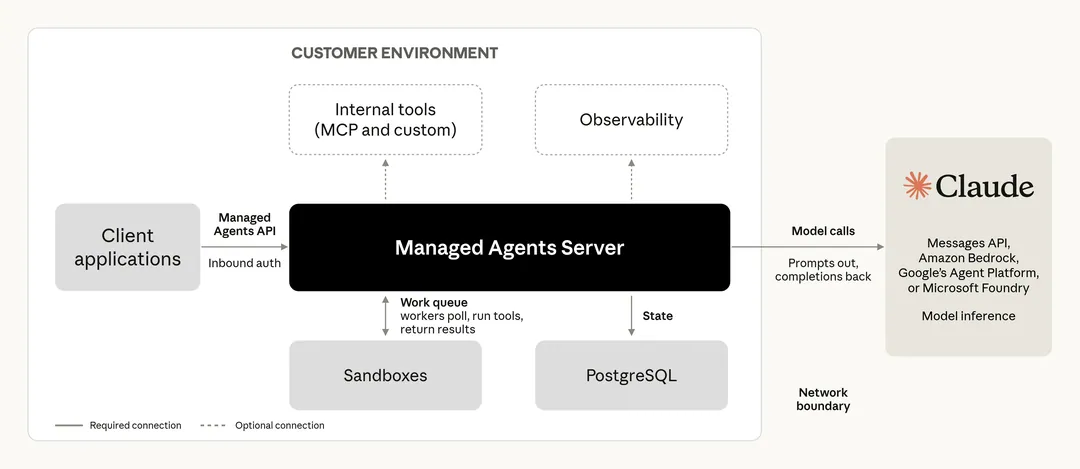
On November 12, 2026, Anthropic announced the private beta release of Self-hosted Claude Managed Agents, allowing engineering organizations to deploy and operate the entire autonomous agent control plane inside their own private cloud or on-premises data centers rather than relying on Anthropic-hosted infrastructure.
Image source: https://x.com/ClaudeDevs/status/2120938988165091693
Anthropic originally introduced Managed Agents as a turnkey cloud offering where Anthropic managed the underlying compute, sandboxes, and agent loops. While this eliminated operational overhead, organizations subject to strict data sovereignty rules, internal compliance mandates, or air-gapped network policies faced barriers when granting autonomous agents direct access to private code repositories and internal production tooling. The self-hosted release resolves this friction by moving the entire control plane and runtime directly inside the enterprise perimeter.
Autonomous Workflows Require Infrastructure-Level Control
Unlike interactive chatbots that await human prompts on every turn, long-running autonomous agents execute multi-step workflows independently. In practical engineering workflows, agents fix broken build pipelines, triage incoming production alerts, test release candidates, and process issue backlogs without constant oversight. These responsibilities require unattended shell commands, workspace file manipulation, and direct connectivity to internal databases and proprietary source trees.
Anthropic previously addressed early corporate isolation requirements by introducing self-hosted sandboxes, which allowed user code execution to occur locally while Anthropic managed orchestration. However, as autonomous agents assumed broader operational responsibilities across internal services, organizations required complete custody over the entire control plane. Until now, engineering teams had to build custom agent orchestration harnesses from scratch if they refused to run their agent state on third-party clouds.
Self-hosted Claude Managed Agents provides enterprise teams with the complete operational stack: the agent harness, isolated sandboxes, credential management layers, and session event databases. Developers continue to build agents using the same core APIs provided by the hosted version of Managed Agents. Crucially, all session transcripts, step logs, and internal payloads remain stored inside the organization's self-operated databases rather than external storage.
Four Architectural Pillars for Unattended Agent Security
When autonomous software agents run unattended on production codebases, safety cannot rely on manual approvals for individual tool calls. Instead, safeguards must be built directly into the system topology. Anthropic organized the platform around four core security principles:
- Decoupled Brain and Hands Architecture: The agent harness (the brain) coordinates logical planning and dispatches model calls to Claude, while the sandboxes (the hands) execute shell tools and file modifications. The two components remain strictly isolated. Session transcripts, state loops, and vault secrets reside outside the sandbox environment. Sandboxes spin up on demand only when a tool call is executed, ensuring that sandbox termination does not corrupt the parent agent session.
- Externalized Credential Handling: Authentication tokens and API keys are never exposed as plain-text environment variables or files inside the sandbox. A proxy service residing outside the execution boundary intercepts outgoing Model Context Protocol (MCP) tool requests and injects required authorization headers. Teams can also integrate their existing enterprise secrets management systems directly into this layer.
- Granular Network Segmentation: Administrators can restrict the sandbox network perimeter to explicit host allowlists while terminating all arbitrary egress connections. For example, a continuous integration repair agent can be limited strictly to an internal Git server and private artifact registry.
- OpenTelemetry Export for Full Auditing: Managed Agents logs every execution step, including tool invocations, parameters, and return payloads. The audit record streams via the OpenTelemetry standard, allowing site reliability teams to route telemetry directly to existing enterprise observability platforms alongside general server metrics.
Model Gateway Flexibility and Operational Responsibilities
A notable design advantage in Self-hosted Claude Managed Agents is flexible model routing. While the agent harness, sandboxes, and session databases run on customer infrastructure, organizations maintain full choice over where model inference requests are routed. Outgoing calls can be directed to the Anthropic Messages API, enterprise hyperscaler endpoints such as Amazon Bedrock, Google Cloud Agent Platform, or Microsoft Foundry, or through internal enterprise model gateways. Existing Zero Data Retention (ZDR) agreements with Anthropic apply to these requests identically to standard API traffic.
However, self-hosting transfers underlying infrastructure responsibilities to the customer. Platform engineering teams must provision, monitor, and maintain the Managed Agents control server, persistent database nodes, and the worker clusters running sandboxed containers and file tools. The private beta is currently restricted to eligible enterprise customers, with access granted through Anthropic account representatives.
Sources
- Anthropic Resource Article: Self-hosted Claude Managed Agents
- Anthropic ClaudeDevs Official Announcement: X @ClaudeDevs Post 2026-11-13