vLLM-Omni Technical Report Released: A Unified Runtime for Omni-Modality Serving
The vLLM team announced the vLLM-Omni technical report and shared its official repository link. This developer briefing covers the orchestrator and stage-engine
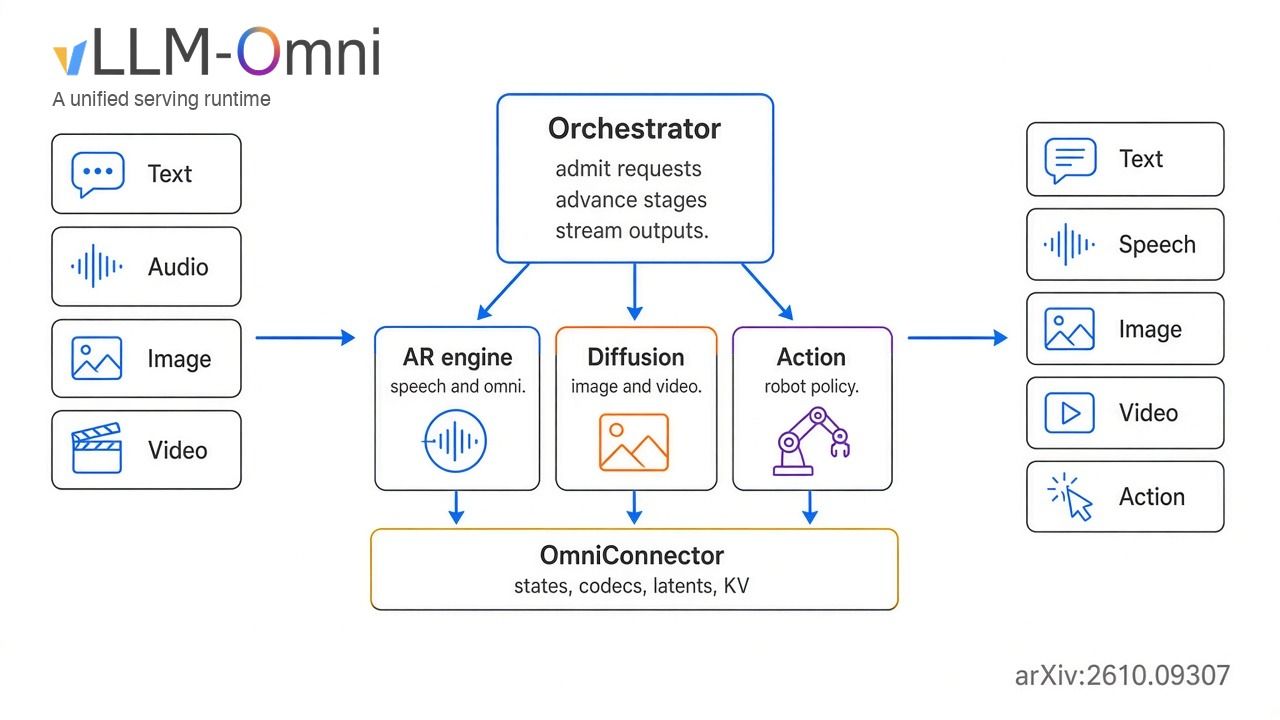
The official vLLM account (@vllm_project) announced the vLLM-Omni technical report in an X post on October 8, 2026. vLLM-Omni is a unified serving runtime for omni-modality generation that goes beyond a single text decode loop.
Image source: @vllm_project X post
The core idea is separation of concerns in serving. An orchestrator advances each request across stages and owns the overall flow, while specialized engines run the compute. According to the announcement, the goal is one shared control plane for workloads whose execution patterns diverge with the output: speech assistants, visual generation, world models, and robot loops.
What was confirmed: technical report announcement and official repository link
The confirmed items are the technical report announcement (arXiv 2602.02204) and the shared official repository link (github.com/vllm-project/vllm-omni). The paper abstract describes fully disaggregated serving for any-to-any multimodal models that jointly handle text, images, video, and audio. The bundled evidence does not establish that the repository itself was newly created at this time, so this article covers only the link-sharing fact.
The architecture documentation states the supported scope explicitly: non-text outputs including images, audio, and video, plus non-autoregressive structures such as Diffusion Transformers (DiT). The design targets the deployment pain where LLM servers and diffusion stacks each optimize for only one execution paradigm, forcing operators to stitch disjoint runtimes together.
This matters to developers who run multimodal inference servers themselves and must manually handle cross-stage interactions. It is relevant only when text, speech, and image/video outputs must be served in a single pipeline.
Orchestrator and stage-engine architecture
The repository code and design documents confirm the following structure.
- Orchestrator: runs in a background thread and owns the stage-engine clients, input/output processors, and stage-to-stage transfer logic. It advances requests stage by stage, whether the pattern is a multi-stage autoregressive pipeline, iterative diffusion, or a state-carrying session.
- Specialized stage engines: run the actual compute for each stage. Model paths, batching, attention, parallelism, and quantization policies are mapped to stage-local execution policies.
In the design document's terms, vLLM-Omni extends the text-oriented autoregressive runtime of vLLM with stage-based execution for non-textual outputs and non-autoregressive components. Maintaining compatibility with the vLLM core is part of the stated design goals.
Caveats for readers checking this now
Nothing beyond the verified scope is included here. The confirmed material contains no install commands or benchmark figures, so they are not covered in this article. Before adopting it, check the official repository README and design documents directly.
The dates should also be kept distinct. The X post date is October 8, 2026 (KST), which is separate from the publication timeline of the paper identifier arXiv 2602.02204 itself. Do not confuse the report announcement with the paper's original release date.
Sources
- vLLM on X (@vllm_project): vLLM-Omni technical report announcement
- Official repository: vllm-project/vllm-omni
- Architecture overview: docs/design/architecture_overview.md
- Technical report: arXiv 2602.02204 (PDF)