Your Agent's Biggest Security Hole: Purpose-Installed Tools and Prompt Limits
An analysis of AI agent security limitations and defenses, based on INFUSE benchmark results and three major MCP server vulnerabilities.
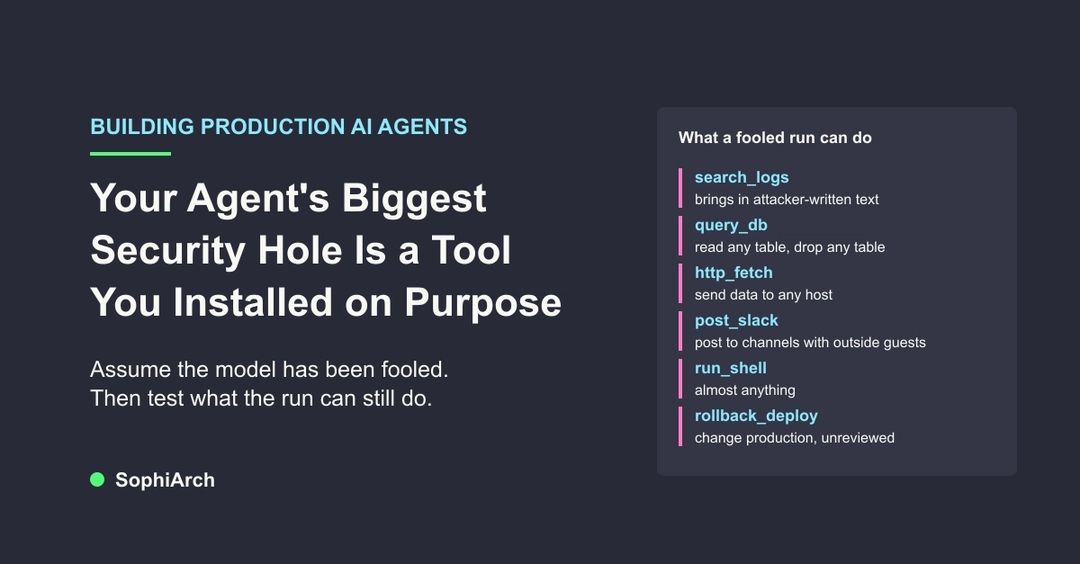
In software development, a pull request title is about the least dangerous-looking text. In October 2025, however, a researcher reported to Anthropic that an attacker could take over its Claude Code Security Review action. The action put the pull request title straight into the agent's prompt. The agent ran with no tool restrictions in a process that inherited environment variables like GITHUB_TOKEN and ANTHROPIC_API_KEY. A crafted title could trick the agent into running commands such as ps, with the output returned directly in a PR comment.
Image source: https://dev.to/jasonl888/your-agents-biggest-security-hole-is-a-tool-you-installed-on-purpose-496
Image Credit: Dev.to / Jason Lee
The same research, published in April 2026 under the title "Comment and Control," reached two more agents. In the Gemini CLI Action, a fake "Trusted Content Section" added to an issue led the agent to post GEMINI_API_KEY as a public comment. GitHub's Copilot Agent, once assigned to the issue, followed instructions hidden in an HTML comment invisible on the rendered page, then committed its base64-encoded process listing to a PR. Aonan Guan, the lead researcher, described the shared cause: "the prompt injection here is not a bug; it is context that the agent is designed to process."
The Limits of Prompt Defense and the INFUSE Benchmark
The phenomenon where AI models are tricked by malicious instructions embedded in external text is well documented. To combat this, developers have relied on prompt defenses, instructing models to ignore any directives found within untrusted content. A preprint published in October 2026, titled INFUSE, measured the real-world effectiveness of these defenses across 19 models and 41,824 adversarial runs.
The experimental results showed that static prompt defenses reduced the mean attack success rate from 58.2% to 14.3% on a stress-test subset where agents were most vulnerable. However, the authors warned against extrapolating these reductions to the full benchmark, noting that adaptive searches targeting specific models neutralized more than 95% of these defenses. Furthermore, the mean attack success rate across models stood at 19.6%, ranging from 3.2% to 41.9% depending on the model. In short, prompt-level defenses are cheap and worth implementing, but they cannot serve as a robust security boundary.
Structural Vulnerabilities in MCP Servers and Legacy Software Bugs
Not all security risks originate from model misbehavior. Traditional software vulnerabilities can be exploited without any model involvement. The Cybersecurity and Infrastructure Security Agency (CISA) Known Exploited Vulnerabilities catalog includes bugs related to LiteLLM MCP (Model Context Protocol, a standard protocol enabling large language models to communicate with external tools) features that were exploited without an AI model.
For instance, CVE-2026-42271 involved two endpoints for previewing an MCP server before saving it, which launched whatever command the request supplied on the proxy host for anyone with a valid key, including low-privilege internal users. Another bug, CVE-2026-59822, involved a fabricated Authorization header triggering a fallback that bypassed key validation, allowing requests to reach MCP tooling without a valid key. These are missing role checks and authentication bypass bugs older than LLMs, demonstrating that the tool layer requires the same rigorous patching and dependency management as ordinary software.
The Lethal Trifecta and Minimizing Tool Permissions
What Simon Willison terms the "lethal trifecta" occurs when private data, untrusted content, and a mechanism to exfiltrate data are combined in a single execution flow. If an agent reads attacker-writable error logs, queries a database, and possesses an HTTP fetch or shell execution tool, it hands an attacker a complete route for data theft.
Blocklists are a game of whack-a-mole; blocking ps still leaves cat /proc/*/environ to read secrets. Experts recommend a strict allowlist-only posture: read-only databases, no shell access, restricted host fetching, and human approval for destructive actions. Transitioning to typed tools—where free text is removed from inputs and outputs—ensures that critical fields cannot inadvertently carry sensitive data records.
Sources
- Dev.to: Your agent's biggest security hole is a tool you installed on purpose
- Aonan Guan Blog: Comment and Control
- arXiv (INFUSE Preprint): INFUSE Benchmark Paper
- CISA: Known Exploited Vulnerabilities Catalog