Open-Source 'UHP' Protocol and HarnessRouter Launched for Agent Infrastructure
Following MCP and A2A, the open-source Unified Harness Protocol (UHP) and its reference server implementation HarnessRouter have been unveiled to standardize ro
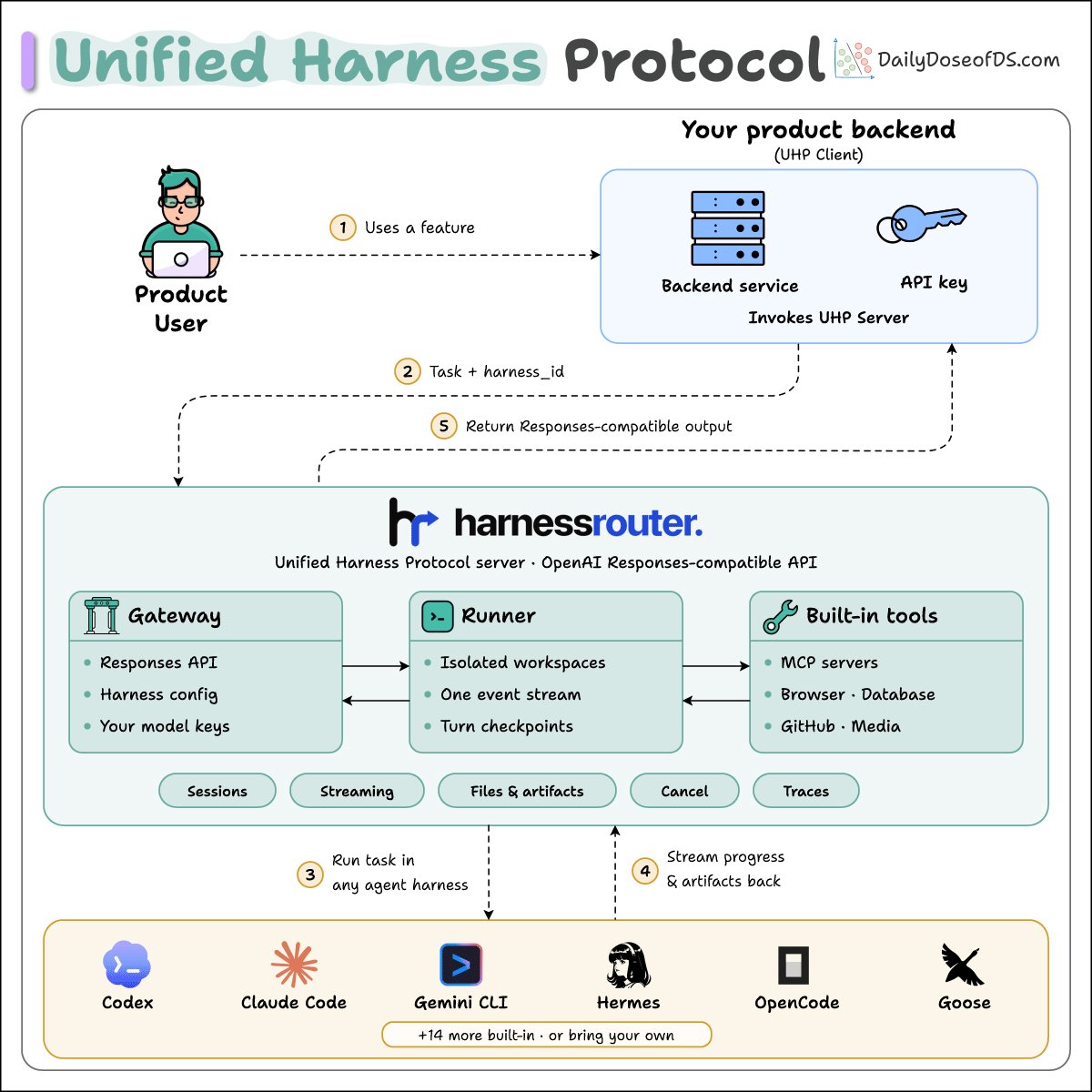
On October 16, 2026, a new open-source protocol titled the Unified Harness Protocol (UHP) and its reference server implementation, HarnessRouter, were officially released to establish an interoperable routing and execution layer across diverse AI agent harnesses.
Image source: @_avichawla via X
While protocols like Model Context Protocol (MCP), Agent-to-Agent communication (A2A), and Agent-GUI interfaces (AG-UI) have addressed tool connectivity and presentation, agent execution environments (harnesses) have remained largely fragmented. Disparate approaches to session management, file operations, event streaming, and state checkpointing have historically locked teams into specific harness architectures. UHP introduces a vendor-neutral contract that allows product backends to swap and route tasks between heterogeneous harnesses, such as Codex and Claude Code, without altering core application code.
The UHP Standard and the Three Core Pillars of HarnessRouter
Under UHP, a client backend sends a task payload and a target identifier (harness_id) to a centralized router. The router delegates execution to the configured harness runtime and captures the resulting artifacts, state changes, and progress updates through a unified stream.
HarnessRouter, the open-source server implementation accompanying the standard, is built around three core architectural components:
- Gateway: Serves the unified Responses API, coordinates harness connection profiles, and securely stores provider model API keys.
- Runner: Provisions isolated workspace environments for each harness execution, manages a standardized real-time event stream, and maintains granular per-turn checkpoints to trace and preserve execution state.
- Built-in Tools: Delivers out-of-the-box interfaces for common agent capabilities, including native MCP server connections, headless browser automation, database connectivity, GitHub repository interactions, and media pipelines.
By centralizing these primitives, development teams avoid authoring brittle glue code to accommodate syntax and lifecycle variations across different agent environments.
Harness Portability, Controlled Benchmarks, and Ecosystem Adoption
A major operational benefit of UHP is converting agent harness selection from an infrastructure migration hurdle into a dynamic routing configuration. Teams can swap execution from Codex to Claude Code without modifying downstream services, or dispatch identical task specifications across multiple harnesses simultaneously to evaluate output quality and token efficiency.
In initial controlled benchmark tests reported by the project maintainers, swapping only the underlying harness while holding the foundation model constant yielded cost reductions of up to 2.1x. The more optimized harness setup consumed approximately 53% fewer credits for equivalent tasks.
On the industry adoption front, Alibaba Cloud's AI coding agent Qoder has officially integrated UHP support. Developers can now target Qoder as an execution backend directly through the standard HarnessRouter API without custom integration bridges.
Current Integration Boundaries and Permission Model Constraints
Despite the enhanced portability offered by UHP, engineering teams must weigh several structural boundaries during evaluation:
- Harness-Specific Permission Models: While UHP standardizes task lifecycles, event streaming, sessions, and artifact retention, low-level sandboxing rules, file system isolation, and tool execution confirmations remain governed by each harness's proprietary security model.
- Intermediary vs. Native Implementation: Leading commercial harnesses such as Claude Code and Codex have not embedded UHP natively into their internal binaries. At present, interoperability relies on HarnessRouter acting as an intermediary server layer wrapping each harness CLI or API.
- Controlled vs. Production Benchmarks: The reported 2.1x cost efficiency and 53% credit reduction reflect controlled test scenarios. Net savings in production will vary depending on task complexity, multi-turn tool interaction depth, and retry frequency.
Sources
- Avi Chawla on X (@_avichawla): October 16, 2026 Announcement of UHP and HarnessRouter