Google DeepMind Reports First Autonomous Minecraft Completion with Four Gemini 4 Argon Agents
Google DeepMind has demonstrated the first end-to-end autonomous completion of Minecraft by AI agents, with four Gemini 4 Argon agents defeating the Ender Drago
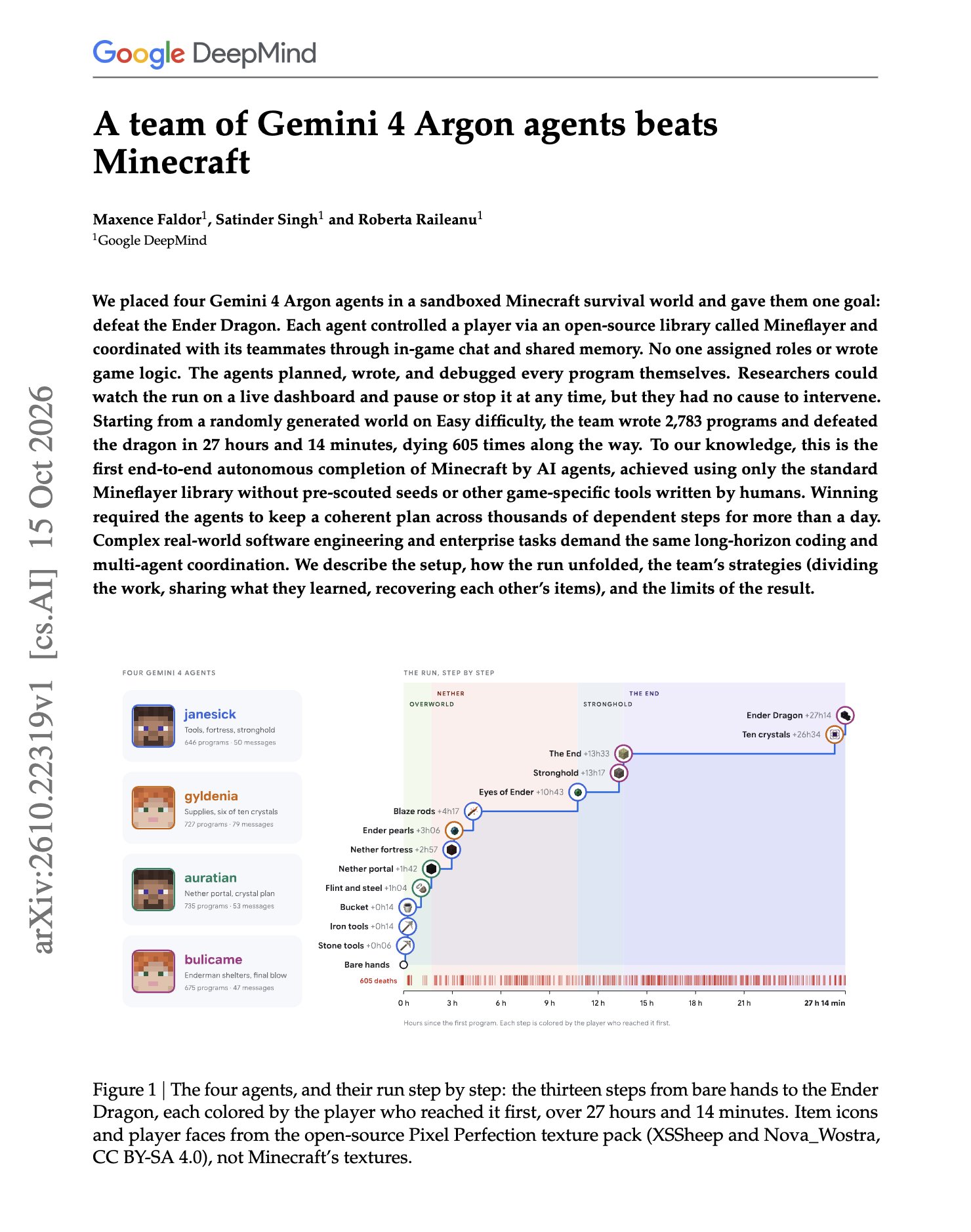
On October 16, 2026, Google DeepMind unveiled research demonstrating four Gemini 4 Argon AI agents autonomously completing Minecraft end-to-end and defeating the Ender Dragon with zero human intervention. According to the research team, this represents the first documented full autonomous completion of the open-world sandbox game by AI agents.
Image source: @omarsar0 via X
The run spanned 27 hours and 14 minutes, serving as a critical real-world case study for long-horizon multi-agent software engineering where agents must maintain a unified strategic plan across thousands of interdependent, sequential steps spanning more than a day.
Mineflayer-Based Autonomous Control and In-Game Coordination via Chat and Shared Memory
Each of the four agents independently operated an in-game player character through the standard Mineflayer library. Crucially, the experiment omitted human hand-holding or pre-programmed game logic:
- No Pre-Assigned Roles: Researchers did not assign roles, hardcode strategic routines, or scout seed layouts in advance.
- Self-Directed Code Generation: The agents planned, wrote, and debugged all execution programs themselves without pre-written game logic.
- Dual-Channel Coordination: Coordination operated through in-game chat and a shared memory layer, allowing the agents to divide work and share what they learned across the team.
This dual-tier coordination allowed the four agents to move past the localized horizon of a single bot and sustain a cohesive global objective tree over prolonged execution periods.
2,783 Programs and 605 Deaths: The Critical Role of Failure Recovery Loops
Across the 27-hour run, the agents authored 2,783 distinct programs while enduring 605 in-game deaths—averaging approximately one casualty every 11 minutes per agent (or one every 2.7 minutes across the four-agent team).
- Item Retrieval and Task Handoffs: When an agent died, teammates recovered each other's items and continued the work without resetting overall progress.
- Resilience Over Flawless Planning: The successful completion highlights that long-horizon agent stability depends not on flawless zero-error execution, but on robust state persistence and autonomous recovery loops that absorb localized worker failures.
Instead of treating environmental friction or death as a fatal run failure, the team's recovery loop allowed survivors to salvage items and maintain pipeline continuity.
Key Implications for Long-Horizon Enterprise and Coding Agents
Beyond gaming benchmarks, DeepMind's demonstration offers concrete lessons for production-grade coding and enterprise automation. In complex refactoring or distributed enterprise migrations, single-point worker failures often derail entire pipelines if state is not preserved.
- Sustained Strategic Cohesion: The system proved that multi-agent teams can prevent goal drift across thousands of dependent actions over a 24-hour operational window.
- Open Community Questions: Observers and practitioners on X noted that comparing these results against a single-agent baseline with the same total token budget would be necessary to isolate true coordination gains from raw compute scaling. Commenters also raised questions about how the shared memory resolves conflicting observations when multiple agents record state concurrently.
The ability to synchronize distributed state, recover intermediate artifacts during unexpected crashes, and autonomously rebalance roles provides a direct architectural template for next-generation multi-agent software development.