10 Practical Experiment Checklists to Put the TypeSafe Jev API to Work
From desktop accessibility tree control and high-frequency market making to knowledge graph traversal and coding agent completion judging (Canny): 10 practical
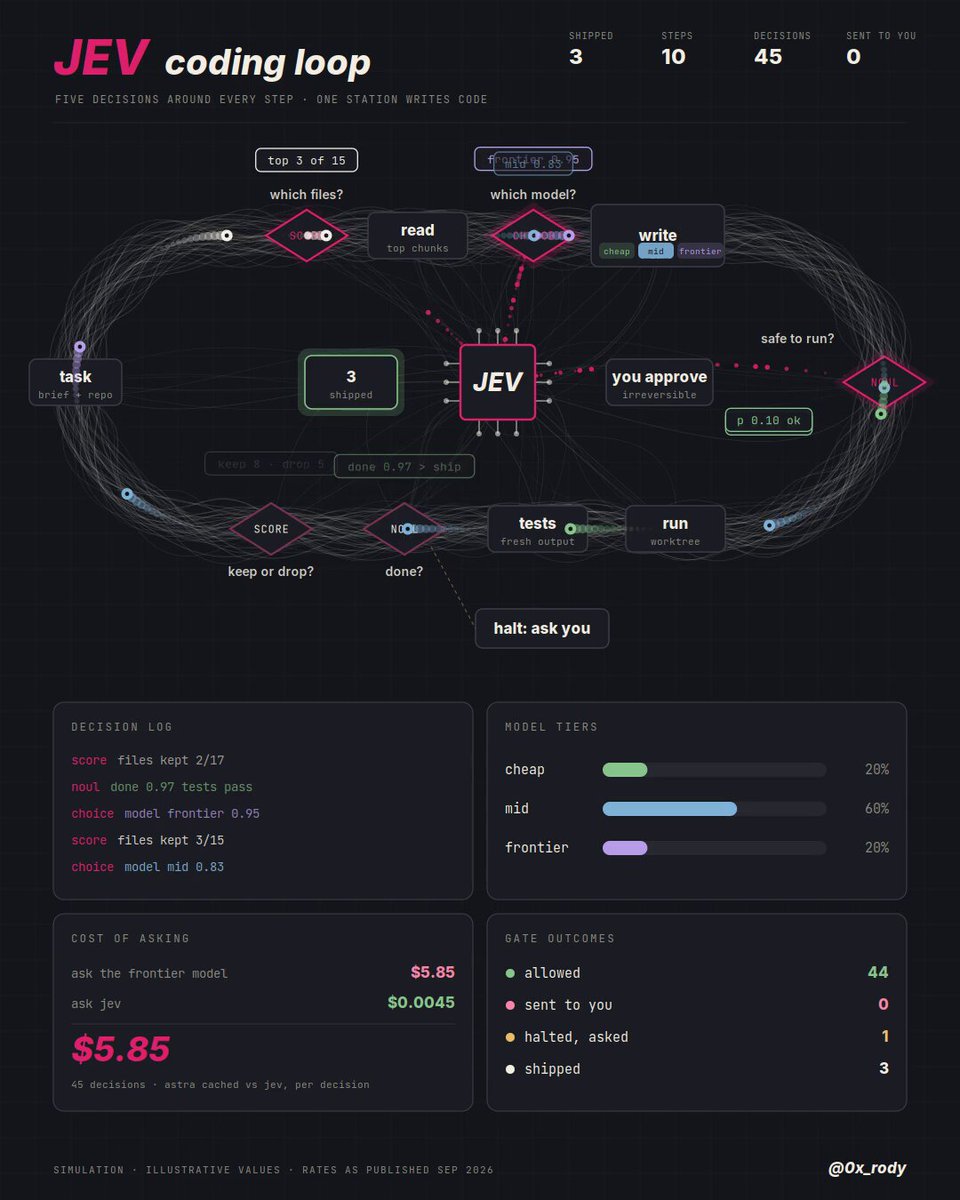
With TypeSafe's ultra-lightweight, high-speed decision model Jev (System One) gaining rapid traction across the AI engineering ecosystem, builder and AI engineer @0x_rody shared a 10-item practical experiment checklist designed for developers with API access looking to prototype immediately.
Image source: @0x_rody / X
Unlike traditional large language models (LLMs) that spend seconds generating extensive natural language responses at high token cost and latency, Jev delegates environment observation and actuation back to host code. The model focuses solely on rendering structured micro-decisions in milliseconds. This 10-project checklist spans desktop operating system control, high-frequency cryptocurrency market making, autonomous drone piloting, and stopping false completions in autonomous coding agents.
System Control and Real-Time Interactive Loops (Experiments 1–4)
These experiments replace full-display visual screenshots and brittle pixel coordinate predictions with direct OS accessibility trees or runtime in-memory states to close low-latency control loops.
1. agent-desktop: Native Desktop Automation via Accessibility Trees
- Core Architecture: Instead of inspecting full display pixels or guessing XY coordinates, the system reads the OS accessibility (AX) tree, allowing Jev to evaluate exactly which button, menu item, or input field to interact with next.
- Practical Value: Eliminates vision-model coordinate drift and delivers deterministic interaction targets across dynamic UI updates via structured accessibility nodes.
- Project Link: https://t.co/ZtSEjUSPBF
2. typesafe-mario: Super Mario Gameplay via In-Memory RAM State
- Core Architecture: Bypasses screen captures by directly inspecting structured game state within emulator RAM, allowing Jev to select actions such as run, jump, or dodge.
- Practical Value: Strips away vision processing latency to achieve tight in-memory micro-loops, proving real-time viability for fast arcade-style game control.
- Project Link: https://t.co/GHttIjWQ3p
3. jev-drone: High-Level Tactical Decision Control for Drones
- Core Architecture: The physical flight controller (PID loops, IMU attitude stabilization) continues to handle flight safety and aerodynamic stability, while Jev is tasked exclusively with higher-level tactical evaluations such as climbing, braking, and navigating obstacles.
- Practical Value: Illustrates a robust hierarchical agent architecture that isolates high-level tactical choices from mission-critical physical stability, preventing reasoning hiccups from causing hardware crashes.
- Project Link: https://t.co/z0lYh9ykJq
4. OneVOneJev: 1v1 Browser-Based First-Person Shooter Control
- Core Architecture: In a browser-based 1v1 FPS, Jev evaluates movement vectors, view angles, aiming, firing, and jumping on every individual decision tick.
- Practical Value: Serves as a high-frequency benchmark for tick-based decision latency and action-selection accuracy in fast-paced 3D competitive environments.
- Project Link: https://t.co/aJiU0aaNcI
High-Frequency Operations and Market Regime Detection (Experiments 5–6)
Leverages Jev's sub-100ms inference profile in decentralized finance and quantitative trading environments where execution latency dictates feasibility.
5. jev-trader: High-Frequency Market Making on Monad Testnet
- Core Architecture: Operating on the high-throughput Monad testnet, Jev evaluates live bid-ask spreads and order-flow direction to decide subsequent buy and sell placements.
- Demonstrated Latency: Measured model latency hovers around 81ms, enabling real-time order-book strategy updates within high-performance decentralized finance networks.
- Project Link: https://t.co/DaDRIrkJpO
6. Prism: Meta-Layer for Toxic Flow and Market Regime Detection
- Core Architecture: Rather than executing orders directly, Jev functions as a meta-layer that assesses market regimes—such as detecting toxic order flow, order-book pressure, and mean-reversion probability—before handing state signals over to existing quantitative execution engines.
- Practical Value: Avoids the risk of endowing an AI model with direct execution authorization, using Jev instead as an upstream filter and state classifier for battle-tested rule-based systems.
- Project Link: https://t.co/aim9lGRAP8
Graph Traversal, Data Curation, and Agent Evaluation (Experiments 7–10)
Advanced workflows applying Jev to knowledge graphs, large-scale dataset filtering, coding agent stop-condition validation, and early venture evaluation.
7. neo4jev: Autonomous Traversal of Knowledge Graphs
- Core Architecture: Embedded into a graph database, Jev evaluates the most relevant outbound edge at each visited node given a specific query context, following relational paths toward the target answer.
- Practical Value: Eliminates the overhead of extracting and dumping massive graph contexts into generative LLMs, querying complex networks step-by-step with minimal token expenditure.
- Project Link: https://t.co/9h0KXKdWj9
8. jev-curate: JSONL and Parquet Training Data Pre-Screening
- Core Architecture: When screening massive training datasets in JSONL or Parquet format, Jev performs multi-dimensional checks for sample quality, relevance, and safety/toxicity risks before admitting data to downstream training runs.
- Practical Value: Drastically reduces API overhead compared to grading training data with frontier generative models, filtering out low-quality or out-of-distribution samples early.
- Project Link: https://t.co/yYV6aEdUtG
9. Canny: Coding Agent Completion Claim Verifier
- Core Architecture: Solves the common failure mode where coding agents stubbornly claim a task is completed despite broken unit tests or incomplete diffs. Jev inspects bash tool outputs, git diff changes, and test exit codes to make a strict, unbiased judgment on whether completion claims are valid.
- Practical Value: Mitigates "false-positive completion" loops in autonomous development harnesses by introducing an external judge model to verify genuine acceptance criteria fulfillment.
- Project Link: https://t.co/H4jFT8hV0E
10. killmyidea: Multi-Dimensional Startup Idea Scoring
- Core Architecture: Upon receiving a startup concept, Jev scores its feasibility and potential across multiple discrete dimensions rather than returning unstructured prose, delivering a final verdict of KILL, FIX, or SHIP.
- Practical Value: Replaces verbose, subjective feedback with immediate quantitative multi-dimensional scores and a definitive triage decision, helping founders stress-test initial assumptions without emotional bias.