Understanding Curiosity and Humor Through Compression Progress Theory
How To Prompt explains the compression progress theory, framing the brain as a compression engine where curiosity, humor, and beauty emerge as neural dopamine r
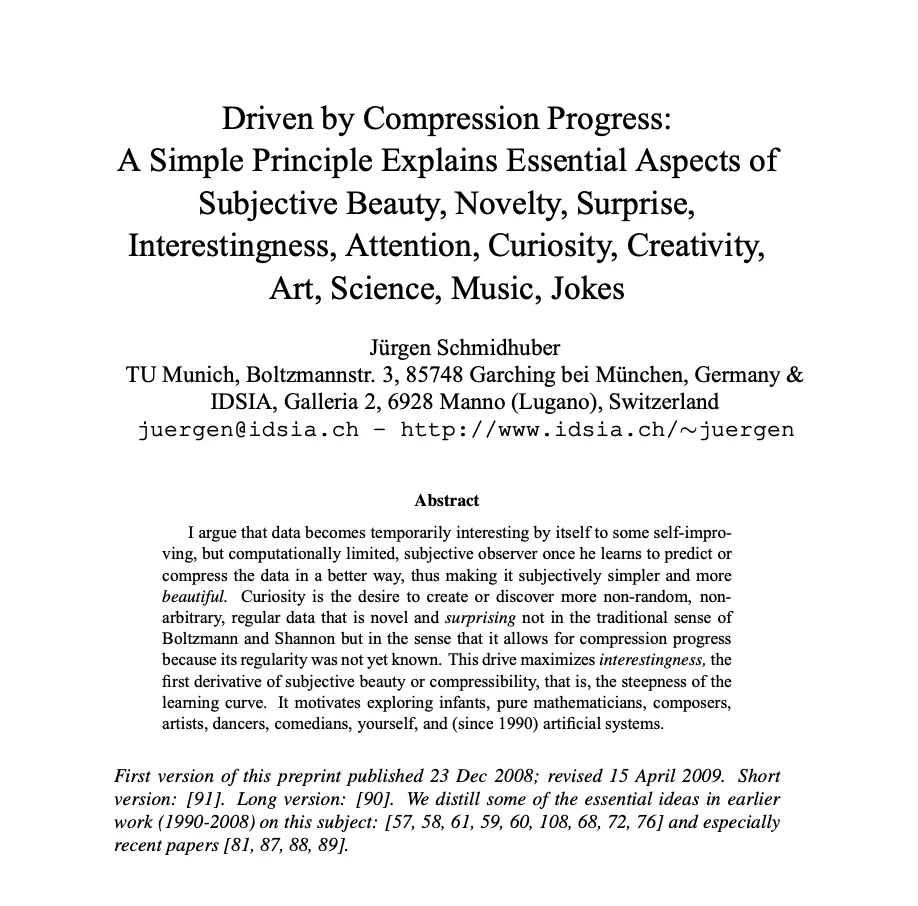
According to @HowToPrompt__, the human brain operates as a compression engine predicting the world. Curiosity, humor, and beauty are dopamine rewards when neural networks achieve compression progress.
Image source: @HowToPrompt__ via X
The Brain as a Predictive Compression Engine
The brain processes data to predict events and compress information into compact models.
Predictability and randomness produce distinct reactions:
- Predictability: When events are fully predictable, the brain already compressed them, causing boredom.
- Randomness: When data is purely random, the brain cannot compress it, causing annoyance or tuning out.
Between Boredom and Chaos: The Dopamine Sweet Spot
Intellectual engagement occurs when complexity reveals hidden patterns:
- Curiosity: Dopamine released when finding hidden patterns in complex data.
- Humor: Rapid neural compression when a confusing setup snaps into place with a punchline.
- Beauty: Cognitive reward upon noticing symmetry and order within apparent chaos.
Art, science, music, and jokes are optimized datasets designed to trigger compression progress.
Programming Intrinsic Motivation in Artificial Agents
This framework was formulated by an AI pioneer to program intrinsic motivation into artificial agents.
If subjective experiences are mathematical rewards for compression progress, artificial agents can use identical drives to explore environments and learn patterns.