Topcoat: Tokio Team's Full-Stack Rust Web Framework Without WASM Bundles
An overview of Topcoat, a full-stack Rust framework from the Tokio team that compiles Rust expressions to client-side JavaScript without WASM bundles or separat
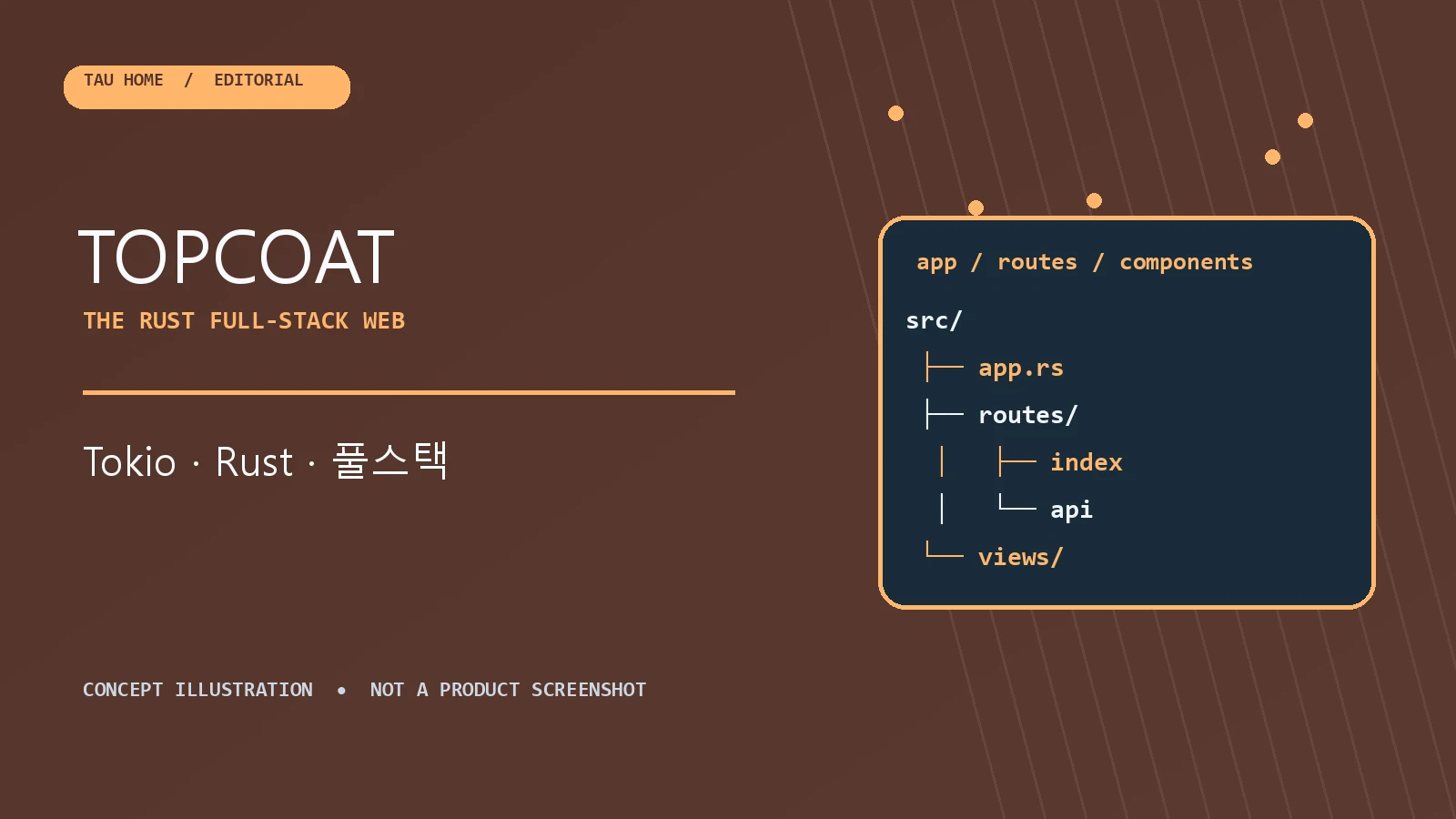
Topcoat, a batteries-included full-stack web framework developed under the Tokio organization, is drawing significant interest across the Rust ecosystem. Following its v0.12.1 release on November 10, 2026, the project directly addresses longstanding pain points in Rust web development: oversized WebAssembly (WASM) distribution bundles and fragmented client-side build pipelines.
Hero image: Original TAU HOME editorial concept illustration, not a product screenshot. Traditional Rust full-stack solutions often mandate shipping complete WASM binaries or wiring multi-step JavaScript bundlers. Topcoat takes an alternative route: it defaults to server-side markup generation and selectively translates interactive Rust expressions straight into lightweight browser JavaScript.
Client Reactivity Without Bundlers and Dynamic Server Updates via #[shard]
At the core of Topcoat's rendering model are the $(...) reactivity expression and the #[shard] macro.
Markup renders entirely on the server by default, enabling async components to query databases directly without requiring an intermediate API layer. For browser-side interactivity, developers wrap expressions in $(...). Topcoat evaluates standard, type-checked Rust on the server during the initial paint, while simultaneously translating that expression into browser JavaScript.
- Zero WASM footprint: Interactive UI states execute directly in the browser without downloading a runtime WASM blob or configuring a client bundler.
- The
#[shard]macro: For operations requiring fresh server data, such as live search filtering, marking a component with#[shard]causes Topcoat to re-render it on the server whenever its reactive inputs change, immediately swapping the updated HTML into the DOM.
This design delivers responsive local UI updates while eliminating the overhead of synchronizing custom REST or GraphQL endpoints for minor interface changes.
Module-Based Routing and the Topcoat UI Ecosystem
Topcoat packages native utilities designed to minimize configuration boilerplate.
The module_router! macro automatically infers the application routing table from project directories and module structures. Developers do not need to register routes manually; modules organized beneath src/app/ map directly to corresponding HTTP endpoints and dynamic parameters.
- Topcoat UI: A Tailwind-powered component system inspired by shadcn/ui. Components are copied directly into the project through the CLI, allowing teams to modify markup and styling without framework constraints.
- Dedicated CLI formatting: The built-in
topcoat fmtcommand parses and formats JSX-likeview!templates and Rust macro blocks uniformly. - Built-in asset pipeline: The compiler scans for
asset!declarations, collects static assets into a local directory, and serves them with content hashing and aggressive caching headers.
Current Maturity and Adoption Considerations
Since its repository creation in April 2026, Topcoat has surpassed 7,100 GitHub stars under the MIT license. However, the official documentation explicitly cautions that Topcoat remains early-stage and experimental, warning users to expect breaking API changes across upcoming releases.
Rather than running mission-critical enterprise workloads immediately, Topcoat currently fits best in projects seeking rapid full-stack prototyping in Rust without the operational burden of managing Node-based build infrastructure.
Sources
- GitHub: tokio-rs/topcoat