Optimizing Opus 5.5 Video Production with Decision Model Frame Inspections
Offloading automated frame checks and brand rule verification to lightweight decision models cuts Claude Opus 5.5 video review costs by 90% and review time by 7
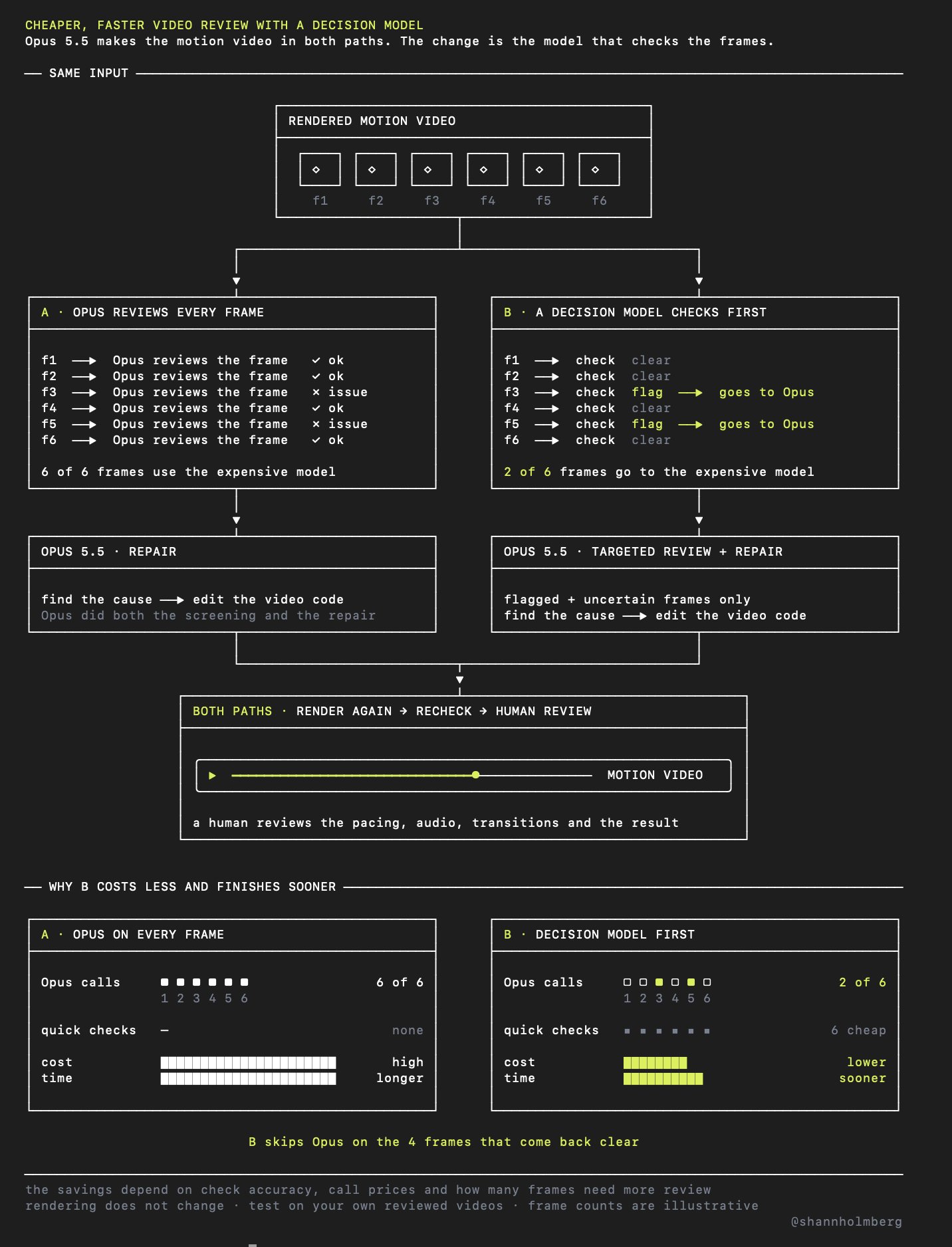
Image source: @shannholmberg on X
When creating programmatic videos with Claude Opus 5.5, submitting thousands of rendered frames directly to a flagship model causes excessive token costs and review latency.
Separating Mechanical Checks from Creative Work
@shannholmberg's workflow separates repetitive quality assurance from creative synthesis across four sequential steps:
-
Build the video with Claude Opus 5.5: Feed ideas, brand books, assets, and references to storyboard and code animations. With Remotion, code renders directly into completed video files.
-
Decouple repeated checks: Deterministic code verifies measurable rules like text sizing, blank or frozen frames, and brand colors. Simultaneously, a decision model inspects individual frames, answering targeted questions to detect defects. Only flagged frames and test summaries reach Opus 5.5.
-
Fix issues with Opus 5.5: The flagship model reviews only selected defect frames and modifies the video code before re-rendering and re-testing, minimizing frame-by-frame scrutiny by the frontier model.
-
Review the video manually: Automated audits reliably catch technical glitches, but creators must personally evaluate pacing, audio, transitions, and overall artistic vision.
Empirical Cost Benchmarks and Review Savings
SageCut provides one practical implementation of this workflow for Remotion videos. In an example shared from Chris's setup, a decision model named Sage evaluated 3,153 frames for $0.16. Crucially, this reflects solely frame-reading inspection costs, not complete video production expenses. According to @shannholmberg, delegating frame checks to a decision model reduced review costs by 90% and shortened review time by 75%. These savings come from eliminating massive visual payloads from the primary model's context, reserving flagship compute for targeted remediation.
Operational Caveats and Phased Adoption
Teams adopting this workflow should heed key caveats. First, the 90% cost cut and 75% time savings apply strictly to the review stage; rendering video files still requires standard computational time. Second, human oversight remains necessary because automated models cannot assess subjective qualities like narrative pacing and audio harmony. Third, @shannholmberg advises testing the workflow on an already reviewed video to confirm the decision model reliably flags known defects before replacing existing production processes.