Three.js Softbody Physics Prompt: Comparing Claude Opus 5.5 and Gemini 4 Argon on Interactive Gummy Bears
A complete 3D prompt for rendering translucent softbody jelly physics and refraction in a single HTML file with Three.js, comparing Claude Opus 5.5 and Gemini 4
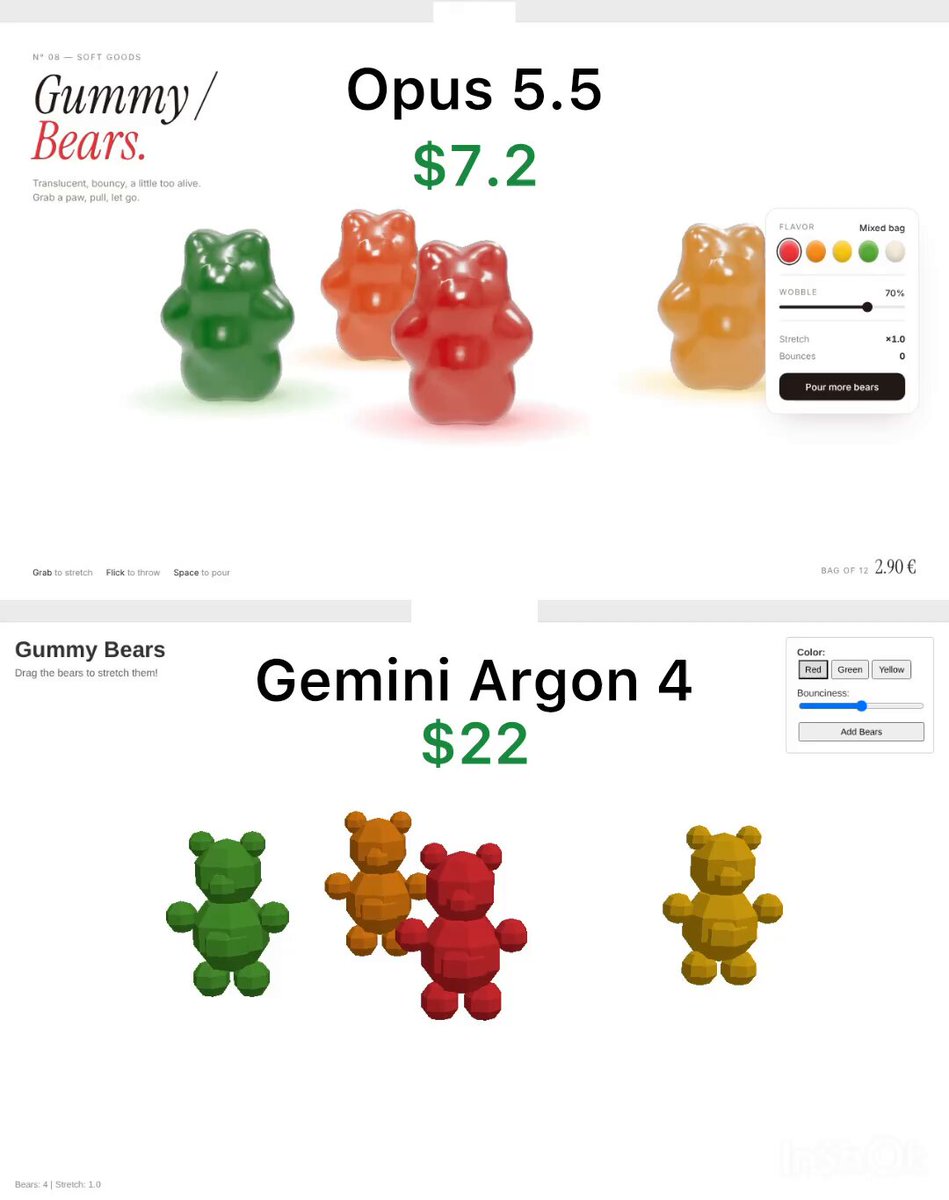
Semichenko (@semichenkko) has shared an elaborate 3D prompt designed to generate interactive, translucent gummy bears with softbody jelly physics in a single, self-contained HTML file running solely off CDN-hosted Three.js. Running the identical prompt through Anthropic's Claude Opus 5.5 and Google's Gemini 4 Argon revealed stark contrasts in simulation fidelity, shader quality, and token expenditures.
Image source: @semichenkko on X
Simulating the organic elasticity and squish of gummy candy inside a browser cannot be achieved with standard rigid-body mechanics or static polygonal meshes. It demands point-mass softbody algorithms with volume-preserving shape matching, paired with physically based transmission and refraction shaders. The benchmark highlights noticeable differences in how leading frontier models architect client-side WebGL code.
Benchmark Results: Organic Jelly Physics (Opus 5.5) vs. Rigid Statues (Gemini 4 Argon)
The author subjected both model-generated HTML files to five standardized interactive stress tests: pulling a paw, yanking the head, squishing it flat, throwing it across the scene, and pouring a fresh bag of bears from above.
-
Claude Opus 5.5 (Authentic Jelly Behavior)
- Elasticity and Damped Rebound: Grabbing and pulling a paw stretches it into a thin, rubbery strand; upon release, it snaps back with an organic, damped wobble.
- Volume-Preserving Squish: Squashing a bear flattens it like a pancake, and it then launches itself back upward.
- Elastic Collisions: Throwing a bear causes it to bounce dynamically off the floor while pushing neighboring bears out of the way.
- Optical Realism: Accurately rendered a translucent, glossy look with light passing directly through them.
- Cost: $7.20
-
Gemini 4 Argon (Rigid Plastic Statues)
- Loss of Softbody Dynamics: Failed to deliver the intended jelly elasticity, behaving instead like rigid plastic figurines. Pulling a limb turned it into a stiff, unresponsive stick.
- Missing Collision Detection: Throwing a bear resulted in it flying straight through adjacent bears without triggering collision responses.
- Mesh Clipping on Stacking: Dropping a cluster of bears from above produced mutual polygon clipping rather than a jiggling, settling pile.
- Cost: $22.00 (burned more tokens and still produced plastic results)
Full Prompt: Single-File Three.js Softbody Gummy Bears
Below is the verbatim prompt authored by Semichenko. It requires the entire application to exist within a single HTML file with no local build step or server dependencies beyond the Three.js CDN.
PROMPT

Build "Gummy Bears" - a single self-contained HTML file (three.js from a CDN is the only dependency): a handful of translucent gummy bears on a white table that you can grab, stretch, squash, throw and pour.

The bears
- Classic gummy bear silhouette: round head with two ears, short snout, plump body, stubby arms and legs, tiny molded eyes and nose
- Every part melts smoothly into the next - build the body as an implicit surface (metaballs / marching cubes), not separate spheres
- Material: real gummy candy. Translucent with transmission and refraction, colored light absorption that gets deeper in thick parts, glossy clearcoat with sharp highlights
- Colors: cherry red, orange, lemon yellow, apple green, clear pineapple
- Soft colored shadow under each bear, tinted by the bear's own color

Physics (this is the whole point - it must feel like jelly, not plastic)
- Each bear is a soft body: mass points for head, ears, snout, body, belly, hands and feet, held together by volume-preserving shape matching
- Limbs and neck are rendered as stretchy strands between points, getting thinner as they stretch
- Grab any part and pull: it stretches like rubber, the rest of the bear leans after it, on release it snaps back with a damped wobble
- Pull the head up: the neck stretches, the body follows, on release the bear squashes and hops
- Press down on the head: the bear pancakes, bulges sideways, then launches itself back up
- Throw a bear: it flies, squashes on landing, bounces and pushes other bears out of the way
- Bears collide with each other and never pass through one another
- Idle bears do small random hops with squash and stretch
- "Pour more bears" drops a handful from above into a wobbling, jiggling pile

UI
- Editorial product-page style on a white background. Large italic serif title "Gummy / Bears.", a short subtitle, a minimal card on the right with flavor swatches, a wobble slider, live "Stretch" and "Bounces" readouts and a "Pour more bears" button
- A subtle circular cursor that grows while grabbing
- ACES tone mapping, environment reflections, soft key and back light. Smooth 60fps
Prompt Engineering Architecture and Model Synthesis Gaps
This prompt serves as an instructive benchmark because it pairs complex mathematical physics with advanced WebGL graphics shaders in a zero-dependency frontend context:
- Implicit Surface Geometry: Specifying metaballs or marching cubes forces the model to blend joints smoothly into a continuous gelatinous silhouette rather than stitching disconnected primitives.
- Volume-Preserving Shape Matching: Dictating mass points coupled with shape-matching constraints guides the model toward authentic continuum mechanics rather than generic particle damping.
- PBR Optical Properties: Demanding transmission and refraction, colored light absorption that deepens in thicker sections, and glossy clearcoat highlights prevents the model from falling back on naive alpha transparency.
While Claude Opus 5.5 synthesized compact numerical solvers and Three.js shader pipelines for $7.20 in generation costs, Gemini 4 Argon burned $22.00 in tokens while reducing the physics model to rigid plastic structures with polygon clipping. For developers building generative 3D web interactive prototypes, model selection remains a decisive factor in both functional fidelity and generation cost.
Original source
- Semichenko (@semichenkko) on X: Opus 5.5 vs Gemini 4 Argon Three.js Gummy Bears Prompt