Tencent Open-Sources 'TencentDB Agent Memory': 100% Local SQLite-Based Long-Term Memory for AI Agents
An architectural overview of TencentDB Agent Memory, an open-source long-term memory framework for AI agents powered by local SQLite and a 4-layer semantic pyra
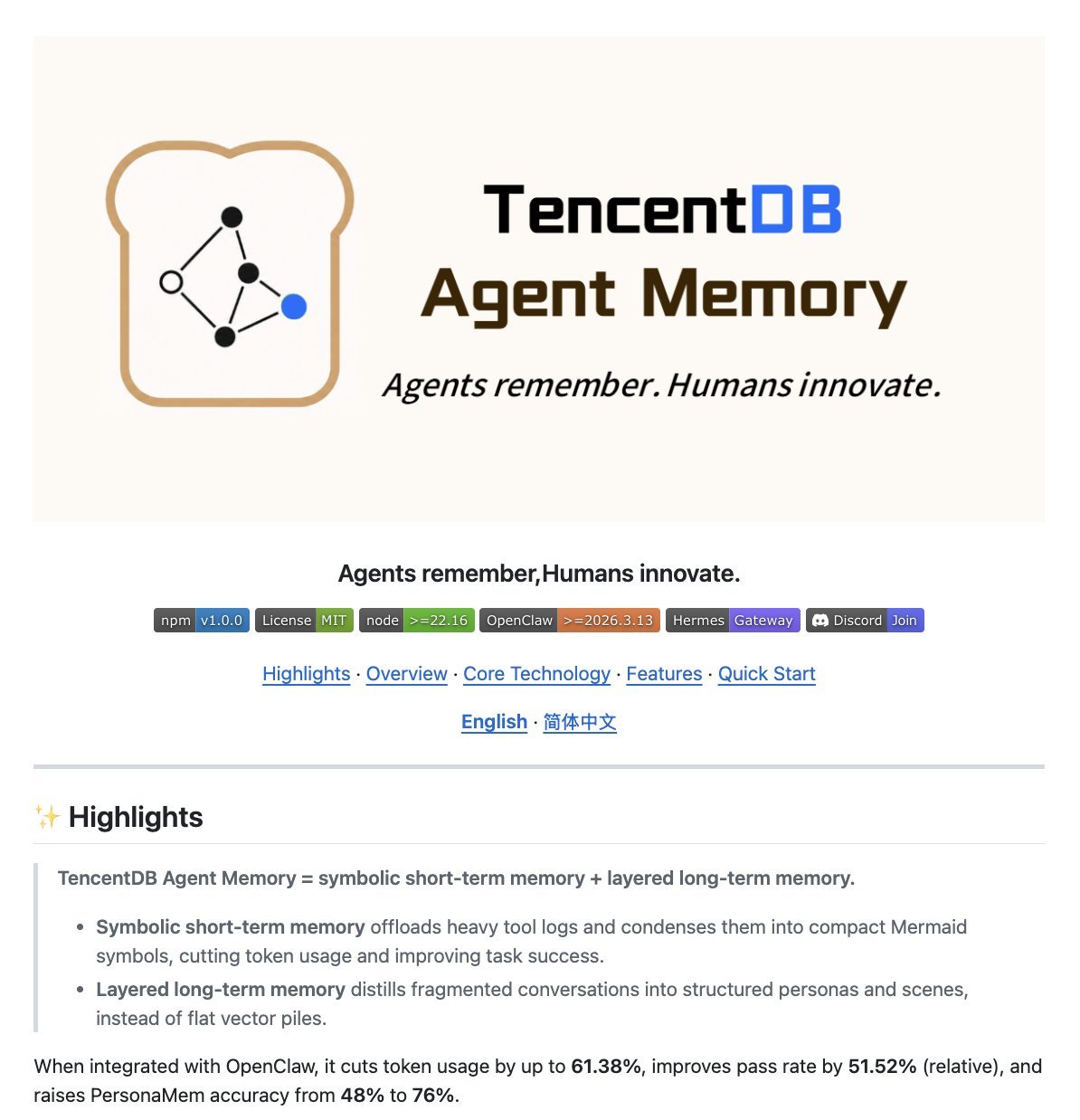
Tencent has officially open-sourced TencentDB Agent Memory, an AI agent long-term memory framework designed to run entirely in local environments without dependencies on external cloud vector databases. By bypassing managed cloud vector APIs like Pinecone in favor of a single local SQLite database paired with a structured semantic pyramid, the framework offers a lightweight solution to preserve cross-session agent context and eliminate repetitive setup.
Image source: @Divyyanshishrma via X
Most existing AI agent memory systems compress raw interaction history into an opaque pile of embedding vectors stored in an external vector database. When retrieval fails or hallucinations occur, diagnosing the cause often turns into guesswork, while context windows become overloaded across prolonged sessions. TencentDB Agent Memory addresses this challenge by replacing lossy vector compression with human-readable Markdown tiers and Mermaid graph-based short-term state tracking.
Replacing Opaque Vector Dumps with a 4-Layer Semantic Pyramid (L0–L3)
At the heart of TencentDB Agent Memory is a 4-tier semantic pyramid designed to organize and structure agent memories systematically:
- L0 Conversation: Raw, uncompressed dialogue turns between the user and the agent.
- L1 Atom: Discrete granular facts, key-value assertions, and entity-level statements extracted from conversations.
- L2 Scenario: Contextual task workflows and operational routines grouped from atomic facts.
- L3 Persona: The apex tier containing enduring user preferences, interaction habits, and high-level behavioral rules.
A decisive advantage of this tiered structure is transparency and verifiability. Higher tiers are stored not as binary vector blobs, but as human-readable Markdown files. When an agent exhibits faulty assumptions or outdated memories, developers and users can inspect the files directly, adjust factual assertions, or prune unwanted rules without re-indexing an entire database.
Context Optimization: Mermaid Graph State and node_id Log Drill-Back
To curb real-time inference overhead and conserve context window limits, the framework enforces a clear separation between active state and execution history:
- Mermaid Graph Encoding for Short-Term State: Rather than dumping verbose conversation history into the prompt, the agent's active execution trajectory is injected directly as a compact Mermaid diagram. This allows the model to grasp current progress and workflow status with minimal token overhead.
- Disk Offloading for Verbose Tool Logs: Detailed tool invocations and output logs are offloaded directly to local disk rather than cluttering the active context window.
- Drill-Back via node_id: Whenever an agent requires concrete evidence or needs to verify raw output, it queries the disk log directly using the corresponding
node_idembedded in the Mermaid graph.
Measured Benchmarks and Practical Operational Trade-offs
According to reported project metrics, TencentDB Agent Memory achieved a 61% reduction in token consumption while elevating PersonaMem evaluation accuracy from 48% to 76%. Operating with zero external API dependencies on local SQLite (via sqlite-vec), it enables fully self-contained deployment.
However, viral claims that the release "kills the entire vector database industry" overlook important architectural nuances:
- Complementary Local Vectors: The system does not abandon vector search entirely; its baseline layer utilizes local SQLite with the
sqlite-vecextension for local vector indexing. - Summarization Hallucination Risks: Because higher tiers (L2 Scenarios and L3 Personas) rely on LLM summarization passes, errors or hallucinations during initial extraction can propagate upward.
- Absence of Continuous Goal Injection: Mechanisms for persistently injecting long-term goals into continuous execution loops must be implemented separately.
- Standalone Library Architecture: Despite carrying the 'TencentDB' branding, the project is an independent open-source library rather than a proprietary cloud database service.
For developers seeking an auditable, token-efficient memory architecture that eliminates cloud lock-in for AI agents, TencentDB Agent Memory offers a compelling, inspectable reference implementation.
Sources
- GitHub Repository: TencentCloud/TencentDB-Agent-Memory
- Divyanshi (@Divyyanshishrma via X): Release announcement and benchmark notes