The Reality Behind the Claim That Open-Source MCP 'REA' Reverse Engineers Any App
Sorting out what the open-source MCP 'REA' claims to do for AI agents, where verification stops, and the safety caveats around its repository lead.
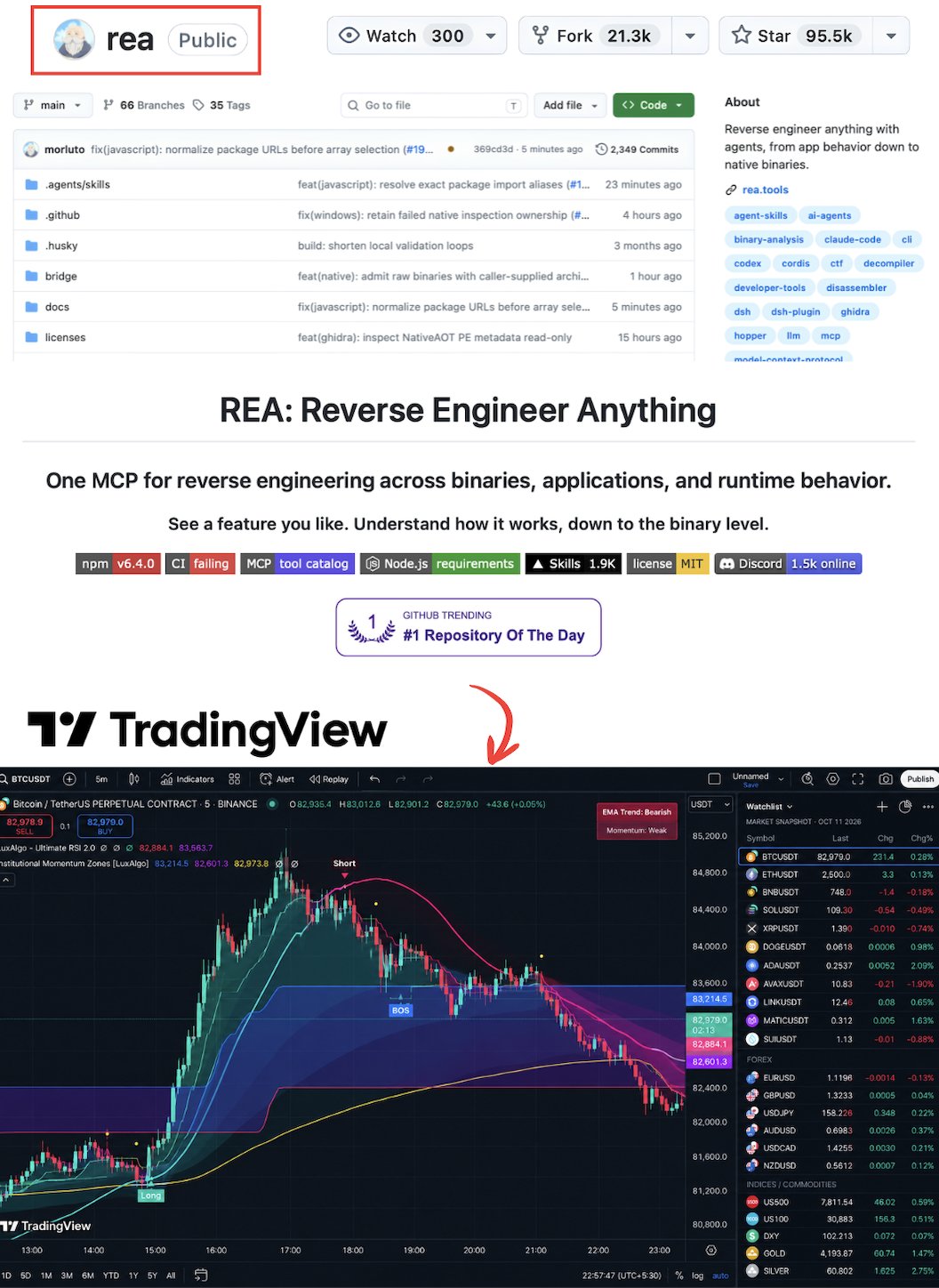
X user Roan (@RohOnChain) introduced REA (Reverse Engineer Anything) on October 12, 2026, as an open-source MCP that lets an AI agent reverse engineer any app down to the binary level. Framed with the provocative claim of tearing apart TradingView to use premium indicators for free, the post drew attention on X. The collection bundle includes no view, like, or bookmark counts, so no specific figures are stated here.
Image source: @RohOnChain(X post)
The key point first: what is verified so far is only the claims and reactions in the X post and its reply thread. The repository itself (README, install steps, tool list, license) is unconfirmed, and the core efficacy claim is disputed within the thread. This article is not a definitive introduction to REA; it separates what the post claims from what remains unverified.
What REA Claims and the Outlined Workflow
According to the original poster, REA is an open-source tool in MCP (Model Context Protocol) form that connects to an AI agent and helps trace an app from its publicly observable interface down to application logic. The TradingView example outlines this approach:
- Point REA at TradingView's publicly observable interface and map the major features, from chart interactions to indicators and alerts
- Trace how the interface behaves when switching symbols, changing timeframes, adding indicators, drawing levels, and updating chart layouts
- Use REA's available MCP tools to investigate authorized software artifacts and trace application logic
Note that the collected source text was truncated after 768 characters, so later steps (such as the "step 6" mentioned in thread replies) are not in the bundle. The full workflow therefore cannot be presented as a complete procedure.
Repository Lead and Unconfirmed Details
A reply in the same thread (@siribraheem33, 2026-10-12 05:29 KST) shared https://github.com/morluto/rea as the repository lead. But the repository contents were not included in the collection bundle and further lookup is out of scope, so install commands, supported clients, the tool list, the license, and whether it actually works cannot be confirmed.
Who might care can only be stated on the basis of the post's claims: developers and researchers who want to delegate public-interface mapping and behavior tracing of an app to an AI agent. The reason it is worth noticing now is thread traction, not verified efficacy. Because the install and usage path is unconfirmed, this article gives no commands or setup instructions.
Counterarguments to the Efficacy Claim and Safety Caveats
The core claim of "using premium indicators for free" is the original poster's one-sided assertion and must not be stated as fact. Several replies in the thread challenge it directly:
- "It can't reverse data feeds" (@strykertrades)
- "How did you reverse engineer data sources which are paid on API basis? What a nonsense." (@erkoPollo)
- "Where does the price data come from?" (@gravyrocks)
In other words, wherever paid data feeds or paid APIs are involved, the post alone does not establish that the problem is solved.
Attempting to bypass paid features may violate service terms and copyright, so it should not be reproduced as a how-to. Separately, some replies raised unverified malware/scam allegations (@ChromaticAbber, @MotherfuckerPhD). Those cannot be reported as fact, but they are valid grounds for standard precautions before running an unclear-origin repository: an isolated environment, minimal privileges, never on a machine holding wallets or sensitive accounts, and reviewing code and releases first.
Sources
- Roan (@RohOnChain) original post (2026-10-12): X post
- Repository lead in thread (@siribraheem33): https://github.com/morluto/rea