10 Essential Open-Source GitHub Repositories for Building Production AI Agents
Moving beyond basic LLM calls: a curated collection of open-source tools for workflow orchestration, type-safe outputs, dynamic memory, browser control, sandbox
High-performing foundation models are only the starting point for AI agent engineering; building reliable, autonomous agents in real-world environments depends fundamentally on the system architecture constructed around the model—spanning state orchestration, strict type validation, temporal memory, browser interactions, sandboxed execution, and automated evaluation.
Image source: @RodmanAi (X)
The open-source AI engineering community has increasingly converged on a six-layer system stack: Model → Context → Memory → Tools → Execution → Evaluation. Centered around a curated selection of ten key GitHub repositories highlighted by Leonard Rodman (@RodmanAi), this overview breaks down the foundational open-source toolset required to build production-grade AI agents that perform end-to-end tasks.
1. Workflow Orchestration and Type-Safe Control Layers
When an agent executes multi-step reasoning, system controllability and deterministic output structure become the primary technical requirements.
- LangGraph (
langchain-ai/langgraph): A low-level orchestration framework for building stateful, controllable multi-agent workflows. Drawing architectural inspiration from distributed graph systems like Pregel and Apache Beam, LangGraph models agent cycles as explicit nodes and edges. It provides human-in-the-loop inspection and state modification, durable execution capable of resuming past steps across interruptions, and comprehensive memory bridging short-term scratchpads with cross-session persistence. - PydanticAI (
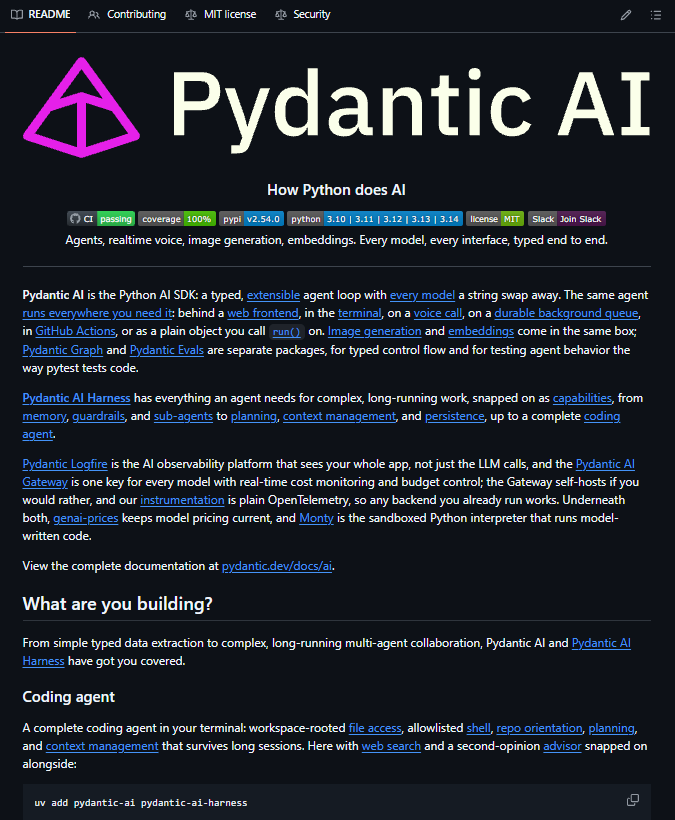
pydantic/pydantic-ai): A model-agnostic Python agent framework built by the Pydantic team to bring the developer ergonomics of FastAPI to generative AI. It enforces strict type checking and output validation through Pydantic models, eliminating schema mismatch errors at runtime. PydanticAI features native dependency injection, streamed structured outputs, built-in Model Context Protocol (MCP) server support, and dedicated state-machine orchestration viapydantic-graph. - Mastra (
mastra-ai/mastra): A full-featured agent framework designed to integrate complex business workflows, memory structures, and external tool invocations into a unified architecture. - Agno (
agno-agi/agno): A multi-agent coordination framework tailored for building, managing, and synchronizing groups of specialized agents working toward shared objectives.
2. Dynamic Memory and Web/Browser Interaction Layers
Scaling agents beyond standard context windows requires memory layers that capture relational knowledge over time and libraries that bridge agents to live web environments.
- Cognee (
topoteretes/cognee): Ingests unstructured raw data—such as technical documentation and logs—and transforms it into structured knowledge graphs and vector formats, establishing an actionable long-term memory layer for agents. - Graphiti (
getzep/graphiti): A specialized agent memory framework that models dynamic, time-evolving information as temporal knowledge graphs. By distinguishing between historical state and updated facts, Graphiti prevents memory contradictions and hallucinated drifts over extended sessions. - Browser Use (
browser-use/browser-use): A browser automation library that enables AI agents to launch and control real web browsers, inspecting DOM elements, clicking, typing, navigating pages, and completing interactive web tasks autonomously.
3. Sandboxed Execution and Observability/Evaluation Layers
Autonomous agents that generate code require secure execution runtimes and rigorous continuous evaluation before deployment to production environments.
- E2B (
e2b-dev/E2B): Provides isolated microVM cloud sandboxes where agent-generated code (such as Python scripts and shell commands) can execute safely without risking the security or stability of the host infrastructure. - Langfuse (
langfuse/langfuse): An open-source LLM observability platform providing end-to-end trace tracking, latency breakdown, token and cost monitoring, and runtime visibility across complex agent execution graphs. - DeepEval (
confident-ai/deepeval): A unit testing and evaluation framework designed to quantify agent behavior—including instruction following, hallucination rates, and answer relevancy—enabling automated regression testing prior to production release.
Practical Implementation Considerations
The ten open-source repositories featured here are not designed as a single monolithic stack, but rather as specialized modular building blocks for specific architectural layers.
When designing production systems, engineering teams should evaluate and compose layers tailored to their operational constraints. A deterministic data extraction agent may combine PydanticAI with Langfuse for type validation and cost tracking, whereas an autonomous research agent might integrate LangGraph, Browser Use, and an E2B sandbox for dynamic web exploration and isolated code execution. Because browser automation and cloud sandboxes involve external runtime environments and security boundaries, teams should review infrastructure isolation and credential management policies early in development.
Sources
- Leonard Rodman Official X (@RodmanAi): 10 GITHUB REPOS FOR BUILDING AI AGENTS THAT ACTUALLY DO THINGS
- LangGraph GitHub Repository: langchain-ai/langgraph
- PydanticAI GitHub Repository: pydantic/pydantic-ai
- Mastra GitHub Repository: mastra-ai/mastra
- Agno GitHub Repository: agno-agi/agno
- Cognee GitHub Repository: topoteretes/cognee
- Graphiti GitHub Repository: getzep/graphiti
- Browser Use GitHub Repository: browser-use/browser-use
- E2B GitHub Repository: e2b-dev/E2B
- Langfuse GitHub Repository: langfuse/langfuse
- DeepEval GitHub Repository: confident-ai/deepeval