Surface Laptop Ultra Debuts with RTX Spark for Local On-Device GitHub Copilot
Microsoft introduced the Surface Laptop Ultra with NVIDIA's RTX Spark N1X, pairing MAI Code 1.1 Flash and Hybrid Intelligence for local GitHub Copilot on Window
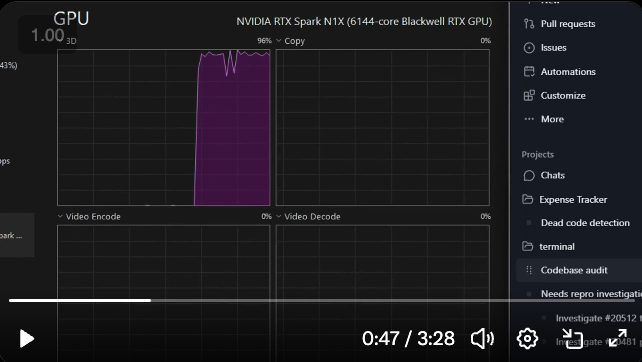
Microsoft officially unveiled the Surface Laptop Ultra during a special press event in San Francisco on October 7, 2026, introducing its flagship notebook powered by NVIDIA's next-generation RTX Spark N1X superchip. Alongside the custom system-on-chip combining an NVIDIA Blackwell GPU with a Grace Arm CPU, the announcement highlighted native Windows 11 integration that enables GitHub Copilot to execute code generation directly on the physical device.
Image source: @LearnerBR / Microsoft
The keynote featured Microsoft CEO Satya Nadella, NVIDIA CEO Jensen Huang, and Windows and Devices head Pavan Davuluri showcasing co-engineered hardware and software workflows. The initiative marks a practical step in Microsoft's broader "Hybrid Intelligence" roadmap, moving demanding developer AI workloads from remote datacenter clusters down to client PCs. Pre-orders are live now, with commercial availability scheduled for October 16, 2026.
NVIDIA RTX Spark N1X Architecture and 128GB Unified Memory
The Surface Laptop Ultra features a 15-inch PixelSense Ultra touchscreen display and is engineered from the ground up around NVIDIA's mobile-focused RTX Spark N1X superchip.
To eliminate the graphics memory bottlenecks that typically hinder large foundation models on mobile platforms, the architecture relies on a shared unified memory pool across compute engines:
- Integrated SoC Layout: The chip combines an NVIDIA Grace CPU (up to 20 cores) with a Blackwell architecture RTX GPU (up to 6,144 cores) on a single silicon package with low-latency interconnects.
- Up to 128GB Unified Memory: The CPU and GPU dynamically share a massive pool of system RAM, enabling developers to run models exceeding 120 billion (120B) parameters locally without VRAM transfer penalties.
- Compute Throughput: Top-tier configurations achieve up to 1 petaflop of peak AI compute performance (theoretical FP4 with sparsity), providing the headroom necessary for local inference, code synthesis, and multi-modal workloads.
- Pricing and Retail Availability: Pre-orders opened on October 7, with shipments beginning October 16, 2026. The baseline model (18-core CPU, 24GB RAM, 512GB SSD) starts at $2,599, while the fully equipped high-end specification (20-core CPU, 128GB unified memory, 1TB SSD) reaches $5,899.
Hybrid Intelligence and the Lightweight MAI Code 1.1 Flash Model
To pair the new silicon with developer tooling, Microsoft and GitHub highlighted Windows 11's broader vision for hybrid intelligence, coordinating local client execution with cloud reasoning.
As part of this effort, Microsoft AI introduced "MAI Code 1.1 Flash," a specialized on-device coding model tuned specifically for the RTX Spark platform:
- Compact 53GB Footprint: Engineered as a Mixture-of-Experts (MoE) architecture with 137 billion total parameters and 6.8 billion active parameters, the quantized package reduces footprint by roughly 80% compared to the cloud Bfloat16 baseline (53GB on-device, consuming up to 75.5GB memory at 256k context).
- Multi-Client Surface: The model connects natively across the GitHub Copilot desktop application, Visual Studio Code extensions, and the GitHub Copilot CLI.
- Benchmark Evaluation Results: On the Terminal-Bench 2.1 evaluation (89 tasks), the on-device quantized version scored 66.29%, surpassing the cloud build (62.9%) and open-source models such as GPT OSS 120B (23.6%). On SWE-Bench Verified (500 tasks), the cloud version registered 72.6% while the on-device quantized version achieved 70.80%.
- Live GPU Acceleration: In demonstration sessions, initiating code generation in the Copilot desktop client instantly saturated the N1X GPU cores, verifying that on-device models can assist coding even in disconnected scenarios like airplane mode.
Intelligent Orchestration (Auto Mode) vs. Offline Execution: Caveats and Limits
GitHub Copilot on Windows 11 introduces two primary operating modes to govern how tasks are routed between local silicon and remote endpoints:
- Auto Mode Orchestration: The runtime inspects task complexity and prompt cache state across multi-turn sessions, routing tasks automatically between local and cloud resources.
- Explicit Local Model Selection: When developers need direct control over execution, they can explicitly select the local model to keep inference processing on the physical device.
Several practical constraints and hardware trade-offs remain essential for prospective buyers:
- High Price Floor for 128GB: Accommodating 120B+ parameter models requires the 128GB unified memory tier priced at $5,899, placing the top configuration primarily within reach of enterprise budgets and specialized AI teams rather than individual developers.
- Local Selection Distinct from Offline Mode: Merely selecting a local model does not automatically put the session offline or disable telemetry. Full offline mode in the GitHub Copilot CLI requires setting the
COPILOT_OFFLINE=trueenvironment variable. Furthermore, the default Auto mode may route select queries to cloud endpoints to preserve cache locality. - Arm Architecture Emulation: The machine runs on NVIDIA's Grace Arm architecture, meaning legacy x86-only development binaries rely on the built-in Windows Prism emulator.
Sources
- Microsoft Devices Blog: Pre-order our most powerful Surface devices ever
- Dev Bora (@LearnerBR) X Post: GitHub Copilot on Surface Laptop Ultra Demonstration
- Wikitree: GitHub Copilot Uses Local Models on Windows with Surface Laptop Ultra