Paper Billed as Stanford: Fix Loops and Stalls with the Harness, Fix Bad Plans with Weight Training
A summarizer presents this as a Stanford study separating agent failures into process failures and content failures, and distinguishing harness evolution from L
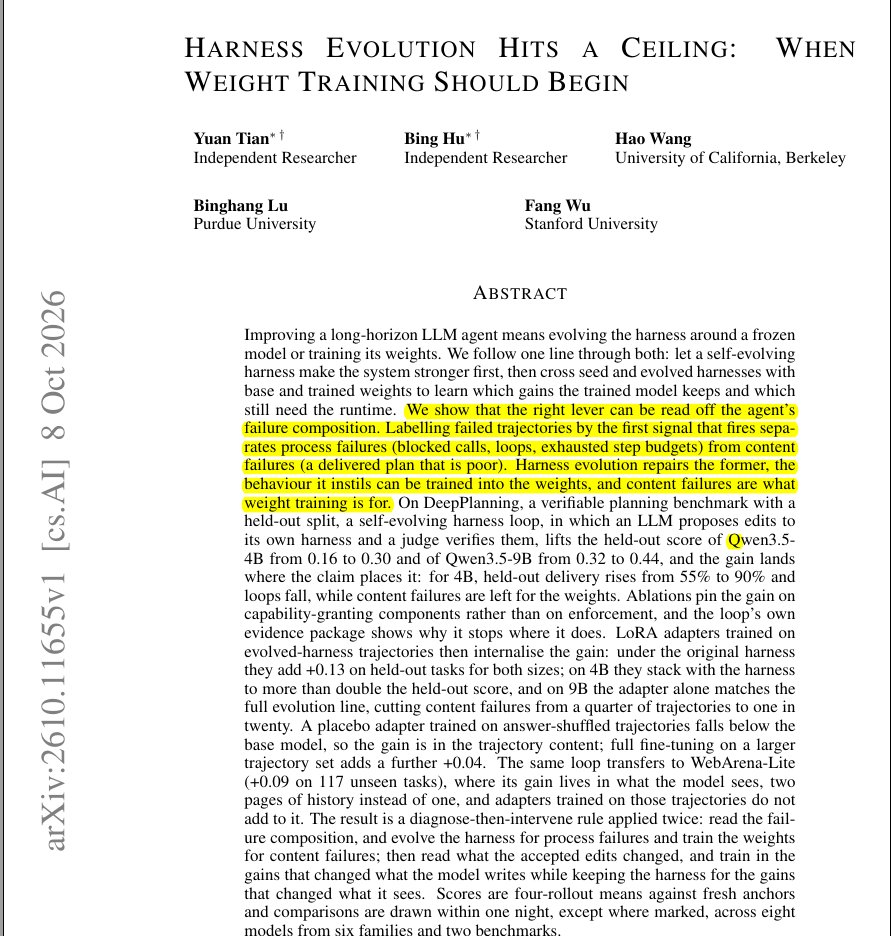
AI reviewer Rohan Paul shared news on October 10, 2026 (October 10–11 by timeline) of a paper presented as a new Stanford study (Stanford affiliation and authorship lack independent confirmation). Titled "Harness Evolution Hits a Ceiling: When Weight Training Should Begin" (arXiv:2610.11655, per a follow-up post), the study is said to separate the two paths of agent improvement — editing the harness versus training the weights — and asks which kind of failure each one actually fixes.
Image source: @rohanpaul_ai on X
The headline message is a cheap diagnostic split. Agents that loop or stall should be fixed by evolving the harness — the prompts, tools, and checks around the model — while agents that deliver poor plans need weight training instead. Mixing the two wastes harness iterations on one problem and extended fine-tuning on the other.
Two Kinds of Failure: Process vs. Content
The failure taxonomy, as reported by the summarizer, has two branches.
- Process failures: runs that loop or burn through their step budget — the execution stalls or spins without finishing.
- Content failures: runs that finish but deliver a poor plan.
According to Paul's summary, the team tested the split on a travel-planning benchmark: an LLM-driven loop rewrote the harness first, and the model's best execution traces then fine-tuned the model. The harness stage fixes the execution environment; the fine-tuning stage fixes the model's planning ability.
What Each Step Moved: Harness Evolution and LoRA by the Numbers
The figures below are reported for Qwen3.5-4B and come from the summarizer's account, not from a direct reading of the full paper — treat them as provisional claims pending verification against the original.
- Harness evolution: held-out task scores rose from 0.16 to 0.30, and plan delivery rose from 55% to 90%. In other words, harness edits alone substantially improved the rate at which the agent finished the job.
- The harness ceiling: harness edits did not shrink the share of poor plans. Finishing the job and producing a good plan are different metrics.
- LoRA adapter: a LoRA fine-tuning step cut the share of poor plans from 28% to 5%. Plan quality was the weights' job.
The evaluation splits and metric definitions behind these numbers were not in the desk memo, so they must not be read as confirmed performance results — only as directional evidence for the division of labor. Replies to the thread echoed the same reading: diagnose loops first, don't expect the harness to fix plan quality, and verify separately whether the gains on small models carry over to frontier models.
Practical Takeaway and Limits
For practitioners, the study offers a cheap triage order. If the agent loops or stalls, inspect the harness — prompts, tools, checks — first. If it finishes but the output is poor, consider weight training then. Reversing that order risks wasted fine-tuning.
The limits are equally clear. At the time of writing, the full arXiv text was not in the bundle, so every figure rests on the summarizer's (@rohanpaul_ai) account, and the Stanford affiliation, authorship, and publication status lack independent confirmation. Treat all numbers as provisional until checked against the original paper.
Sources
- Rohan Paul (@rohanpaul_ai) on X: New Stanford paper finds that harness changes fix agents that loop or stall...
- arXiv: Harness Evolution Hits a Ceiling: When Weight Training Should Begin (arXiv:2610.11655)