7 Open-Source GitHub Projects Replacing Costly Paid AI Subscriptions
A practical guide to 7 essential open-source GitHub projects—including Hermes+Jev Skills, typesafe-ai/skills, OpenHands, and LibreChat—that replace expensive mo
Tech creator 山羊赚钱笔记 (@shanyanggm) has spotlighted a curated collection of seven high-impact open-source GitHub projects designed to replace commercial AI software subscriptions that cost tens to hundreds of dollars per month, detailing practical adoption workflows across software engineering, content generation, and financial research.
Image source: 山羊赚钱笔记 (@shanyanggm) on X
Many commercial AI tools repackage open-source runtimes or basic API wrappers with substantial recurring subscription fees. Highlighting the need to bridge this information gap, the author demonstrated that assembling proven, community-backed open-source projects enables engineers and creators to bypass vendor lock-in, eliminate monthly software fees, and retain granular architectural control over private models, context data, and automated workflows.
Accelerating Agent Latency and Decision Reliability
When operating autonomous agents or LLM-driven coding harnesses, using frontier models for routine categorization or tool-routing decisions introduces severe latency bottlenecks and excessive token costs. Specialized open-source decision engines resolve this friction directly.
-
Hermes + Jev Skills
- Core Functionality: Equips Codex and agent harnesses with routing, persistent memory, dynamic skill selection, and direct GUI click interaction capabilities.
- Measured Impact: Compresses decision cycles that previously took seconds or tens of seconds down to sub-second responses, boosting the perceived velocity of complex agent workflows by up to 10x as reported by the author.
- Source Link: Hermes + Jev Skills
-
typesafe-ai/skills
- Core Functionality: Injects directly into Codex or Cursor environments to supplement decision-making, tool calling, and evaluation loops.
- Measured Impact: Rather than merely expanding skill lists, it prevents errant tool execution and misdirected trajectories, reducing rework time on complex tasks by up to 70% according to the author.
- Source Link: typesafe-ai/skills
Autonomous Software Engineering, Content, and Financial Research
Beyond conversational assistance, specialized open-source tools provide autonomous execution loops for time-consuming engineering and research tasks.
-
OpenHands
- Core Functionality: An open-source autonomous AI coding agent capable of taking over development tasks that previously required an hour of continuous human monitoring, leaving the developer solely in a final review capacity.
- Measured Impact: Autonomously reads codebases, modifies files, executes terminal commands, and resolves runtime issues in an iterative execution loop.
- Source Link: OpenHands
-
MoneyPrinterTurbo
- Core Functionality: An open-source video generation pipeline that collapses the workflow of producing a video from several hours into a 10-to-20-minute process.
- Measured Impact: Streamlines end-to-end video creation into a single automated pipeline, dramatically increasing content production efficiency.
- Source Link: MoneyPrinterTurbo
-
TradingAgents
- Core Functionality: Automates financial intelligence workflows by tracking breaking news, reviewing company financial reports, and synthesizing market perspectives.
- Measured Impact: Compresses the entire workflow of gathering news, analyzing financial statements, and organizing viewpoints down to one-fifth (1/5) of its original time.
- Source Link: TradingAgents
Unified Multi-Model Interfaces and Direct Computer Control
For creators and developers who rely on diverse AI models daily, interface fragmentation and repetitive manual computer tasks create significant overhead.
-
LibreChat
- Core Functionality: A unified web UI that connects ChatGPT, Claude, Gemini, and various API models within a single interface.
- Measured Impact: Eliminates the operational waste of switching between model tabs, copy-pasting conversational context, and hunting down historical sessions, reducing pure workflow friction by roughly 80%.
- Source Link: LibreChat
-
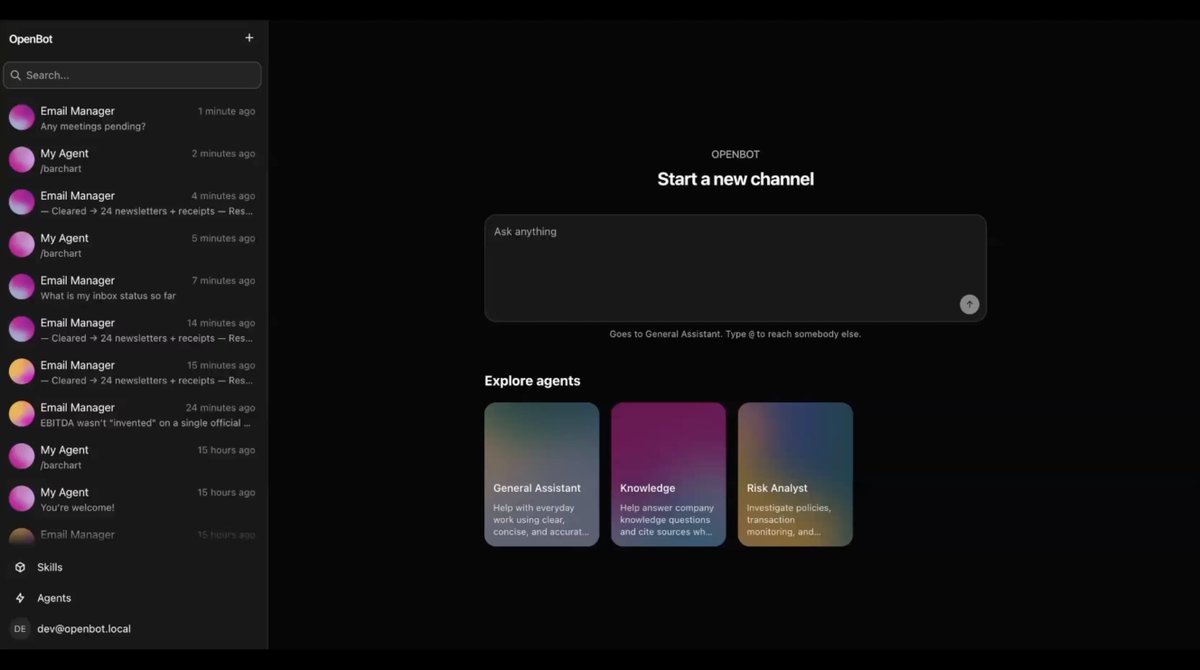
OpenBot
- Core Functionality: Allocates a dedicated "computer" environment to each AI agent, granting it direct agency over web browsers and software applications.
- Measured Impact: Moves beyond passive chat dialogue to autonomously click buttons, fill in forms, and run automated workflows, delegating high-volume repetitive tasks directly to AI.
- Source Link: OpenBot
Practical Implementation: Escaping SaaS Rent with BYOK Architecture
A defining advantage shared across these seven open-source projects is freedom from proprietary subscription walls through Bring Your Own Key (BYOK) configurations and local weights.
- Separating Judgment from Heavy Reasoning: Offload routine routing and skill execution to lightweight primitives like Hermes or typesafe-ai, reserving expensive frontier model calls strictly for high-entropy creative or architectural tasks.
- Delegating Execution Loops: Entrust multi-step engineering and computer interaction to autonomous workers like OpenHands and OpenBot, allowing developers to focus on architectural definitions and code review.
- Centralizing Conversational Hubs: Use unified self-hosted interfaces like LibreChat to aggregate API endpoints and conversation histories into a single private control plane.
By replacing closed SaaS silos with composable open-source alternatives, engineering teams and individual creators can substantially reduce monthly software expenditures while gaining full sovereignty over their tooling and data.