SAS, an AI Framework Said to Decode Self-Harm Signals Hidden in Internet Slang
A look at SAS, an AI framework said to read self-harm signals hidden behind slang and the sick-cute aesthetic — its claimed architecture and reported results.
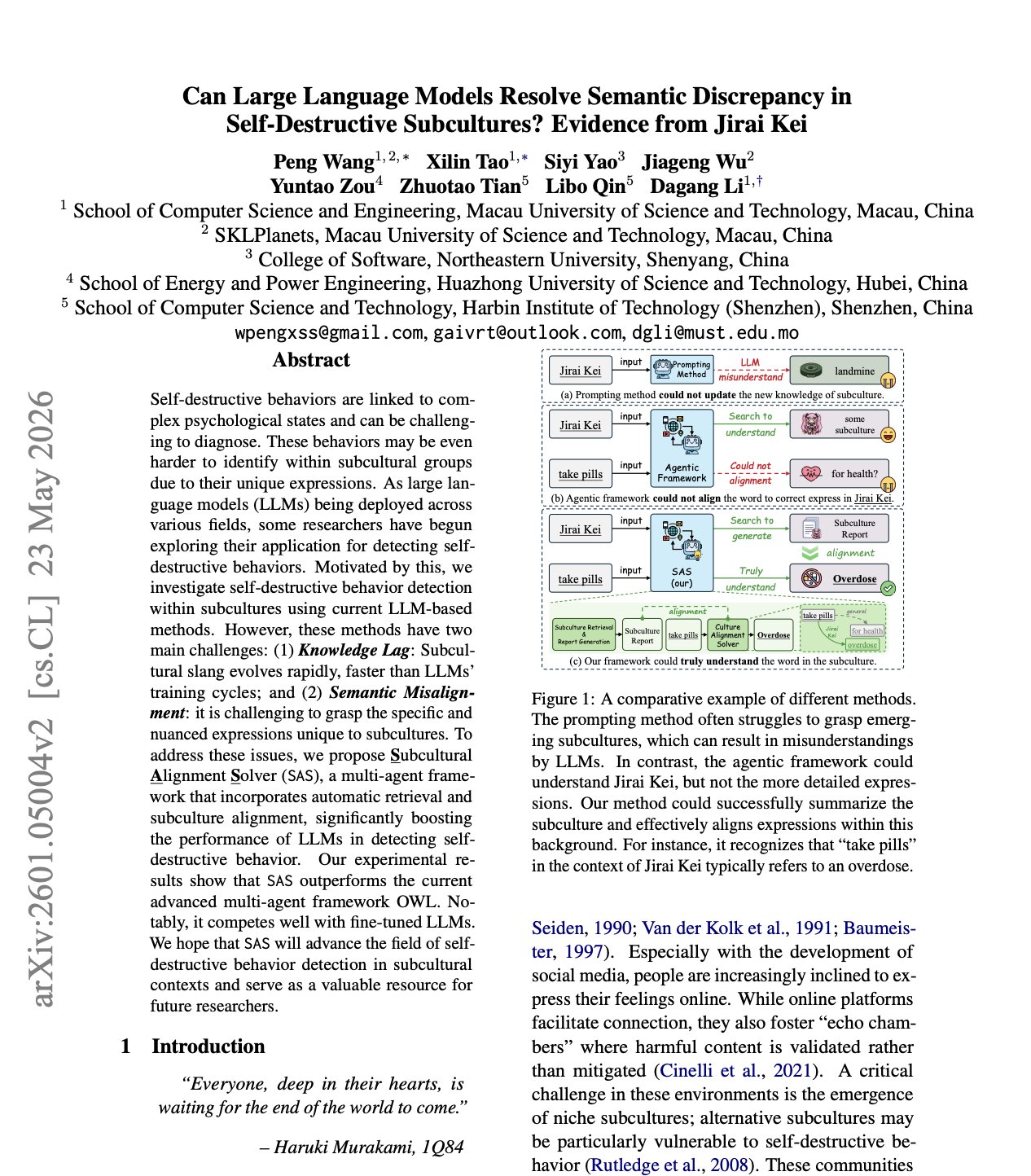
On October 11, 2026, the X account @HowToPrompt__ introduced SAS (Subcultural Alignment Solver), an AI framework said to decode slang related to self-harm, eating disorders, and overdoses. The thread's premise: internet subcultures often hide severe self-destructive tendencies behind cryptic slang and a so-called "sick-cute aesthetic," and standard language models usually miss the harmful intent because it is disguised in fast-evolving terminology.
Image source: attached image in the @HowToPrompt__ X post
As described in the thread, SAS uses a two-stage design that researches the culture before reading the post. A retrieval agent automatically gathers context about the target subculture, and then an alignment solver interprets the actual meaning of the coded text. The thread's example: in the "jirai kei" subculture, a phrase like "taking medicine" is interpreted not as ordinary medication but as an overdose (OD) reference.
Reported results and their limits
According to the thread's claims, SAS accurately classifies overdose (OD), eating-disorder (ED), and self-harm (SH) labels, and — tested with DeepSeek V3, Llama-3.1, and Qwen-2.5 attached — outperforms advanced multi-agent frameworks and competes with fine-tuned LLMs.
These performance claims are, however, a summary of assertions made in an X thread; they have not been cross-checked against the paper itself. The thread gives no quantitative metrics (accuracy, dataset size), so no specific numbers should be stated as fact. The same author's follow-up reply links the full paper (arXiv:2601.05004), which is where the exact methodology and figures must be confirmed.
Why it matters now
Detecting self-harm and eating-disorder signals is a sensitive domain where mistakes cause real harm. Because slang shifts quickly from one subculture to another, the "research the culture first, then read the post" approach offers a design insight for detection systems. This article stays at the methodology level and omits any specific methods or imitable expressions.
If you are struggling with self-harm or suicidal thoughts, please don't face it alone. In South Korea, the suicide prevention hotline 109 (24 hours) and the mental health crisis line 1577-0199 are available.
Sources
- How To Prompt (@HowToPrompt__) X thread: LLMs can now decode the hidden slang of internet subcultures to catch self-harm signals
- Full paper: SAS (Subcultural Alignment Solver) — arXiv:2601.05004