Open Multimodal Decision Model Decision 3.0 Released, Spanning 0.6B to 27B
On October 11, 2026, XunzhuoLiu announced Decision 3.0, an open multimodal decision model family, in an X post. The announcement claims sizes from 0.6B to 27B,
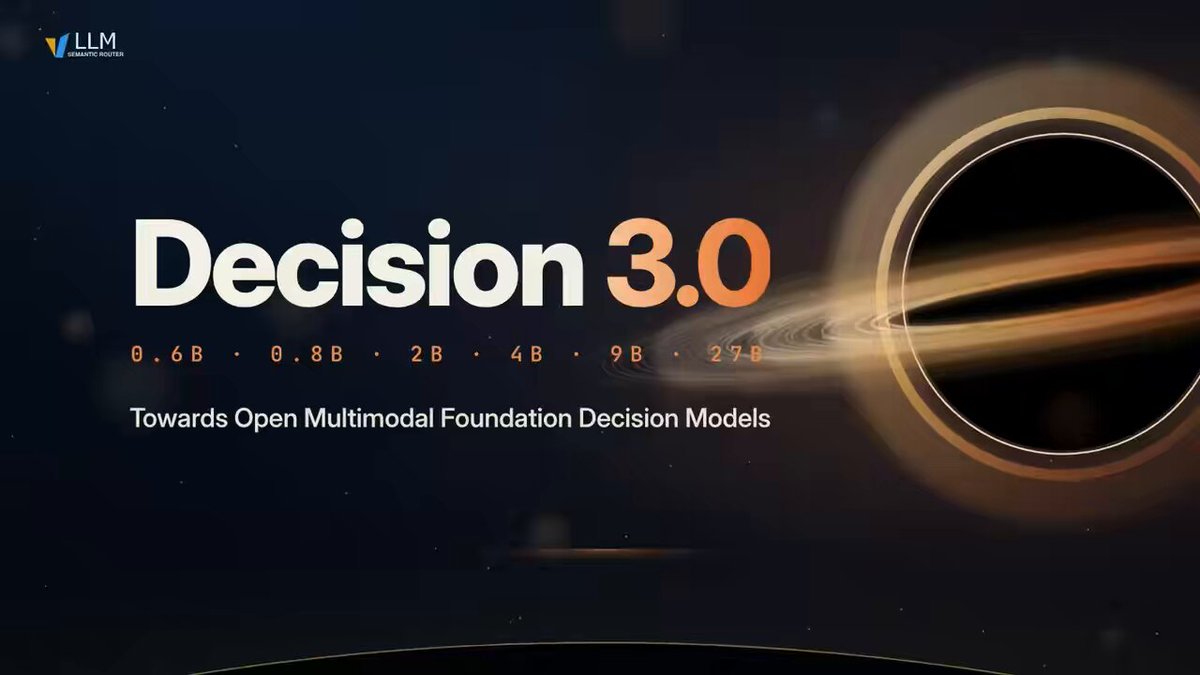
On October 11, 2026 at 17:59 KST, XunzhuoLiu (@XunzhuoLiu) announced Decision 3.0, an open multimodal decision model family, in an X post. The announcement states sizes from 0.6B to 27B, presents the release as open, and points readers to a Hugging Face collection in the same post.
Image source: @XunzhuoLiu on X
The verifiable substance of this release is twofold: the announcement post itself and the linked HF collection. The attached video is confirmed only as a URL in the evidence bundle, while license terms, weight composition, and code or dataset details cannot be confirmed from the evidence available for this draft.
What was announced and where to check it
The original post opens with "Introducing Decision 3.0: towards open multimodal foundation decision models," followed by the size range "Open and state-of-the-art from 0.6B to 27B." The HF collection URL is embedded directly in the post.
- Announcement: October 11, 2026, 17:59 KST, X post by @XunzhuoLiu
- Claimed scale: 0.6B to 27B
- Official pointer: Hugging Face Decision 3.0 collection
Thread replies are mostly congratulations and remarks about the fast follow-up release, with the author replying that the goal is to offer the community more choices. A third-party mention of an unofficial quantization also appears in the thread but must not be treated as part of the official release.
Limits of the ranking claim and how to read it
The author claims the No. 1 spot on both Jev Decision Index boards and a new Pareto frontier, explicitly qualified with "in our evaluation." That is a self-evaluation claim by the announcer, not an independently verified result.
- Attribution: treat the No. 1 and state-of-the-art wording as the announcer's own-evaluation claim only.
- Unconfirmed: detailed open-license terms and the weight, code, and dataset composition are not confirmed in this evidence.
- Evidence scope: with no supplementary web search and only first-party X evidence, spec figures must be handled as the announcer's claims.
Practitioners should therefore check the actual files and license labels inside the HF collection before adopting anything. Until each listed item's model card and license are confirmed, the size range and ranking claim should not be cited as established fact.
Sources
- @XunzhuoLiu X post (2026-10-11): Introducing Decision 3.0
- Hugging Face collection: Decision 3.0 collection