Sakana AI Releases 'The Agentic Scientist' and AutoIllustrate as Open Source for Autonomous Research Workflows
Sakana AI has open-sourced 'The Agentic Scientist' (AI Scientist v3), scaffolding coding agents to automate parallel scientific exploration and evidence generat
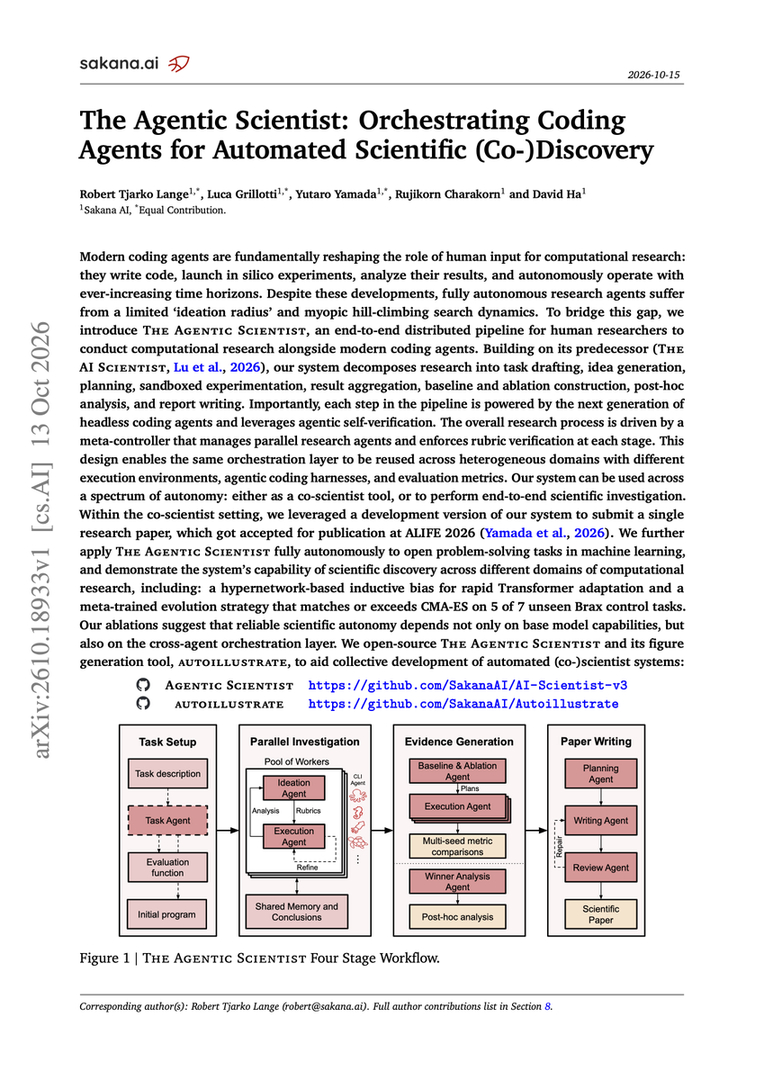
Sakana AI has officially released 'The Agentic Scientist' (AI Scientist v3), the third generation of its automated scientific research system, along with 'AutoIllustrate', a scientific vector diagram tool, on GitHub (SakanaAI/AI-Scientist-v3). While prior iterations relied on a single large language model (LLM) attempting to draft end-to-end papers in one broad pass, v3 introduces a modular scaffold that coordinates multiple off-the-shelf coding agents to manage hypothesis formulation, experiment execution, empirical verification, and manuscript drafting across the full research lifecycle.
Image source: @hardmaru / Sakana AI
Led by Sakana AI researchers David Ha (@hardmaru), Robert Lange, Luca Grillotti, Yutaro Yamada, and Rujikorn Charakorn, the new architecture reframes the system from an isolated text generator into an active 'co-scientist' partner, prioritizing rigorous empirical execution and falsifiable evidence collection over unanchored prose generation.
Architectural Shift: From Single-Agent Generation to Scaffolding Parallel Workers
The primary structural bottleneck in AI Scientist v1 and v2 was the inability of a single agent to maintain coherence across an extended research arc. As context lengths expanded and code execution errors triggered repeated local patches, models frequently suffered from hallucination cascades or drifted away from their original research questions.
The Agentic Scientist addresses this failure mode by wrapping established coding agents in an orchestrating scaffold that enforces a strict division of labor across parallel workers.
- Worker Pool Orchestration: Multiple worker agents operate concurrently, exploring distinct sub-hypotheses and generating targeted experimental implementations.
- Shared Memory and Distilled Insights: Intermediate experimental findings are condensed into structured summaries and stored in a shared central repository, preventing redundant exploration and enabling cross-agent synthesis.
- Stage-Gated Handoffs: Planning, experimental coding, execution monitoring, result interpretation, and manuscript drafting are decoupled through formal interfaces, preventing errors at one stage from silently corrupting subsequent tasks.
Automated Evidence Generation: Controlled Baselines and Ablation Workflows
The definitive technical leap in The Agentic Scientist is its dedicated 'Evidence Generation' subsystem. Rather than accepting an agent's self-reported performance gains at face value, the framework requires autonomous validation to prove why an idea works.
- Isolated Ablation Agents: Distinct validation agents, operating in sandboxed environments separate from the main exploratory loop, systematically remove or substitute individual algorithmic components to isolate genuine causal contributions.
- Automated Baseline Construction: To prevent benchmark inflation against degraded baselines, the system automatically reproduces and evaluates canonical standard implementations alongside the experimental candidates.
- Empirical Benchmark Outcomes: According to published evaluation results, The Agentic Scientist matched or exceeded established CMA-ES baselines across 5 out of 7 unseen Brax benchmark environments.
Co-Scientist Collaboration and Editable Vector Diagrams via AutoIllustrate
Sakana AI emphasizes that The Agentic Scientist is engineered as an empirical force multiplier for human researchers rather than an unmonitored paper mill.
In an end-to-end demonstration, the team deployed a development version of the system as a co-scientist to investigate biologically plausible alternatives to backpropagation. The agent handled the empirical heavy lifting by proposing algorithmic variants and running extensive experiment suites, while human researchers defined the research goals, audited code implementations, verified numerical claims, and calibrated analytical scope. The resulting paper, introducing the 'Error Diffusion' learning rule, was accepted as an Oral presentation at the ALIFE 2026 conference.
Alongside the main framework, the release includes 'AutoIllustrate', a purpose-built utility addressing the limitations of AI-generated visuals in academic publishing:
- draw.io Vector Output: Standard multimodal models generate pixelated raster images (PNG/JPEG) that cannot be altered when labels, typography, or layout elements require correction. AutoIllustrate outputs editable vector diagrams compatible with the open-source draw.io (SVG/XML) format.
- Full Authorial Control: Researchers can open the resulting files directly in local or web-based draw.io editors to adjust annotations, reroute arrows, restyle colors, and rebalance compositions before compilation into LaTeX documents.
Deployment Considerations: Optimization Traps and Mandatory Human Verification
While The Agentic Scientist demonstrates significant progress in agent-driven scientific workflows, practical deployment carries essential operational caveats.
- Hyperparameter Tuning Traps: Autonomous coding agents can become overly focused on local hyperparameter tweaks that superficially elevate benchmark scores without producing meaningful conceptual innovation.
- No Unaudited Submissions: The ALIFE 2026 acceptance was the outcome of collaborative co-discovery where human experts rigorously verified all underlying code, statistics, citations, and theoretical framing. Submitting raw agent outputs directly to academic venues remains strictly inadvisable.
- Domain Generalization Limits: Performance metrics across the evaluated Brax benchmarks reflect specific controlled environments; validating the generalizability of these autonomous loops across diverse physical, biological, or mathematical disciplines requires sustained empirical testing.
Sources
- GitHub Repository: SakanaAI/AI-Scientist-v3
- Sakana AI Blog: The Agentic Scientist
- arXiv Research Paper: The Agentic Scientist (arXiv:2610.18933)
- Official Announcement on X (@hardmaru): 2026-10-15 Release Announcement for The Agentic Scientist and AutoIllustrate