Baidu Releases Unlimited OCR: Open-Source 3B Local Model Processing 100-Page PDFs in a Single Pass
Baidu has open-sourced Unlimited OCR, a 3B-parameter local model featuring a 32k context window that processes up to 100-page PDFs continuously without page chu
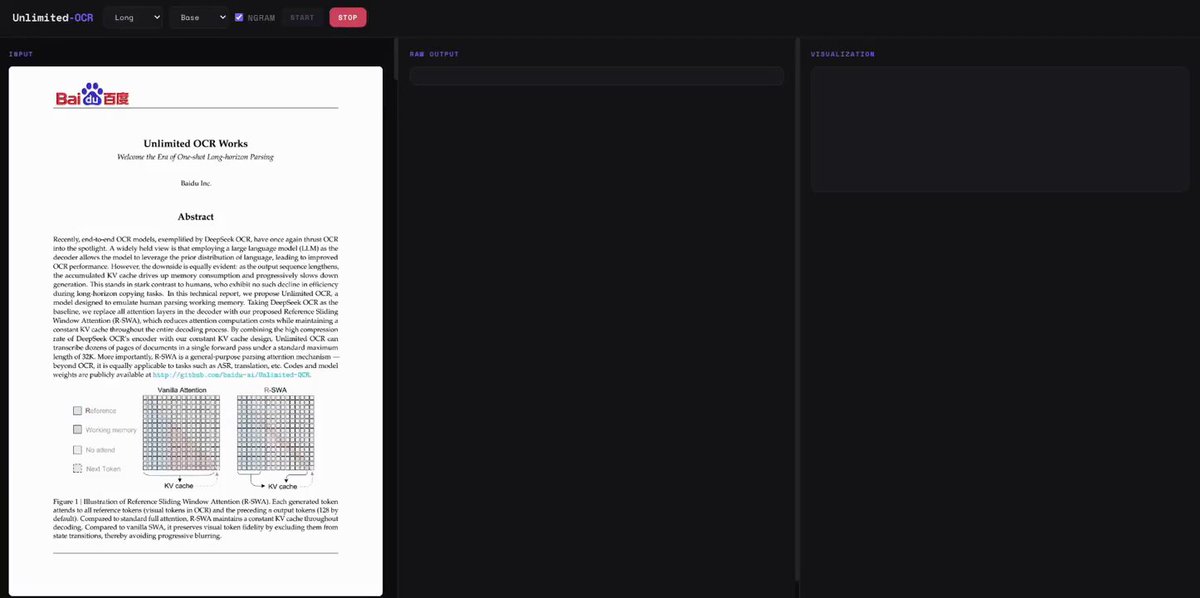
Baidu has released Unlimited OCR, an open-source document intelligence model on GitHub (baidu/Unlimited-OCR) engineered to process massive PDF documents of up to 100 pages in a single continuous pass without intermediate page chunking. Packing 3 billion parameters into a compact footprint with a 32k-token context window, the model parses entire documents locally without routing sensitive files to third-party cloud APIs.
Image source: @liambraus (X)
A persistent bottleneck in traditional document parsing and OCR pipelines has been the necessity of slicing long documents into isolated, page-by-page chunks. This fragmented approach frequently breaks multi-page tables, complex form layouts, and cross-page context, leading to corrupted structural data. Advancing upon DeepSeek's foundational OCR research, Unlimited OCR is architected to read multi-page documents straight through in a single unbroken stream.
Continuous Single-Pass Document Parsing and 32k Context Window
The primary architectural distinction of Unlimited OCR is its native 32k context window, allowing users to feed in up to 100-page PDFs in a single pass.
By reading the entire document continuously, the model prevents the systemic errors inherent to traditional page-slicing pipelines:
- Preservation of Cross-Page Layouts: Extended financial statements, multi-column reports, and comparative tables spanning across page boundaries remain structurally intact rather than being severed at page cuts.
- Unbroken Document Context: Sentences, paragraphs, and named entities flowing across page transitions maintain semantic continuity, significantly reducing post-processing burdens for retrieval-augmented generation (RAG) and structured data extraction pipelines.
- Simplified Ingestion Pipelines: Eliminates the complex engineering overhead of rasterizing PDFs into individual images, managing chunk boundaries, and stitching fragmented outputs back together.
Benchmark Metrics and Inference Framework Compatibility
Despite its compact 3B parameter size, Unlimited OCR demonstrates robust accuracy across rigorous document intelligence benchmarks.
The model achieves a 93% accuracy score on document analysis benchmarks, maintaining an error rate below 0.11 across 40 consecutive pages of continuous document ingestion. Out-of-the-box multilingual capabilities also allow developers to ingest diverse multilingual corpora without requiring dedicated language-specific fine-tuning.
- Standard Serving Frameworks: Provides native support for Hugging Face Transformers, alongside high-throughput inference engines including vLLM and SGLang.
- Containerized Deployment: Ready-to-deploy Docker container configurations ensure standardized deployment across local developer workstations and private on-premises GPU server clusters.
- Permissive Open-Source Licensing: Released under the MIT license, enabling frictionless integration into commercial products and internal enterprise document pipelines without restrictive licensing hurdles.
Cost Dynamics Against Cloud APIs and Hardware Considerations
Compared to proprietary cloud OCR offerings, Unlimited OCR delivers significant cost advantages, paired with explicit self-hosted operational trade-offs.
Major public cloud OCR APIs—including AWS Textract, Google Cloud Vision, and Azure Computer Vision—charge pay-as-you-go rates ranging from $1.50 to $15 per 1,000 pages. For enterprise workloads processing tens of thousands of contracts, reports, or historical archives, these API charges scale rapidly. Unlimited OCR runs locally on owned hardware, eliminating per-page fees entirely.
However, production adoption requires evaluating key technical boundaries:
- 32k Context Ceiling on Dense Documents: For technical documents dense with complex diagrams, intricate tables, and fine-print formulas, 100 pages may approach or exceed the 32k context envelope. Baidu has indicated that an expanded 128k context version is planned for future release.
- Local Hardware Requirements: Unlike cloud-hosted SaaS APIs, running a 3B model with sustained throughput requires dedicated local or on-premises GPU compute resources.
Sources
- GitHub Repository: baidu/Unlimited-OCR
- X Technical Announcement Thread (@liambraus): 2026-10-15 Unlimited OCR Release Discussion