Alibaba Qwen Unveils QwenGyre: An Elastic RL Framework for Extreme-Long-Horizon Agent Training
Alibaba's Qwen team has unveiled QwenGyre, an elastic reinforcement learning framework designed for extreme-long-horizon agent training, cutting end-to-end trai
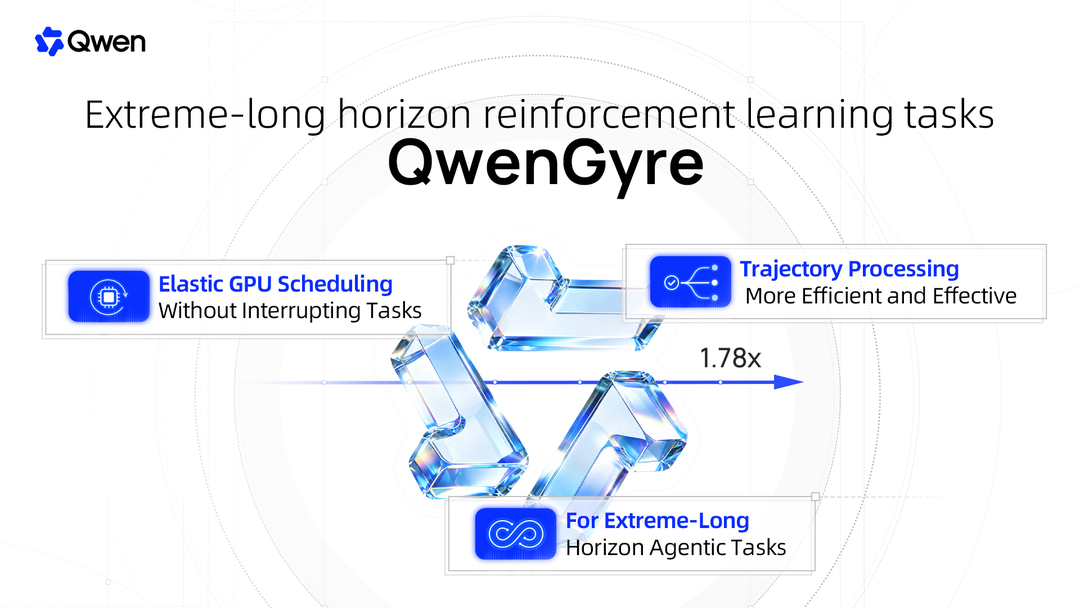
On October 12, 2026, Alibaba's official Qwen research team (@Alibaba_Qwen) announced QwenGyre, an elastic reinforcement learning (Elastic RL) system and accompanying research paper engineered specifically for extreme-long-horizon (XLong) agent training.
Image source: @Alibaba_Qwen on X
When applying reinforcement learning to complex software engineering tasks or multi-step reasoning agents, rollouts routinely generate hundreds of thousands of tokens. Coupled with sub-agent delegation, context compaction, and speculative retries, execution trajectories branch aggressively. These characteristics cause severe GPU workload imbalances between rollout generation and model parameter training. To resolve these core bottlenecks, QwenGyre introduces two foundational architectural pillars: the Elastic Scheduler and the Trajectory Processor.
Elastic Scheduler: Dynamic GPU Reallocation Without Rollout Disruption
The first core component of QwenGyre is the Elastic Scheduler, which manages hardware allocation between rollout generation and model optimization.
Traditional distributed RL architectures either fix GPU allocations statically across rollout and training workers (the Colocate approach) or experience idle hardware bottlenecks when balancing asynchronous queues (the Async approach). QwenGyre dynamically shifts GPUs between rollout and training pools in response to real-time workload fluctuations.
- Uninterrupted Execution: Live agent executions and ongoing rollouts are never terminated or dropped during GPU resource reallocation; transitions occur smoothly without wasting compute.
- Substantial Throughput Gains: According to evaluation benchmarks from the Alibaba Qwen team, the Elastic Scheduler delivers up to a 1.85× speedup over Colocate configurations and up to a 1.78× speedup over standard Async setups.
Trajectory Processor: Prefix-Shared Trajectory Trees and Partial Progress Scoring
The second pillar, the Trajectory Processor, tackles the data overhead and non-linear paths inherent in long-horizon agent interactions.
In real-world agent environments, interactions frequently diverge through automated compaction, sub-agent spawns, and failure retries. Rather than flattening these runs into disconnected linear samples, QwenGyre organizes them structurally.
- Prefix-Shared Trajectory Trees: Trajectories with identical execution history are grouped into prefix-shared trees, capping redundant samples and establishing strict bounds on training data. This prevents duplicate backpropagation passes over shared reasoning chains.
- Scoring Partial Progress After Timeout: For long-horizon tasks that terminate due to timeouts before reaching end-state completion, QwenGyre evaluates and scores intermediate milestones, supplying denser reward signals where sparse binary feedback previously failed.
Empirical Scaling on Qwen3.8-2.4T-A95B and Implementation Caveats
The research team validated QwenGyre by scaling the framework on the Qwen3.8-2.4T-A95B model, handling approximately 700K tokens per rollout in complex repository-level challenges.
- 58.5% on NL2RepoBench: Across 48 training steps, QwenGyre elevated the model's NL2RepoBench benchmark score from 52.5% to 58.5%.
- 44% Reduction in Training Time: End-to-end training time decreased by roughly 44% compared to standard asynchronous baselines, markedly reducing compute expenditure for long-horizon agent training.
Certain considerations apply when evaluating these findings. While the announcement provided a direct link to the research paper, the availability of an open-source code repository and associated licensing terms were not specified in the release. Furthermore, the reported acceleration factors (up to 1.85× and 1.78×) and the 44% wall-clock reduction depend on task branching intensity and workload distribution dynamics between rollout and training phases.
Sources
- Alibaba Qwen Official X (@Alibaba_Qwen): QwenGyre Official Announcement and Research Paper Release