Open-Source Python Library 'quant-trading' Implements 17 Quantitative Strategies
An analysis of 'quant-trading', an open-source Python repository featuring standalone implementations of 17+ quantitative trading strategies across momentum, st
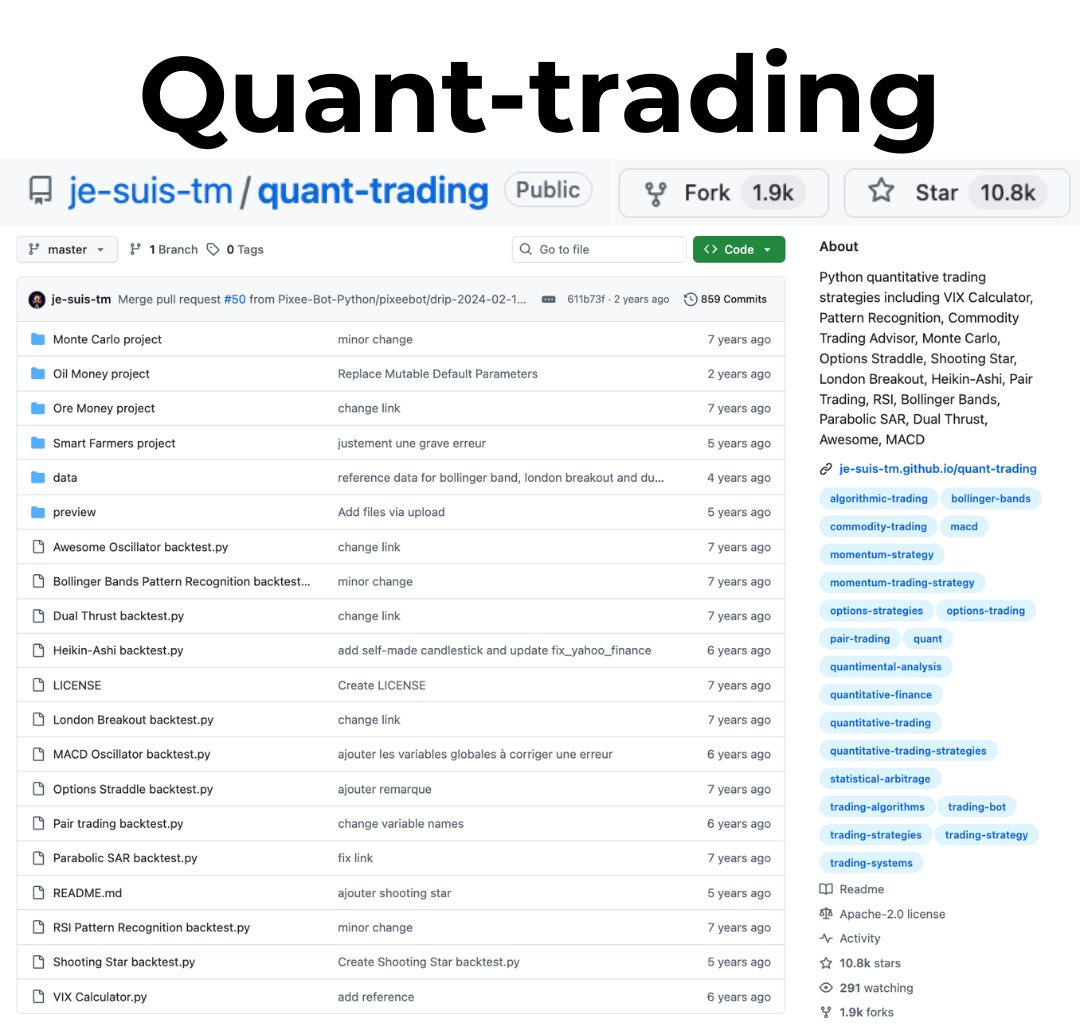
The open-source repository 'quant-trading' (authored by je-suis-tm) is drawing attention among financial engineers and algorithmic trading researchers on GitHub, offering standalone Python implementations for more than 17 quantitative trading strategies. Released under the Apache-2.0 license, the collection spans technical trend-following models, statistical arbitrage, options structures, and Monte Carlo risk simulations.
Image source: @RuujSs / je-suis-tm
Quantitative developers and algorithmic finance students frequently face a gap between textbook mathematical formulations and executable code. The quant-trading repository avoids heavy framework abstractions, packaging the core logic and backtesting flow of each strategy into clean, standalone scripts that maximize inspectability and practical code reuse.
Three Core Domains: Technical Indicators, Options, and Statistical Arbitrage
The 17+ strategies contained in the repository are systematically categorized across three fundamental quantitative modeling areas:
- Technical Indicators & Automated Momentum: Includes signal generation engines for MACD, Bollinger Bands, RSI, Parabolic SAR, Dual Thrust opening range breakout, London Breakout, Heikin-Ashi candlestick filtering, Shooting Star reversal detection, Awesome Oscillator, and CTA (Commodity Trading Advisor) trend tracking models.
- Statistical Arbitrage & Derivative Strategies: Features cointegration-based Pair Trading for mean-reversion capture, Options Straddle algorithms designed to monetize implied volatility expansions, and a dedicated VIX Calculator for market variance estimation.
- Quantamental & Risk Simulations: Supplies portfolio allocation optimization routines, geometric Brownian motion-based Monte Carlo simulations for future equity path modeling, and quantitative chart pattern recognition tools.
Modular Script Architecture with Standard main() Entry Points
Each strategy script is structured as a self-contained module centered around a standard main() execution entry point.
- Standalone Execution & Seamless Embedding: Without imposing complex framework dependencies, individual strategy files can be run directly or broken down into modular functions for integration into custom backtesting engines or live trading bots.
- Multi-Source Financial Data Pipelines: Built-in data collection routines connect to historical and real-time feeds including Yahoo Finance, Bloomberg, Quandl, Stooq, CME/LME commodity futures, and Histdata FX tick/minute datasets.
- Long/Short Signal Generation: Evaluates indicator thresholds and statistical models to output clear long/short entry rules and quantitative position allocations.
Prototyping Caveats and Real-World Friction Adjustments
The repository serves primarily as an educational and research prototyping benchmark designed for transparent algorithmic inspection. Several structural assumptions must be factored in prior to capital deployment:
- Frictionless Market Assumptions: Default backtests assume zero slippage, zero broker commissions, and unlimited market liquidity. Real-world implementation requires transaction cost analysis (TCA) and slippage modeling to prevent theoretical alpha from being eroded by execution drag.
- Historical Backtesting Focus: The codebase is tailored for daily and intraday time-series research rather than high-frequency trading (HFT) requiring sub-millisecond network latency and specialized tick processing infrastructure.
Sources
- GitHub Repository: je-suis-tm/quant-trading
- Project Documentation: quant-trading GitHub Pages
- Original Signal: Ruuj (@RuujSs) on X