Open-Source Web Agent 'dots' Released: Anti-Detect Firefox at C++ Level to Bypass Bot Defenses with Local LLM Support
Released right after OpenAI DevDay, the MIT-licensed open-source AI agent 'dots' bundles a C++ patched anti-detect Firefox browser to bypass anti-bot defenses,
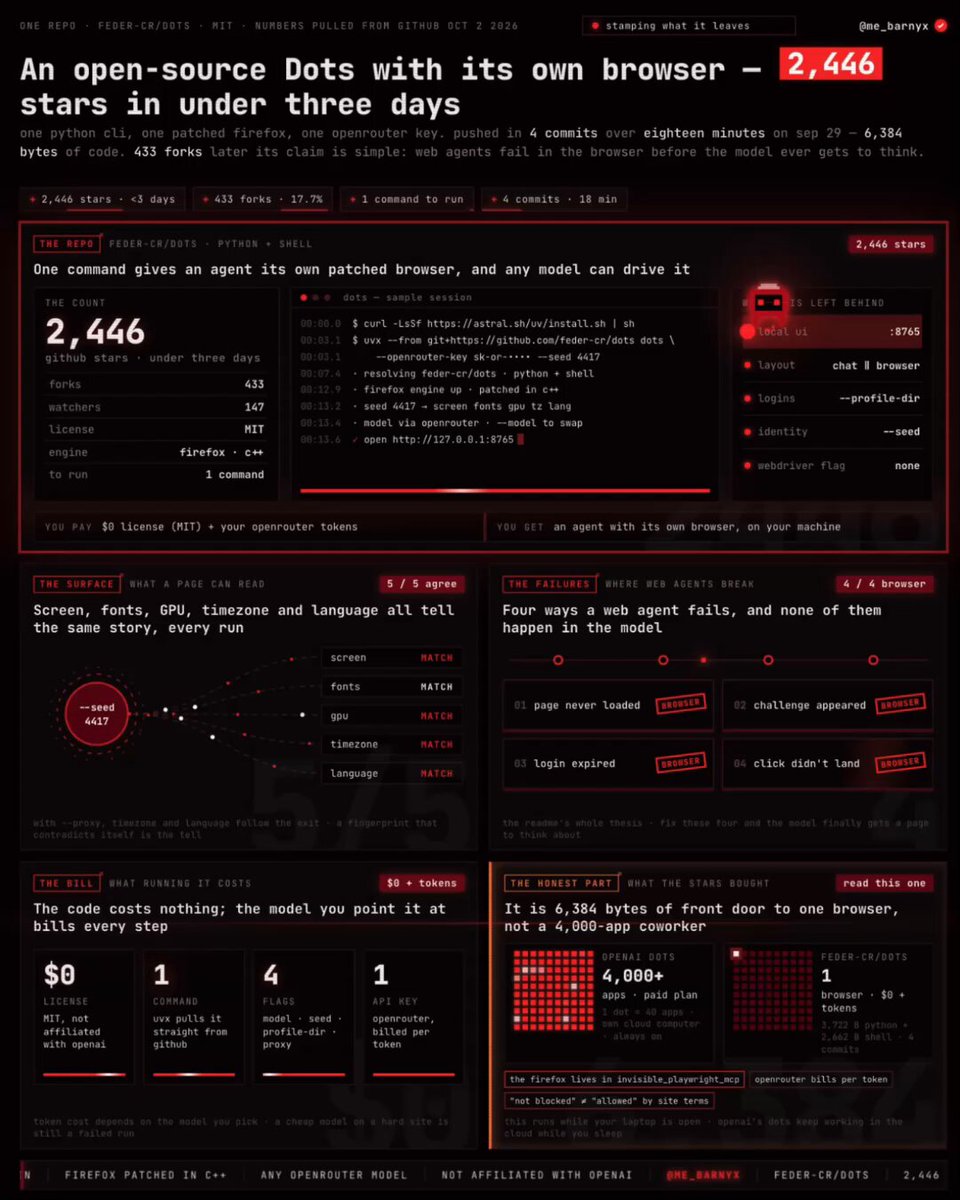
Following OpenAI's DevDay announcement of its always-on AI coworker 'Dots', an MIT-licensed open-source alternative named 'dots' (feder-cr/dots) has been released to give developers a self-hosted, local-first option. Within three days of release, the repository gathered over 2,400 GitHub stars and 420 forks, quickly gaining traction across developer communities.
Image source: @me_barnyx via X
In contrast to proprietary cloud agents that require $100 to $200 monthly subscriptions and locked-in cloud runtimes, dots runs entirely on the user's local machine and pairs with any preferred LLM provider.
Redefining Web Agent Failures: Anti-Bot Bypasses Over Model Intelligence
Web browsing agents frequently fail on modern web tasks, but the bottleneck is rarely the LLM's reasoning capacity. Instead, the author of dots argues that failures primarily originate within the browser layer before the model can even act—such as Cloudflare challenges, expired login cookies, broken DOM rendering, or automated bot detection blocking click events.
To resolve these barriers, dots integrates a custom Firefox browser build patched at the C++ level.
- Browser Fingerprint Stealth: By eliminating standard automation signatures and internal driver flags at the C++ binary level, anti-bot security systems recognize the browser as an authentic human session rather than an automated script.
- Robust Multi-Step Navigation: With challenge screens bypassed, the agent can reliably navigate complex login flows, multi-page interactions, and data extraction pipelines without getting locked out.
C++ Patched Firefox and OpenRouter Integration: Self-Hosted Architecture
The architecture of dots emphasizes simplicity and model flexibility, centered around a lightweight Python CLI interface (cli.py and pyproject.toml).
- Bring Your Own Model (BYOM): Integrates with the OpenRouter API, allowing developers to switch between open-weight and commercial foundation models via the
--modelflag based on budget and latency needs. - Self-Contained Local Execution: All browser sessions, authentication tokens, and scraped artifacts remain strictly on local storage, avoiding privacy and compliance risks associated with external hosted virtual machines.
- Automated Web Scraping and Tasks: Supports conversational web queries, automated interactive logins, form submission, and structured data extraction from dynamic websites.
Practical Use Cases and Local Resource Considerations
dots provides a compelling toolkit for automation engineers, scrapers, and developers seeking an unblocked web agent without recurring subscription overheads.
However, several operational caveats should be considered during local deployment:
- Local Memory (RAM) Consumption: Launching a full patched Firefox browser instance locally consumes noticeable memory, requiring careful resource budgeting when running background automation.
- Platform Support and OS Constraints: Currently, the engine supports Windows and Linux (x86_64/arm64) while macOS remains unsupported; developers should verify operating system compatibility and track upstream engine updates.
Sources
- @me_barnyx via X: dots Open-Source Release Announcement
- andrew.ooo: dots Review: feder-cr's Open-Source OpenAI Dots Rival
- OpenSourceDex: dots: Open Source Data Extraction & Web Scraping