Pixel Plays: Zero-Dependency 3D Pixel Diorama Web Game Engine Built in Plain JavaScript
An overview of Pixel Plays, an open-source collection of isometric 3D pixel diorama browser games powered by a pure JavaScript software rasteriser with no exter
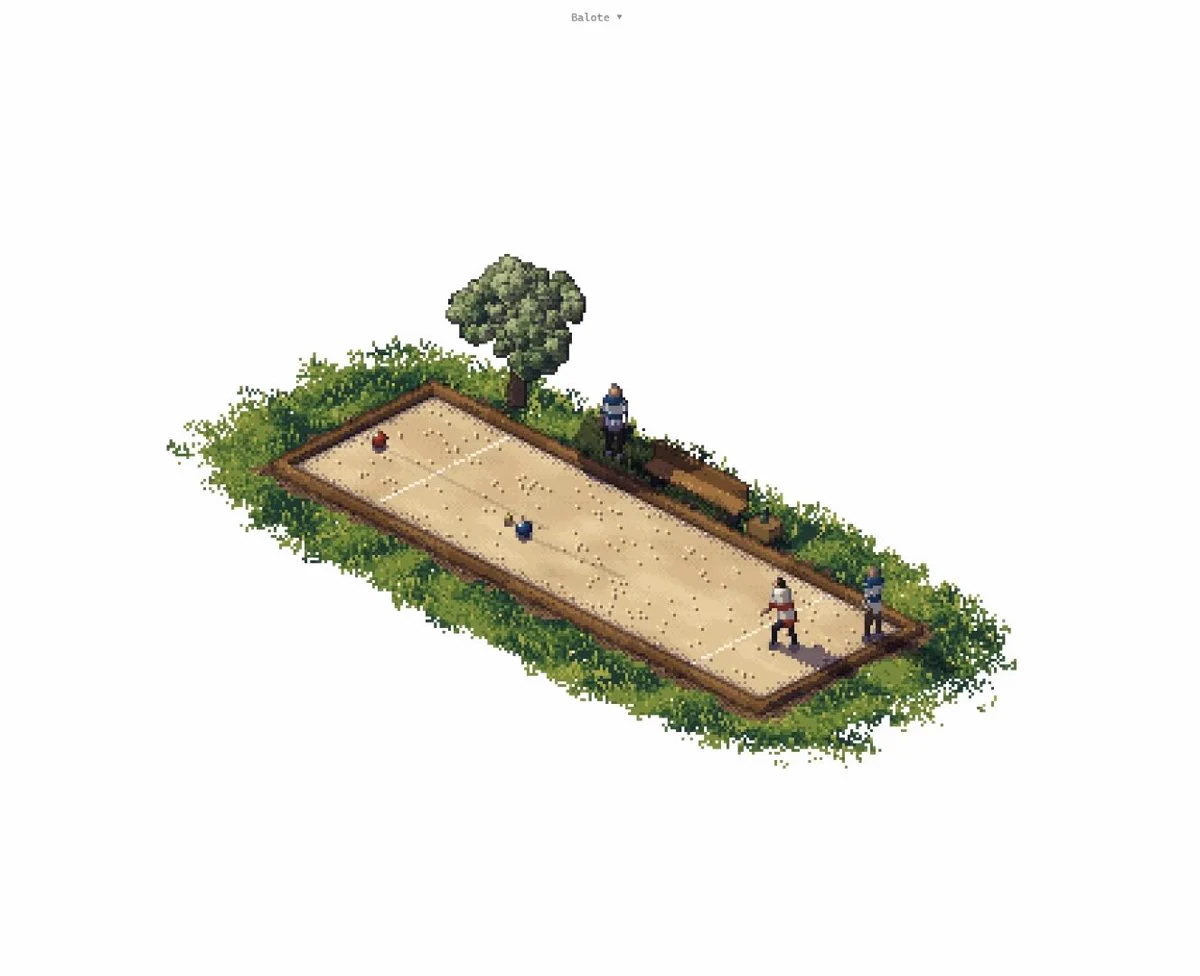
Image source: https://x.com/AmirMushich/status/2116509069477621819
Pixel Plays is an open-source collection of browser-based 3D pixel diorama mini-games built entirely in plain JavaScript without external image assets or build pipelines. Created on GitHub and shared on X on October 31, 2026 by developer AmirMušić (@AmirMushich), the project was built using Claude Opus 5.5 (OS) and ships with five playable games ready to run in a standard web browser.
Software Rasteriser Architecture Without Build Steps or Dependencies
Most browser-based 3D games rely on WebGL wrappers such as Three.js alongside bundlers like Vite or Webpack to compile assets. Pixel Plays removes both package dependencies and build steps. Instead of offloading rendering to the GPU, it uses a custom CPU-driven software rasteriser that calculates pixel colors directly inside a single-page JavaScript runtime.
The repository separates shared application scaffolding, rendering primitives, and individual game scenes into modular files:
shell.js: Handles the game selection menu, rules modal, credits, and background audio controls.engine.js: Exposes globals for the fixed 30-degree orthographic camera, depth buffer (which tracks object occlusion), hue-shifted color ramps, cast shadows, edge outlines, human figures, trees, and ambient wind motion.- Game directories: Each game defines its own scene configuration and loop via
groundColor,bake,update, anddrawfunctions inside a standalone HTML page.
Scenes render onto a low-resolution 360x280 canvas and scale up using integer nearest-neighbour interpolation to keep pixel edges sharp. Combined with four-level shading, long hard cast shadows, and Bayer dithering (an ordered dot-matrix pattern used to simulate intermediate tones), the engine produces a self-contained miniature diorama look floating on a white background.
Included Mini-Games and Local Execution Workflow
The repository includes five isometric mini-games, each built around a single physical mechanic:
| Game | Objective | Controls |
|---|---|---|
| Balote | Bocce match against a bot, first to 5 points | Drag back and release; arrow keys + space |
| Stari Most | Five dives off the old bridge, flipping to enter the water vertically | Hold and release |
| Rooftop Laundry | Gather clothes into the basket before the storm arrives | Drag; space |
| Tie-Break | Clay-court tennis tie-break against a bot where timing controls ball placement | Tap/click; space |
| Mini Ramp | 60-second skateboard ramp session pumping for height and air grabs | Hold and release; space |
Running the project locally requires only Node.js, with no npm install step needed:
node serve.mjs
Once the built-in static server starts, opening [http://127.0.0.1:5300/](http://127.0.0.1:5300/) in a browser loads the full game collection. Because the project consists solely of static HTML, JavaScript, and audio files, it can also be hosted on any standard static file server. Developers adding a new game create <id>/index.html, load shell.js and engine.js, assign window.PP_SCENE, and register the entry inside GAMES in shell.js.
Design Trade-Offs and Licensing Details
By avoiding external sprite sheets and third-party libraries, Pixel Plays keeps its codebase compact and easy to inspect or deploy. At the same time, its CPU software rasteriser and fixed 360x280 canvas are intentionally scoped to lightweight, retro-styled browser games rather than complex WebGL scenes or heavy physics simulations. In the README, the author credits @awwbhi2 for the concept and @zzzzshawn for visual style inspiration, noting that no assets or subjects were copied.
Developers reusing the repository should note a split licensing arrangement: while the JavaScript source code is released under the MIT License, the .mp3 background music tracks bundled with the games are excluded from the MIT License and governed separately under MUSIC.md.
Sources
- Official GitHub Repository: amirmushichge/pixel-plays
- AmirMušić Official X Post: 2026-10-31 Pixel Plays Release Thread