PGRun Announced: Ephemeral Postgres Branching for AI Agents and CI
Alex Shapalov has announced PGRun, an ephemeral database branching platform provisioning isolated Postgres instances for AI coding agents and CI pipelines in se
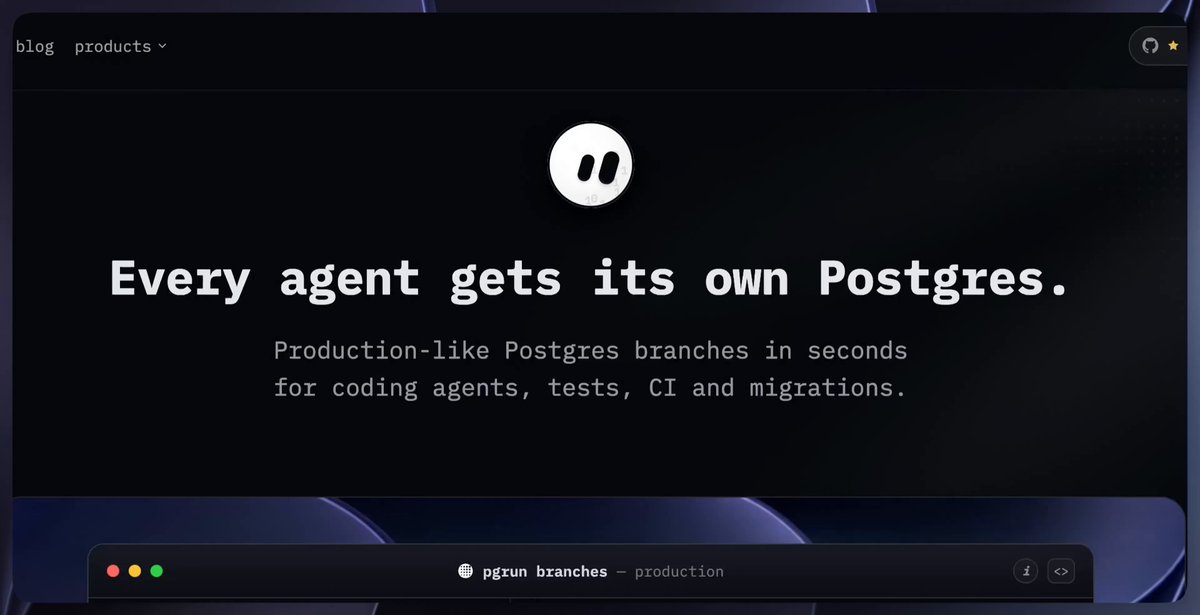
On October 7, 2026, developer Alex Shapalov (@alxshp) officially announced PGRun (pgrun.dev), an ephemeral database branching platform designed to provide disposable, production-grade Postgres environments for autonomous AI coding agents, pull requests (PRs), and continuous integration (CI) workflows. Moving past traditional setups that require engineers to manually maintain local or staging databases, PGRun allows developers and autonomous processes to provision and destroy isolated database instances within seconds.
Image source: @alxshp (X) / pgrun.dev
Shapalov declared that manual creation of local and staging databases must end, arguing that in the era of autonomous coding agents, infrastructure must be treated as disposable. PGRun provisions and destroys isolated database instances in seconds, running each branch as its own Postgres process on a ZFS Copy-on-Write (CoW) clone.
ZFS Copy-on-Write Storage and Standard DATABASE_URL Integration
The core architecture of PGRun connects to an existing production database once without moving or altering it, allowing agents and pipelines to spin up isolated Postgres branches in seconds on demand.
According to technical details confirmed by Shapalov, each branch runs as its own dedicated Postgres process on a ZFS clone.
- ZFS Copy-on-Write Storage: Branches share underlying baseline storage blocks and only pay for the storage mutations they create, minimizing storage overhead.
- Standard DATABASE_URL Handoff: Every branch returns a standard connection string (
DATABASE_URL) without requiring a custom database API, proprietary query language, or specialized ORM. It works natively with existing Postgres clients including Rails, Django, Prisma, Drizzle, pgx, and psql. - Credential and Data Isolation: Production credentials never reach the agent, and sensitive columns can be detected and masked before reaching an agent branch.
- Zero-Cost Disposal: Once tasks conclude, branches are destroyed on demand with no lingering state and no manual cleanup jobs required.
These capabilities make the disposable database pattern viable in practice, enabling an AI coding agent or CI job to spin up a dedicated database instance inside a single test loop, execute migrations, verify assertions, and destroy the environment immediately upon completion.
Eliminating Staging Collisions in Multi-Agent Workflows and Open-Source Tooling
In modern software development teams deploying multiple autonomous agents or high-concurrency CI pipelines, shared staging databases represent a persistent point of failure.
When several agents or CI workers simultaneously run differing database migrations or seed incompatible test fixtures, schema collisions corrupt test states. PGRun addresses this by connecting once to an existing production database without moving or altering it, allowing agents, pull requests, and CI jobs to fork fully isolated branches on demand.
- Parity Between Code Branches and Database Branches: Developers and agents can run
pgrun branch createdirectly in the command line, mirroring the workflow of agit checkoutcommand for database state. - Companion Open-Source Tooling: In the announcement thread, Shapalov shared links to companion repositories under the project's GitHub organization (github.com/pgrundev), including
pgbot,pgbook, andpgterm.
This tooling enables terminal-first coding agents, such as Cursor, Claude Code, and Codex, to independently manage isolated databases during code synthesis and regression testing.
Shared Host Architecture and Operational Considerations Versus PGlite
While PGRun provides rapid isolation, its underlying infrastructure involves specific architectural considerations that teams must evaluate before production adoption.
Responding to technical inquiries from developer Rahul Yadav (@slowrah), Shapalov confirmed that branches currently share an underlying host machine. Although each branch executes as its own independent Postgres process on a dedicated ZFS clone—ensuring copy-on-write storage billing where teams only pay for delta mutations—concurrent execution of heavy CI test suites or dozens of intensive agent queries can lead to CPU and memory contention across shared host resources.
Furthermore, Shapalov clarified the distinction between PGRun and embedded solutions such as PGlite in response to community questions. Whereas PGlite functions as a local embedded database, PGRun provides a real isolated Postgres process for each agent, PR, and CI run. Unlike local embedded databases, this offers a full Postgres process environment for automated testing workflows.
Sources
- PGRun Official Website: pgrun.dev
- Alex Shapalov Announcement (X @alxshp): Official Release Thread
- PGRun Open-Source Projects: GitHub pgrundev Organization