OWASP Cheat Sheet Series: 137 Practical Security Guides for Servers and Applications
An overview of the official OWASP Cheat Sheet Series. From authentication, sessions, and password management to Docker, GraphQL, GitHub Actions, and language-sp
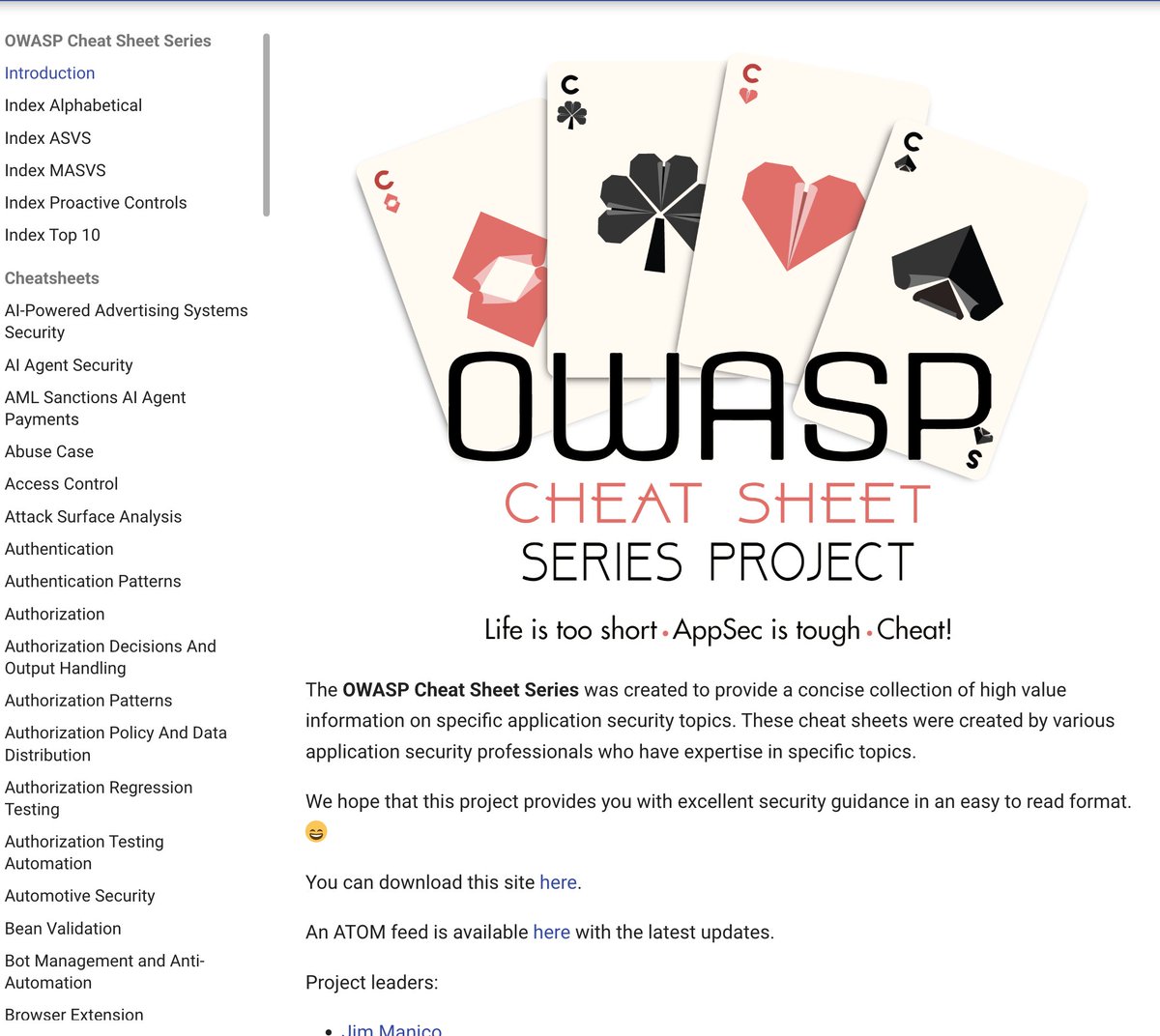
The OWASP Cheat Sheet Series, an official open-source initiative under the Open Web Application Security Project (OWASP), has emerged as an essential reference for engineers deploying and operating their own servers and web applications. Comprising 137 focused, topic-specific guides, the project delivers practical defensive architectures and actionable security recipes that engineering teams can apply directly to production workflows for free.
Image source: Miguel Ángel Durán (@midudev) / OWASP Foundation
The collection gained renewed attention across the developer community after software engineer and creator Miguel Ángel Durán (@midudev) highlighted it as a vital reference for anyone managing self-hosted infrastructure or application stacks. For engineering teams evaluating where to begin security architecture on a new codebase, the series offers a concrete checklist bridging core authentication protocols and modern cloud-native environments.
Authentication, Session Management, and Password Handling: Foundational Defenses
A substantial share of web application security vulnerabilities originates in subtle flaws across authentication and session lifecycles. The OWASP Cheat Sheet Series systematically structures the requirements engineering teams must enforce during initial architecture and implementation phases.
- Authentication and Password Storage: Details guidelines for user identity verification, multi-factor authentication (MFA) considerations, safe credential handling, and strict rules against plain-text password storage.
- Session Lifecycle and Token Hardening: Outlines essential rules for secure session lifecycle handling, cryptographically sound session identifier generation, and browser cookie protections to safeguard web applications.
- Credential Protection and Attack Mitigation: Covers practical strategies for protecting authentication endpoints against brute-force attacks and mitigating automated credential abuse.
Docker Containers, GraphQL, and GitHub Actions: Modern Infrastructure Security
As modern development stacks shift toward container orchestration, API-first backends, and automated CI/CD pipelines, attack surfaces have expanded across the delivery chain. The OWASP series directly addresses these modern technologies with actionable hardening strategies.
- Docker Container Hardening: Provides container hardening and isolation principles to safeguard system resources and host environments during containerized server deployments.
- GraphQL API Defense: Addresses architecture-specific risks in GraphQL deployments, offering guidance to mitigate denial-of-service (DoS) vectors and enforce defensive query execution rules.
- GitHub Actions CI/CD Pipeline Security: Establishes safeguards for continuous integration and delivery pipelines, focusing on preventing secret leaks and enforcing security best practices across workflow runs and third-party actions.
.NET, Java, PHP, and SQL: Language-Specific Guidance and Standards Alignment
Rather than stopping at abstract security concepts, the repository provides implementation checklists tailored to widely used programming languages and relational database systems.
- Language-Specific Checklists: Targets runtime environments across .NET, Java, PHP, and related stacks, providing defensive implementation patterns and practical coding checklists to prevent common vulnerabilities.
- SQL and Database Security: Details defensive patterns against SQL injection, promoting parameterized queries, the principle of least privilege on database access credentials, and strategies for protecting stored data.
- Alignment with OWASP Standards: Individual cheat sheets directly cross-reference foundational frameworks including the OWASP Top 10 and the Application Security Verification Standard (ASVS), serving as a reliable starting point and baseline for secure architecture.
Practical Considerations for Engineering Teams
While the OWASP Cheat Sheet Series provides an accessible, community-driven collection of industry best practices, effective production deployment requires considering several operational factors:
- Complementing with Automated Tooling: Cheat sheets provide implementation guidance, but production pipelines should pair them with automated testing tools—such as Static Application Security Testing (SAST) and Dynamic Application Security Testing (DAST)—alongside project-specific threat modeling.
- Version Tracking and CVE Cross-Referencing: Specific API recommendations and framework syntax can evolve alongside runtime version updates or newly discovered Common Vulnerabilities and Exposures (CVEs). Engineering teams should cross-reference recommendations against official upstream release notes and security advisories.
The OWASP Cheat Sheet Series is publicly accessible at cheatsheetseries.owasp.org, with the open-source project maintained on GitHub at OWASP/CheatSheetSeries.
Sources
- OWASP Cheat Sheet Series Official Website: cheatsheetseries.owasp.org
- Miguel Ángel Durán (@midudev) Official X Post: X (Twitter)