OpenShorts: Open-Source AI Video Clipping Tool Replacing $49/mo SaaS with Self-Hosted MCP Agents
OpenShorts is an MIT-licensed open-source video clipping tool replacing paid SaaS like OpusClip. It automatically converts YouTube and local videos into 9:16 sh
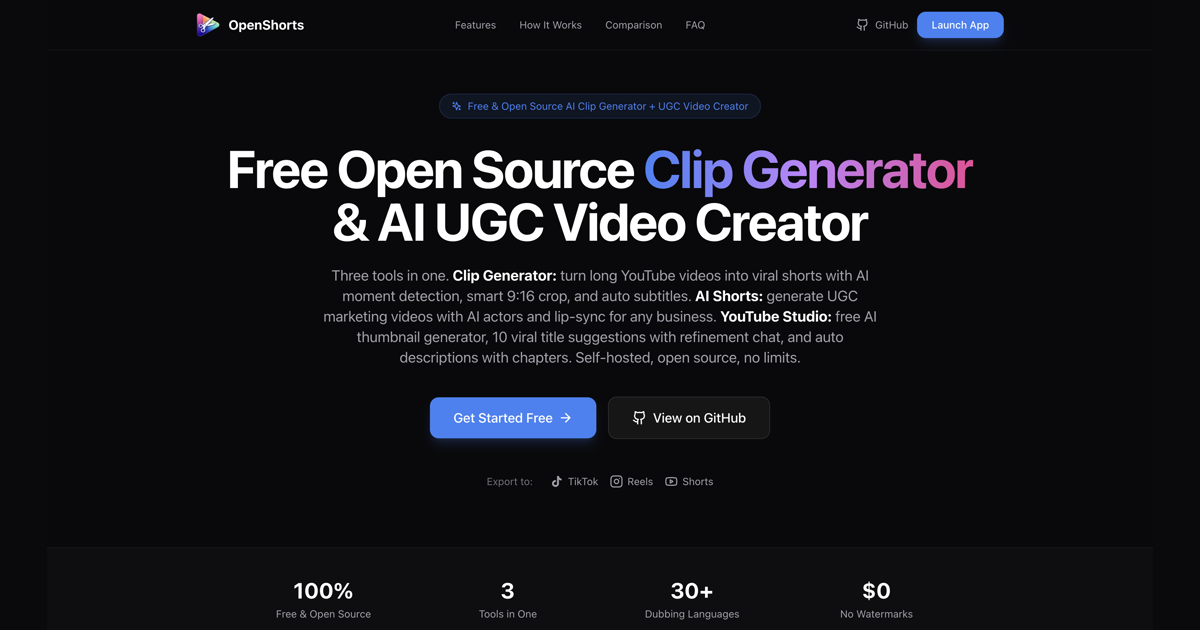
OpenShorts, an open-source AI video clipping tool designed to turn long-form YouTube and local videos into 9:16 vertical shorts with automated captions, has been officially released under the MIT license. Built as a free, self-hostable alternative to commercial SaaS platforms such as OpusClip that charge $20 to $49 per month, it eliminates recurring subscription fees, watermarks, and per-clip processing limits.
Image source: https://www.openshorts.app/
The automated video clipping market has largely been dominated by commercial cloud platforms like OpusClip and Vidyo.ai. However, fixed monthly subscription tiers, capped processing minutes, and mandatory watermarks on free plans have created substantial friction for independent creators, agencies, and developers. OpenShorts addresses these limitations by providing a fully open-source, local-first platform for generating high-engagement vertical shorts on private hardware.
Automated 9:16 Vertical Reframing and Viral Highlight Detection
At its core, OpenShorts uses AI to analyze long-form video content, pinpoint high-engagement segments, and automatically reformat them into vertical short-form videos.
By submitting a YouTube URL or uploading local video files—such as podcasts, interviews, webinars, or livestream recordings—the system scans the full transcript and context to isolate viral-ready highlight clips ranging between 15 and 60 seconds.
- Intelligent Vertical Reframing: Identifies active speakers and primary visual subjects in horizontal 16:9 footage, automatically reframing and tracking them within a 9:16 vertical canvas.
- Whisper-Powered Synchronized Subtitles: Employs Whisper speech-to-text to transcribe audio with precise word-level timestamps and overlay styled, synchronized animated subtitles.
- Watermark-Free Full-Resolution Export: Unlike restrictive freemium tiers, OpenShorts renders and exports videos in original quality without artificial limits on clip count or monthly volume.
Docker-Based Self-Hosting and BYOK (Bring Your Own Key) Architecture
OpenShorts emphasizes data privacy and cost control through a containerized, local-first architecture.
Using Docker, users can deploy an isolated instance on a personal PC or private server with standard commands. This ensures that sensitive pre-release video assets, internal meeting recordings, or proprietary footage remain entirely within private infrastructure without being uploaded to third-party cloud servers.
- BYOK (Bring Your Own Key) Integration: Users supply their own LLM API keys (such as Google Gemini) to power semantic analysis and viral highlight detection.
- Local Whisper Speech Recognition: Runs open-source local Whisper models directly on host hardware for transcription, avoiding recurring third-party audio transcription API charges.
- Compute-Only Cost Profile: By replacing fixed SaaS subscriptions with direct compute resource utilization and raw token consumption, creators and teams achieve significant cost savings at scale.
Dedicated MCP Endpoint, REST API, and Python CLI for AI Agents
OpenShorts extends beyond a standalone web UI by offering programmatic interfaces designed specifically for AI agents and workflow automation orchestrators.
It natively implements a dedicated Model Context Protocol (MCP) server, allowing AI coding assistants and autonomous agents to execute end-to-end video production workflows directly.
- Direct AI Agent Control via MCP: AI agents in Claude Code, ChatGPT, and Cursor can invoke MCP tools to ingest YouTube videos, segment highlights, and trigger exports via natural language instructions.
- REST API and Python CLI: Developers can automate batch video processing through clean REST endpoints or a dedicated Python CLI in headless server environments.
- n8n Workflow Integration: Integrates directly with n8n and low-code orchestration platforms to construct fully automated channel autopilot pipelines—from video ingestion to clipping and scheduled social media distribution.
Self-Hosting Hardware Considerations and Caveats
When deploying OpenShorts in a local or private server environment, users should consider key hardware requirements and operational prerequisites:
- Rendering Hardware Throughput: Video decoding, reframing, and subtitle rendering performance depend directly on host CPU and GPU specifications. On standard CPU-only configurations, processing an 8-minute source video requires approximately 5 to 8 minutes.
- Required LLM API Credentials: To activate the automated viral-moment detection engine, users must obtain and configure an LLM API key, such as Google Gemini, in their environment settings.
OpenShorts delivers an effective open-source solution for content creators seeking to scale short-form video production without recurring SaaS overhead, as well as developers building automated media workflows driven by AI agents.
Sources
- Official Website: OpenShorts
- Original X Post (@RoundtableSpace): 2026-10-03 OpenShorts Announcement