Classify LLM Requests with OpenRouter and TypeSafe Jev to Cut Pipeline Costs
Use OpenRouter's Classifiers feature with TypeSafe AI's high-speed System One model Jev to automatically tag incoming LLM requests, analyze task mix in Explore,
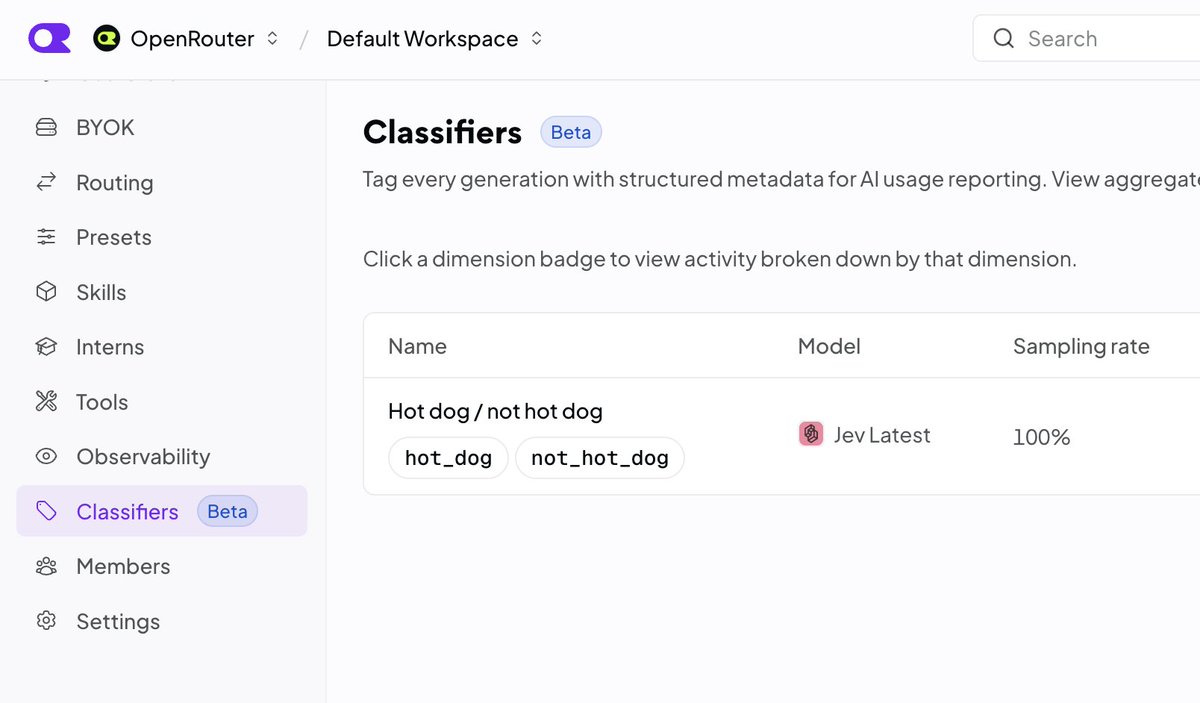
AI gateway provider OpenRouter (@OpenRouter) shared an optimization tip detailing how to use TypeSafe AI's high-speed System One model, Jev (Jev Latest), within OpenRouter's workspace Classifiers configuration to automatically categorize incoming LLM requests and inspect task mixes in the Activity Explore dashboard.
Image source: OpenRouter on X
In high-throughput LLM pipelines, routing every incoming prompt directly to premier reasoning models creates an unnecessary cost bottleneck. By connecting OpenRouter's native Classifiers interface with Jev, development teams can inspect and classify the nature of each prompt before routing it downstream, unlocking granular observability and substantial infrastructure savings.
How OpenRouter Classifiers and Jev Automated Tagging Work
Developers can configure custom classification rules directly inside OpenRouter workspaces under the Classifiers menu (https://openrouter.ai/workspaces/default/classifiers).
At the core of this automated workflow is TypeSafe AI's Jev, an early-access System One decision model architecturally distinct from conventional autoregressive LLMs:
- Parallel Probability Computation: Rather than generating output text token-by-token, Jev computes class probabilities across predefined targets simultaneously in parallel.
- Zero Hallucination Risk: By forfeiting arbitrary string generation, Jev produces strictly structured outputs, completely removing conversational hallucinations from the classification step.
- Sub-Second Latency and Low Cost: According to TypeSafe AI's benchmarks, Jev operates up to two orders of magnitude faster and at a fraction of the cost of general-purpose LLMs on classification tasks, ensuring that upfront request categorization introduces virtually no latency overhead into production pipelines.
Tagged transactions stream directly into OpenRouter's Activity Explore dashboard (https://openrouter.ai/activity/explore), where teams can visually audit the distribution of incoming tasks and track routing telemetry in real time.
The 'Classify First, Generate Second' Routing Architecture
Engineering teams running production LLM systems emphasize that this built-in capability enables the highly effective "classify first, generate second" operational pattern.
Alex Builds (@wandeforer) reported using this precise approach with Jev to preprocess Reddit discussion ingestion pipelines. By determining upfront whether a thread was cited by AI, not cited, or worth generating a reply for, his team reduced overall pipeline execution costs by approximately 30x. Having this classification step natively embedded into OpenRouter eliminates the need to maintain separate orchestration infrastructure to achieve similar savings.
Software engineer Yi Casillas (@YiCasillas) noted that classifying incoming prompts before dispatching them to different models is an indispensable engineering technique to compress the cost of simple, repetitive tasks. Workflows requiring multi-step reasoning can be reserved for top-tier foundation models, while routine extraction and formatting jobs can be safely delegated to cheaper lightweight models.
Production Caveats: Context Size Limits and Boundary Sample Audits
While OpenRouter Classifiers streamline routing automation, practitioners should account for two crucial operational nuances highlighted in recent community testing.
First, undersized classifier context windows can create silent telemetry gaps. As John Rood (@johnroodepic) observed, if the classifier's allocated context window is significantly smaller than the full prompt, OpenRouter may return the downstream completion normally while leaving the request untagged in logs. Teams should evaluate tag coverage across varying prompt lengths before treating Explore's task-mix graphs as authoritative.
Second, avoid optimizing solely for high-level averages. Software engineer Yi Casillas noted that focusing exclusively on aggregate metrics can obscure classification errors and borderline samples, expressing hope that Explore will offer direct visibility into misclassifications and boundary cases. Without inspecting edge cases and classification logs, teams risk overlooking routing failures where sensitive or complex queries inadvertently drop into basic execution tiers.