OpenDots: Model-Agnostic Open-Source Autonomous AI Coworker Template
OpenDots is an open-source autonomous AI coworker template built on CopilotKit and AG-UI. It enables self-hosting across arbitrary agent harnesses, featuring Co
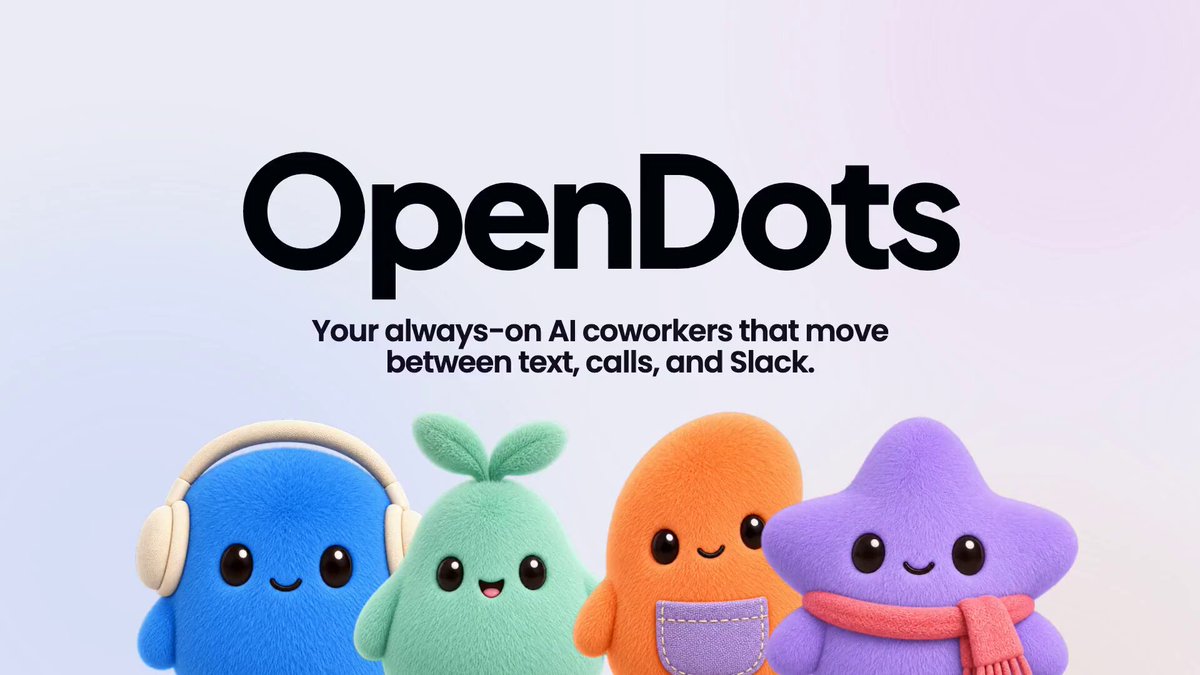
Following OpenAI's announcement of its always-on AI agent 'Dots' at DevDay 2026, an open-source alternative template named 'OpenDots' has been unveiled. Built on CopilotKit and AG-UI, OpenDots serves as a starter kit that allows developers to wrap arbitrary agent harnesses and deploy autonomous AI coworkers on their own infrastructure without platform lock-in.
Image source: @masahirochaen / @ataiiam (X)
Harness-Agnostic Architecture and Self-Hosting
The core premise of OpenDots is decoupling the autonomous agent layer from proprietary ecosystem constraints. While commercial always-on agent solutions mandate specific provider infrastructure and closed models, OpenDots abstracts the harness layer to integrate with existing developer workflows.
- Arbitrary Agent Harness Wrapping: Rather than binding to a single model provider, developers can wrap their existing custom agent harnesses or orchestration pipelines directly.
- Self-Hosting Support: Deployable directly to on-premise servers or private cloud environments, keeping enterprise data and proprietary contexts within organizational boundaries.
- Integrated UI and Interaction Layer: Leverages CopilotKit and AG-UI to deliver frontend surfaces that visualize agent reasoning paths, execution status, and working artifacts.
Computer Use and Multi-Channel Collaboration (Slack, Teams, Voice)
OpenDots extends beyond basic conversational chat to provide interactive tooling and multi-channel presence within team workspaces.
- Computer Use Capabilities: Executes operational tasks across browser automation, terminal commands, and local filesystem read/write operations.
- Multi-Channel Presence (Channels SDK): Integrates directly into enterprise communication platforms like Slack and Microsoft Teams via a dedicated Channels SDK, allowing teams to collaborate with the agent as an active coworker.
- Multimodal Workspaces and Interfaces: In addition to text chat, it supports voice call interactions alongside project-level 'Spaces' and document-level 'Pages' interfaces across both web and mobile environments.
Deployment Considerations and Sandboxing Safeguards
Because OpenDots is distributed as an open-source template and starter kit, deploying it into production environments requires dedicated operational safeguards.
- Sandboxing and Permission Isolation: Since Computer use interacts directly with browsers, terminals, and file systems, execution environments should be isolated inside strict containers or virtual machine boundaries.
- Human-in-the-Loop (HITL) Controls: Destructive or irreversible actions—such as critical file deletions, external data transmissions, or system configuration edits—require custom approval gates to maintain supervisory control.
- Compute and Token Budgeting: Continuous background presence and persistent tool invocation can rapidly scale token consumption, necessitating call-frequency throttling and telemetry monitoring at the harness level.
Sources
- Atai Shamir (@ataiiam) X Announcement: OpenDots Official Release
- Masahiro Chaen (@masahirochaen) X Technical Breakdown: OpenDots Architecture and Features Overview